
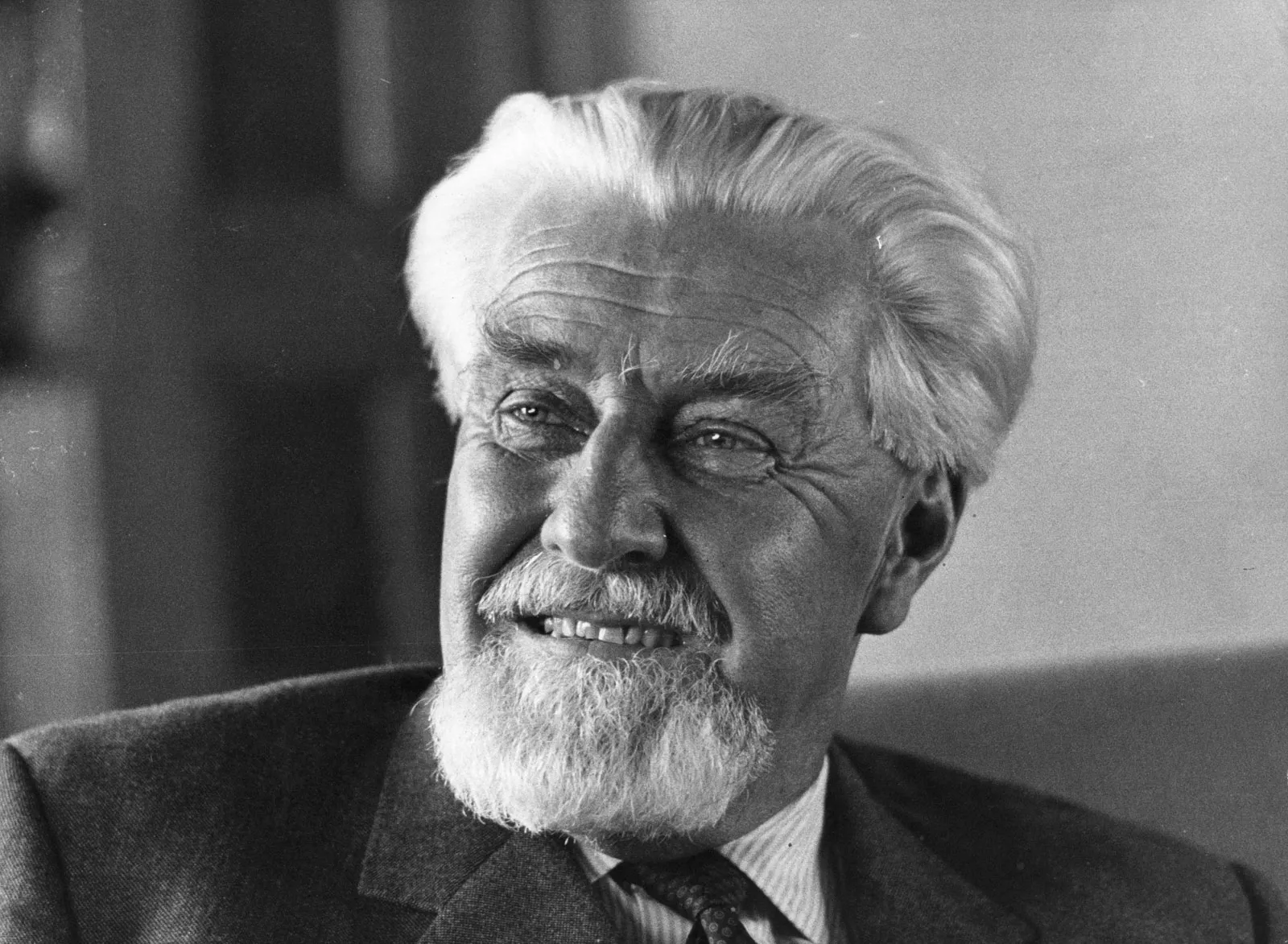
Konrad Lorenz, born on November 7, 1903, in Vienna, Austria, was a pioneering figure in the field of ethology, the scientific study of animal behavior. Often referred to as the “father of ethology,” Lorenz’s groundbreaking research and innovative ideas have left an indelible mark on the world of science. His work, particularly in the study of animal behavior, has provided deep insights into the connections between human and animal psychology. This article delves into the life, career, and significant contributions of Konrad Lorenz, exploring the nuances of his journey and the lasting impact of his work on both science and society.
Early Life and Academic Beginnings
Konrad Lorenz was born into a well-educated family in Vienna, where his father was a successful orthopedic surgeon, and his mother was a physician. From an early age, Lorenz exhibited a deep fascination with animals, a passion that was nurtured during his family’s summer retreats to their estate in Altenberg, Austria. It was here that Lorenz began his lifelong observation of animals, particularly birds, which would later form the basis of his scientific inquiries.
Despite his love for zoology, Lorenz initially followed his family’s wishes and enrolled in medical school at the University of Vienna in 1922. However, his passion for studying animals never waned. During his time as a medical student, Lorenz began a parallel study in zoology, keeping detailed notes and observations on the behavior of various animals, including a pet starling named Jock. These early studies laid the groundwork for what would become a revolutionary approach to understanding animal behavior.
The Birth of Ethology and Lorenz’s Early Discoveries
Konrad Lorenz’s transition from medicine to zoology marked the beginning of a career that would redefine the understanding of animal behavior. After completing his medical degree in 1928, Lorenz continued his studies in zoology at the University of Vienna, where he earned his doctorate in 1933. It was during this time that Lorenz began developing his ideas on the innate behavior of animals, a concept that would later be central to the field of ethology.
One of Lorenz’s most famous contributions to ethology is the concept of imprinting, a phenomenon he discovered while studying the behavior of graylag geese and other birds. Imprinting refers to a critical period early in an animal’s life when it forms attachments and develops an understanding of who or what its caregiver is. Lorenz famously demonstrated this by becoming the “mother” to a group of goslings, who followed him around as they would their biological mother. This discovery not only illustrated the importance of early experiences in shaping behavior but also provided a model for understanding attachment in humans.
Lorenz’s work on imprinting was revolutionary because it challenged existing notions about learned behavior, suggesting that certain behaviors are biologically programmed rather than acquired through experience. This idea had profound implications for understanding both animal and human behavior, influencing fields as diverse as psychology, education, and evolutionary biology.
Academic Career and World War II
As Lorenz’s reputation as a leading scientist grew, so did his academic responsibilities. In 1937, he was appointed as a professor of psychology and comparative anatomy at the University of Vienna. His lectures and research began attracting significant attention, and his work was increasingly recognized for its innovative approach to studying animal behavior in natural settings rather than in controlled laboratory environments.
However, Lorenz’s career was interrupted by the outbreak of World War II. In 1941, he joined the German Army as a medical officer, a decision that would later cast a shadow over his legacy due to his brief association with Nazi ideology. Lorenz was captured by the Soviet Army in 1944 and spent several years as a prisoner of war in Russia, where he continued to reflect on his scientific ideas, although under challenging circumstances.
Post-War Contributions and the Rise to Fame
After his release from Soviet captivity in 1948, Lorenz returned to Austria, where he resumed his scientific work with renewed vigor. He was appointed to a position at the Max Planck Institute for Behavioral Physiology in Seewiesen, Germany, where he would spend much of his later career. Here, Lorenz continued to develop his theories on animal behavior, often collaborating with other leading ethologists, including Nikolaas Tinbergen and Karl von Frisch.
Together with Tinbergen and von Frisch, Lorenz established the foundations of ethology as a distinct scientific discipline. Their collaborative work emphasized the importance of studying animals in their natural environments and introduced the concept of fixed action patterns—innate, pre-programmed behaviors triggered by specific stimuli. This work laid the groundwork for understanding the evolutionary basis of behavior and the role of natural selection in shaping behavioral traits.
In 1973, Lorenz, Tinbergen, and von Frisch were jointly awarded the Nobel Prize in Physiology or Medicine for their discoveries concerning the organization and elicitation of individual and social behavior patterns in animals. This recognition not only solidified Lorenz’s place in scientific history but also brought the study of animal behavior into the mainstream, influencing generations of researchers and practitioners in fields ranging from psychology to conservation biology.
The Legacy of “King Solomon’s Ring”
One of Konrad Lorenz’s most enduring contributions to popular science is his 1952 book, “King Solomon’s Ring”, in which he presented his research on animal behavior in an accessible and engaging manner. The book, filled with personal anecdotes and observations, brought the science of ethology to a broader audience, making complex ideas about animal behavior understandable to the general public.
“King Solomon’s Ring” remains a classic in popular science literature, and its success helped to raise awareness about the importance of studying animals in their natural habitats. Lorenz’s ability to communicate scientific concepts with clarity and humor made him a beloved figure not just among scientists but also among readers worldwide. The book’s impact is still felt today, as it continues to inspire interest in the study of animal behavior and conservation.
Controversies and Ethical Considerations
While Konrad Lorenz’s contributions to science are undeniable, his legacy is not without controversy. His brief involvement with Nazi ideology during the early 1940s has been the subject of considerable debate. Although Lorenz later distanced himself from these views and expressed regret, the association has led some to question the ethical implications of his work and the extent to which his scientific ideas may have been influenced by the political context of the time.
Moreover, Lorenz’s anthropomorphization of animals—attributing human characteristics to animal behavior—has also been critiqued by some in the scientific community. While his observations provided valuable insights, the tendency to interpret animal behavior through a human lens has led to debates about the objectivity and accuracy of some of his conclusions.
Despite these controversies, Lorenz’s work remains a cornerstone of ethology, and his ideas continue to influence the study of animal behavior. His emphasis on the evolutionary basis of behavior and the role of innate mechanisms in shaping actions has been foundational in the development of modern behavioral science.
Later Years and Continuing Influence
In the years following his Nobel Prize, Konrad Lorenz continued to write, lecture, and conduct research, although he eventually retired from active scientific work. He returned to Altenberg, where he spent his final years reflecting on his life’s work and its implications for both science and society.
During this time, Lorenz became increasingly concerned with the environmental and ethical issues facing humanity. He wrote extensively about the dangers of environmental degradation and the need for a more harmonious relationship between humans and the natural world. His later work emphasized the importance of preserving the integrity of both human and animal communities, arguing that the survival of species—including our own—depends on respecting the natural balance.
Konrad Lorenz passed away on February 27, 1989, at the age of 85, leaving behind a legacy that continues to shape the fields of ethology, psychology, and conservation. His pioneering work has inspired countless researchers to explore the intricate connections between behavior, evolution, and ecology, and his influence can be seen in the ongoing efforts to understand and protect the natural world.
Conclusion
Konrad Lorenz was more than just a scientist; he was a visionary who fundamentally changed the way we understand animal behavior and its connections to human psychology. His discoveries, particularly the concept of imprinting and the role of innate behaviors, have had far-reaching implications, influencing not only the field of ethology but also broader discussions about human nature, education, and ethics.
Lorenz’s life and work remind us of the importance of observing the natural world with both scientific rigor and empathy. While his legacy is complex and includes elements of controversy, the impact of his contributions to science is undeniable. Today, Konrad Lorenz is remembered as a giant in the world of behavioral science, whose ideas continue to resonate in the ongoing quest to understand the mysteries of life and behavior.


