
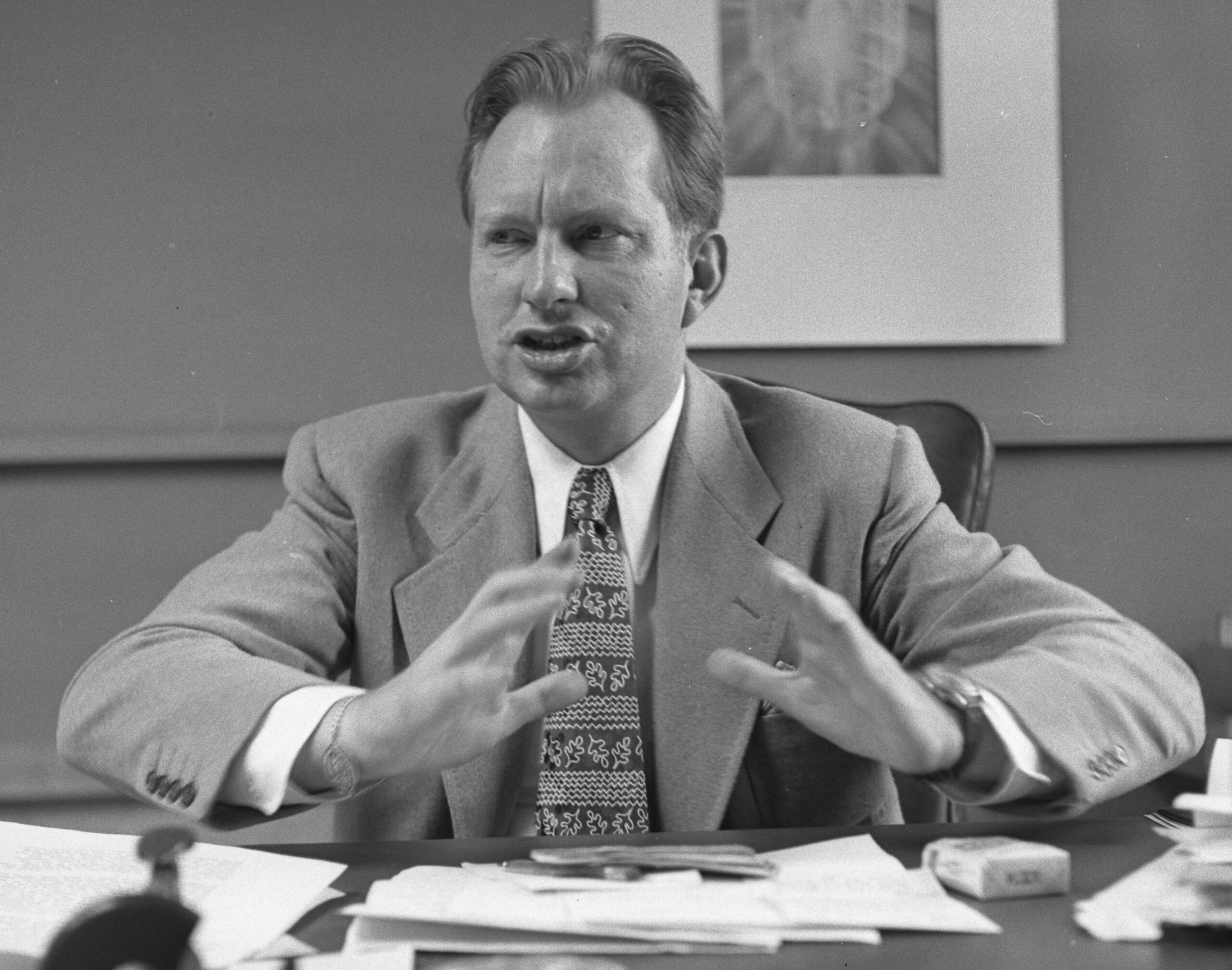
Lafayette Ronald Hubbard, commonly known as L. Ron Hubbard, is a name that evokes both fascination and controversy. Born on March 13, 1911, in Tilden, Nebraska, Hubbard is most renowned as the founder of Dianetics and Scientology, movements that have significantly influenced the landscape of modern spirituality and self-help. However, his life and career extend far beyond these contributions, encompassing a prolific writing career in genres ranging from science fiction to business management. In this article, we will explore the life, fame, and key highlights of L. Ron Hubbard’s multifaceted career.
Early Life and Education
L. Ron Hubbard was born into a family that frequently relocated due to his father’s career as a U.S. Navy officer. This nomadic lifestyle took Hubbard across various states, from Nebraska to Montana, and eventually to California. The constant movement and exposure to diverse cultures during his formative years played a significant role in shaping his worldview.
Hubbard’s early education was marked by his enrollment at the Queen Anne High School in Seattle, followed by his attendance at the Woodward School for Boys. His academic journey continued at George Washington University, where he studied engineering and took courses in molecular and atomic physics. Although Hubbard did not complete his degree, his time at the university was pivotal in fostering his interest in scientific and philosophical inquiries, which would later influence his work in Dianetics and Scientology.
The Early Writing Career and Rise to Fame
Hubbard’s passion for writing emerged during his university years when he published his first story, “Tah,” in the university’s newspaper. This marked the beginning of a prolific writing career that would span decades. In 1934, Hubbard made his professional debut in the world of pulp fiction, with his adventure story “The Green God” appearing in the magazine Thrilling Adventures.
Throughout the 1930s, Hubbard established himself as a prolific writer, producing stories at an astonishing rate. His work covered a wide range of genres, including adventure, science fiction, fantasy, and westerns. Hubbard’s ability to craft compelling narratives quickly gained him a reputation as a skilled storyteller. His popularity grew to the point where Columbia Pictures approached him in 1937 to adapt some of his stories for the big screen. This opportunity led Hubbard to work on screenplays for films such as Murder at Pirate Castle and contributed to several serials for television, including The Mysterious Pilot and The Great Adventures of Wild Bill Hickok.
The Golden Age of Science Fiction
One of the most significant milestones in Hubbard’s writing career came in 1938 when he met John W. Campbell Jr., a prominent figure in the science fiction publishing industry. Campbell, who was then the editor of Astounding Science-Fiction, recognized Hubbard’s talent and brought him into the fold of the magazine’s contributors. Hubbard’s first story for Astounding, “The Dangerous Dimension,” was published in July 1938, marking his entry into what is often referred to as the “Golden Age of Science Fiction.”
During this period, Hubbard produced some of his most famous works, including Final Blackout (1940) and Fear (1951). These stories, characterized by their imaginative plots and exploration of psychological themes, solidified Hubbard’s reputation as a leading science fiction writer. To keep up with the demand for his work, Hubbard wrote under various pseudonyms, including René Lafayette, Frederick Engelhardt, and Kurt von Rachen.
World War II and the Birth of Dianetics
Hubbard’s life took a significant turn during World War II. He served in the U.S. Navy, where he was involved in various operations, including a notable incident in the Pacific where he reported engaging Japanese submarines off the coast of Oregon. Hubbard’s wartime experiences had a profound impact on him, both physically and mentally. While recovering from war injuries at Oak Knoll Naval Hospital, he began conducting research on the human mind, which laid the foundation for his later work in Dianetics.
In 1950, Hubbard published Dianetics: The Modern Science of Mental Health, a book that introduced the concept of the reactive mind—a part of the mind that stores traumatic memories and negatively influences behavior. Dianetics proposed techniques for “auditing” these memories to achieve a state of “Clear,” where an individual is free from the influence of past traumas. The book quickly became a bestseller, and Dianetics centers began to spring up across the United States.
The Emergence of Scientology
Building on the success of Dianetics, Hubbard expanded his ideas into a broader philosophy that he called Scientology. While Dianetics focused on the mind, Scientology explored the spiritual nature of human existence. Hubbard posited that humans are essentially spiritual beings, or “thetans,” who have lived through multiple past lives. Scientology aimed to help individuals achieve spiritual enlightenment and ultimate freedom through a series of courses and auditing sessions.
In 1954, the first Church of Scientology was established in Los Angeles by a group of Hubbard’s followers. The movement rapidly grew, attracting members worldwide, and Hubbard devoted the rest of his life to developing and promoting Scientology. He authored numerous books and lectures on the subject, establishing a comprehensive framework for understanding the human spirit and its place in the universe.
Controversies and Criticisms
Despite its rapid growth, Scientology has been the subject of significant controversy since its inception. Critics have raised concerns about the organization’s practices, including its alleged emphasis on financial contributions from members, its treatment of dissenters, and its aggressive stance against critics. These controversies have led to numerous legal battles and investigations into the church’s activities.
Hubbard himself faced criticism and legal challenges throughout his life. His military service record, for instance, has been the subject of scrutiny, with some questioning the accuracy of his claims about his wartime experiences. Additionally, Hubbard’s claims about the efficacy of Dianetics and Scientology have been met with skepticism by the scientific and medical communities.
Later Life and Legacy
In the 1960s, Hubbard founded the Sea Organization (Sea Org), an elite group within Scientology dedicated to furthering the church’s mission. Sea Org members took lifelong vows of service and were often stationed on ships that Hubbard used as his base of operations while traveling the world. During this time, Hubbard continued to refine Scientology’s teachings and expand its global presence.
Hubbard’s later years were marked by a return to his first love—writing. In the 1980s, he published Battlefield Earth: A Saga of the Year 3000, a science fiction novel that became a bestseller. He followed this with the ten-volume Mission Earth series, a satirical science fiction epic that further showcased his storytelling prowess.
L. Ron Hubbard passed away on January 24, 1986, at his ranch in Creston, California. By the time of his death, Scientology had grown into a global movement with millions of followers. Despite the controversies surrounding his life and work, Hubbard’s influence on modern spirituality and self-help is undeniable.
Historical Context and Intellectual Impact
Hubbard’s work emerged during a time of significant social and cultural change in the United States. The post-World War II era was marked by a growing interest in self-improvement, psychology, and alternative spiritualities. Dianetics and Scientology tapped into this zeitgeist, offering a new framework for understanding the human mind and spirit that resonated with many.
Hubbard’s approach to self-help and spirituality was unique in its combination of scientific-sounding language with esoteric concepts. While this approach attracted many followers, it also sparked debate and criticism, particularly from those who questioned the scientific validity of his methods. Nevertheless, Hubbard’s ideas have had a lasting impact on the self-help industry, influencing countless authors and practitioners.
The Enduring Legacy of L. Ron Hubbard
Today, L. Ron Hubbard’s legacy is a complex one. On one hand, he is celebrated by millions of Scientologists around the world as a visionary who provided a path to spiritual freedom. His teachings continue to be studied and applied in Scientology churches and missions globally. On the other hand, Hubbard remains a controversial figure, with critics pointing to the practices of the Church of Scientology and the often contentious relationship between the church and the broader society.
Hubbard’s influence extends beyond Scientology. His early work in science fiction remains highly regarded, and he is remembered as a key figure in the Golden Age of Science Fiction. His prolific output and imaginative storytelling have inspired generations of writers and continue to be enjoyed by readers today.
In the end, L. Ron Hubbard was a man of contradictions—a visionary to some, a charlatan to others, but undeniably a significant figure in the 20th century. His ideas, writings, and the movement he founded have left an indelible mark on the world, one that continues to provoke thought, discussion, and debate.


