
Le Corbusier, born Charles-Édouard Jeanneret-Gris on October 6, 1887, in La Chaux-de-Fonds, Switzerland, is one of the most influential architects of the 20th century. His pioneering work in architecture, urban planning, and design has left an indelible mark on modern architecture. Known for his visionary ideas, Le Corbusier’s contributions extend far beyond just buildings; they encompass a comprehensive philosophy that sought to revolutionize the way people live, work, and interact with their environments. In this detailed exploration, we will delve into Le Corbusier’s age, rise to fame, and the significant highlights of his life and career, using insights and historical context to provide a thorough understanding of his legacy.
Early Life and Education
Charles-Édouard Jeanneret-Gris, later known as Le Corbusier, was born into a family of artists in the Swiss town of La Chaux-de-Fonds. His father was a watchmaker, and his mother was a piano teacher. Growing up in an environment that valued craftsmanship and the arts, Le Corbusier was encouraged to explore his creative instincts from a young age. At 14, he enrolled in the local School of Art, where he initially studied engraving and watchmaking—skills that were deeply rooted in his hometown’s tradition.
However, it was his teacher, Charles L’Eplattenier, who recognized Le Corbusier’s potential in architecture and guided him towards this field. L’Eplattenier introduced him to the ideas of Art Nouveau and the emerging trends in architecture and design. By the age of 18, Le Corbusier had designed his first house, showcasing his early inclination towards architecture.
Formative Years and Early Travels
Le Corbusier’s early career was shaped by extensive travel and exposure to different architectural styles and philosophies across Europe. Between 1906 and 1914, he traveled to cities such as Vienna, where he encountered the Secessionist movement, and Berlin, where he worked in the office of Peter Behrens. During his time in Berlin, Le Corbusier met other future luminaries of modern architecture, including Walter Gropius and Ludwig Mies van der Rohe, who would later become central figures in the Bauhaus movement.
These experiences profoundly influenced Le Corbusier’s thinking. He meticulously documented his travels, filling sketchbooks with drawings and notes on the buildings, materials, and architectural details he encountered. This period of exploration allowed him to develop a rich understanding of both historical and contemporary architectural practices, which he would later synthesize into his unique approach.
The Birth of Le Corbusier: Transition to Paris and Name Change
In 1917, Le Corbusier moved to Paris, a city that would become the epicenter of his architectural career. It was in Paris that he adopted the pseudonym “Le Corbusier,” a name derived from his maternal grandfather’s name, Lecorbésier. The adoption of this name marked a significant turning point in his life, symbolizing his new identity as an architect and his break from his past.
In Paris, Le Corbusier immersed himself in the avant-garde art and architecture scenes. He collaborated with painter Amédée Ozenfant and co-founded the Purist movement, which sought to apply the principles of modern art to architecture. Together, they launched the magazine “L’Esprit Nouveau,” which became a platform for Le Corbusier to disseminate his ideas about architecture, urbanism, and design.
Architectural Philosophy: The Five Points of Architecture
Le Corbusier’s architectural philosophy was grounded in the principles of modernism, which emphasized functionality, simplicity, and the use of new materials and technologies. He is perhaps best known for his “Five Points of Architecture,” which he articulated in his 1923 book Vers une architecture (Toward an Architecture). These five points became the foundation of his approach to design and were revolutionary in their time:
-
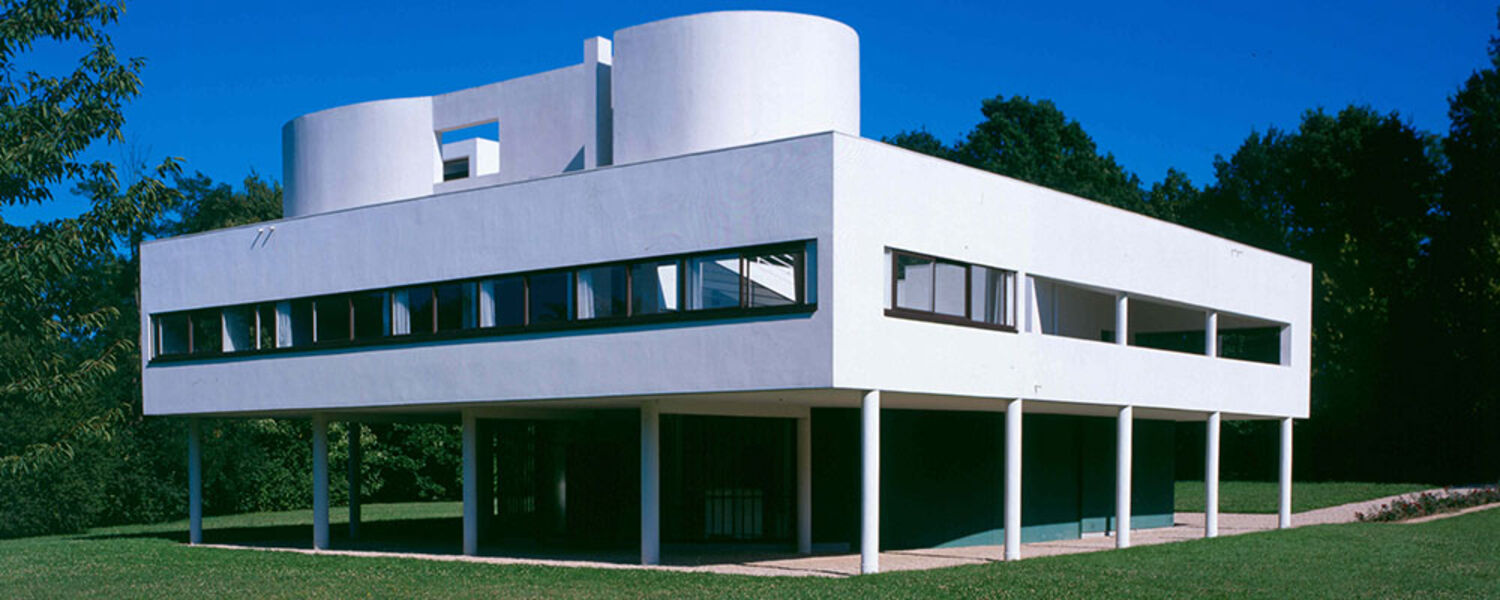
Pilotis (Supports): Le Corbusier advocated for elevating buildings on stilts, or pilotis, to allow for the free flow of air and light beneath the structure, as well as to reclaim the ground space for gardens and outdoor use.
-
Roof Garden: He promoted the idea of flat roofs that could be used as gardens or terraces, thereby integrating green space into urban environments.
-
Free Plan: Le Corbusier believed in the separation of the structural framework from the walls, allowing for flexible, open floor plans that could be easily adapted to different uses.
-
Horizontal Windows: To maximize natural light and views, he designed long, horizontal windows that spanned the length of a building’s façade.
-
Free Façade: By removing the load-bearing function from the exterior walls, Le Corbusier allowed for more creative and varied façade designs, independent of the building’s structural needs.
These principles were first fully realized in his design for the Villa Savoye (1929-1931), a quintessential example of his modernist approach. Located in Poissy, France, the Villa Savoye embodies the ideals of functionalism and aesthetic purity, and it remains one of the most iconic works of modern architecture.
Major Projects and Urban Planning Concepts
Le Corbusier’s contributions extended beyond individual buildings to encompass large-scale urban planning. He was deeply concerned with the challenges of modern cities, such as overcrowding, pollution, and inefficient infrastructure. His solution was to propose new forms of urban living that prioritized health, efficiency, and harmony with nature.
One of his most famous urban planning concepts is the “Radiant City” (La Ville Radieuse), which he developed in the 1930s. This visionary plan called for high-density housing in the form of tall, cruciform towers surrounded by green spaces, with efficient transportation systems connecting different parts of the city. The Radiant City was designed to provide a better quality of life for its residents, with an emphasis on sunlight, greenery, and open space. Although the plan was never fully realized, it influenced modernist urban planning and the development of high-rise housing projects around the world.
Le Corbusier’s ideas about urbanism were also reflected in his work on the “Unité d’Habitation” in Marseille (1947-1952). This massive housing block, often referred to as a “vertical garden city,” was designed to accommodate 1,600 residents in self-contained units. The building featured shops, a gym, a nursery, and even a rooftop garden, embodying Le Corbusier’s vision of a self-sufficient community within a single structure.
Controversies and Criticisms
Despite his visionary ideas, Le Corbusier’s work was not without controversy. His designs were often criticized for being too rigid and impersonal, and his urban planning concepts, particularly the Radiant City, were accused of promoting an overly mechanized and dehumanized vision of urban life. Critics argued that his emphasis on functionality and order came at the expense of the organic, chaotic, and vibrant qualities that make cities dynamic and livable.
Moreover, some of Le Corbusier’s urban projects, when implemented, led to the creation of isolated, monolithic housing estates that became synonymous with social problems and urban decay. His ideas, though revolutionary, sometimes struggled to adapt to the complexities of real-world urban environments.
Later Life and Legacy
In his later years, Le Corbusier continued to push the boundaries of architecture and design. He worked on a variety of projects around the world, including the design of the Chandigarh city plan in India (1951-1965), where he applied his principles of urban planning on a large scale. Chandigarh is one of the few fully realized examples of his urban planning theories and remains a significant testament to his vision.
Le Corbusier also explored the relationship between architecture and spirituality, as seen in his design of the Notre-Dame-du-Haut Chapel in Ronchamp, France (1950-1955). This building, with its sculptural forms and interplay of light and shadow, marked a departure from his earlier, more rationalist works and demonstrated his ability to incorporate emotion and symbolism into his designs.
Le Corbusier passed away on August 27, 1965, while swimming in the Mediterranean Sea near his home in Roquebrune-Cap-Martin, France. His death marked the end of an era in modern architecture, but his influence continues to resonate in the fields of architecture, design, and urban planning.
The Enduring Influence of Le Corbusier
Le Corbusier’s legacy is immense. He is regarded as one of the pioneers of modern architecture, and his ideas have shaped the development of cities and buildings around the world. His emphasis on functionality, simplicity, and the use of new materials and technologies laid the groundwork for much of what we consider modern architecture today.
Moreover, Le Corbusier’s contributions to urban planning and design have had a lasting impact on how we think about cities and living spaces. His visionary ideas, though not always practical, challenged architects, planners, and policymakers to reconsider the relationship between architecture, society, and the environment.
Le Corbusier’s furniture designs, such as the iconic LC4 chaise longue and the LC2 and LC3 armchairs, continue to be celebrated for their elegant simplicity and functionality. These pieces, created in collaboration with Pierre Jeanneret and Charlotte Perriand, remain timeless classics in the world of modern design.
In summary, Le Corbusier was a visionary whose work transcended the boundaries of architecture and design. His ideas continue to inspire and challenge us, reminding us of the power of architecture to shape the world around us and to influence how we live our lives. As we continue to grapple with the challenges of urbanization and environmental sustainability, Le Corbusier’s vision of a harmonious, functional, and human-centered built environment remains as relevant as ever.


