
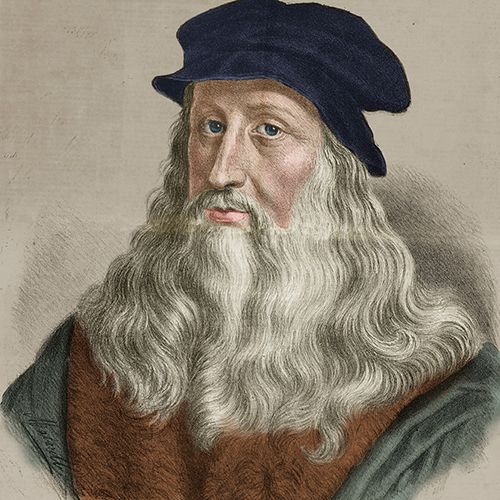
Leonardo da Vinci, born on April 15, 1452, in the small village of Vinci between Empoli and Pistoia, Italy, is one of the most iconic figures in the history of art and science. Widely celebrated for his contributions to various fields, including painting, engineering, anatomy, and architecture, Leonardo epitomizes the Renaissance humanist ideal. His insatiable curiosity and relentless pursuit of knowledge made him a polymath whose legacy continues to inspire millions worldwide.
Early Life and Education
Leonardo was the illegitimate son of Ser Piero, a prominent notary, and Caterina, a woman of humble origins. Despite his illegitimacy, Leonardo was raised in his father’s household, where he received a basic education in reading, writing, and arithmetic. However, it was his precocious artistic talent that set him apart from an early age. Recognizing his son’s potential, Ser Piero arranged for Leonardo to apprentice under Andrea del Verrocchio, a renowned Florentine artist and sculptor.
Under Verrocchio’s tutelage, Leonardo developed his skills in drawing, painting, and sculpture. He also gained exposure to a wide range of disciplines, including mechanics and architecture, which would later inform his diverse body of work. Leonardo’s time in Verrocchio’s workshop was crucial in shaping his artistic style and intellectual approach, as he learned to integrate scientific observation with artistic creativity.
The Florentine Period and Early Works
Leonardo’s early career was marked by his work in Florence, where he became involved in the vibrant cultural life of the city. By the 1480s, he was already recognized as a master in his own right. One of his first major commissions was the “Adoration of the Magi” for the Augustinian monks of San Donato a Scopeto. Although Leonardo left the painting unfinished, it demonstrated his innovative use of perspective and composition, setting the stage for his later masterpieces.
During this period, Leonardo’s interests extended beyond painting. He became deeply involved in the study of anatomy, conducting dissections to better understand the human body. His anatomical sketches, which are among the most detailed and accurate of his time, reveal a profound understanding of the human form and its mechanics. These studies would later inform his paintings, allowing him to create figures that were both anatomically precise and artistically expressive.
Move to Milan and the Height of Fame
In 1482, seeking new opportunities, Leonardo left Florence and entered the service of Ludovico Sforza, the Duke of Milan. It was in Milan that Leonardo produced some of his most famous works and solidified his reputation as a master artist and inventor. He presented himself to Ludovico not just as an artist, but as an engineer capable of designing military fortifications, machines, and public works.
One of Leonardo’s most significant projects during his time in Milan was the creation of “The Last Supper,” an iconic mural painted in the refectory of the Convent of Santa Maria delle Grazie. Completed between 1495 and 1498, “The Last Supper” is renowned for its emotional depth and the innovative use of perspective, which creates a dramatic focal point on Christ. However, the experimental technique Leonardo used—painting on dry plaster—led to the rapid deterioration of the mural, prompting numerous restoration efforts over the centuries.
Another notable work from this period is the “Virgin of the Rocks,” of which two versions exist: one in the Louvre and the other in the National Gallery in London. This painting exemplifies Leonardo’s mastery of chiaroscuro, the use of light and shadow to create depth and volume. It also showcases his interest in botany and geology, as evidenced by the detailed depiction of the plants and rocks in the background.
Engineering and Scientific Pursuits
Leonardo da Vinci’s genius extended far beyond the realm of art. His notebooks, filled with sketches, diagrams, and observations, reveal a mind that was constantly exploring the natural world. These notebooks, often referred to as codices, contain some of the earliest conceptual designs for inventions that would not be realized until centuries later, including flying machines, tanks, and even a rudimentary version of the helicopter.
One of Leonardo’s most ambitious projects was the design of a colossal bronze horse statue, intended to honor Ludovico Sforza’s father, Francesco Sforza. Although the project was never completed due to the invasion of Milan by French forces in 1499, Leonardo’s preparatory studies for the horse remain a testament to his engineering prowess and artistic vision.
Leonardo was also deeply interested in the study of water and its movement. He designed numerous hydraulic systems, including canals, locks, and irrigation systems, some of which were implemented in and around Milan. His understanding of fluid dynamics is evident in his detailed sketches of water currents and vortices, which continue to be studied by engineers and scientists today.
Return to Florence and the Mona Lisa
After the fall of the Sforza dynasty in 1499, Leonardo returned to Florence, where he was received as a celebrated artist. During this period, he began work on one of his most famous paintings, the “Mona Lisa.” Completed between 1503 and 1506, the “Mona Lisa” is renowned for the enigmatic expression of its subject, Lisa Gherardini, and Leonardo’s use of sfumato—a technique that creates a soft, blurred transition between colors and tones.
The “Mona Lisa” is widely regarded as the epitome of Renaissance portraiture, with its lifelike rendering and subtle use of light and shadow. The painting’s fame has only grown over the centuries, becoming one of the most recognized and studied works of art in the world. Today, the “Mona Lisa” resides in the Louvre Museum in Paris, where it continues to captivate millions of visitors each year.
In addition to the “Mona Lisa,” Leonardo was also commissioned to paint a mural depicting the “Battle of Anghiari” for the Palazzo della Signoria in Florence. Although this work was never completed, Leonardo’s preparatory sketches and studies demonstrate his continued interest in the depiction of human anatomy and movement.
Later Years in Rome and France
In 1513, Leonardo moved to Rome, where he worked under the patronage of Pope Leo X. Although his time in Rome was marked by a lack of major commissions, Leonardo continued his scientific investigations, focusing on topics such as anatomy, optics, and geology. He also explored the concept of ideal cities, designing urban plans that incorporated his ideas about architecture, public health, and transportation.
Leonardo’s final years were spent in France, where he was invited by King Francis I to live and work at the Château du Clos Lucé in Amboise. There, Leonardo continued to work on various projects, including designs for court entertainments and hydraulic systems. Despite declining health, he remained intellectually active, and his notebooks from this period reveal a continued interest in a wide range of subjects.
On May 2, 1519, Leonardo da Vinci passed away at the age of 67. He was buried in the Church of Saint-Florentin in Amboise, although his tomb was later destroyed during the French Wars of Religion, leaving his final resting place uncertain.
Historical Context and Influence
Leonardo da Vinci’s life and work must be understood within the broader context of the Italian Renaissance, a period of profound cultural and intellectual transformation in Europe. The Renaissance was characterized by a renewed interest in the classical knowledge of ancient Greece and Rome, coupled with a spirit of inquiry and innovation. Leonardo embodied these values, constantly seeking to expand the boundaries of knowledge and applying his discoveries to a wide range of disciplines.
Leonardo’s impact on art and science is immeasurable. His paintings, with their mastery of composition, perspective, and human emotion, set new standards for artistic achievement. His scientific studies, documented in thousands of pages of notes and sketches, laid the groundwork for future developments in anatomy, engineering, and physics. Leonardo’s interdisciplinary approach, blending art and science, continues to inspire scholars, artists, and innovators to this day.
The Legacy of Leonardo da Vinci
Leonardo da Vinci’s legacy is not confined to his lifetime; it has grown and evolved over the centuries, influencing countless generations of artists, scientists, and thinkers. His works, particularly the “Mona Lisa” and “The Last Supper,” remain among the most famous and analyzed pieces of art in the world. These paintings are celebrated not only for their aesthetic qualities but also for the innovative techniques Leonardo employed, such as sfumato and perspective, which have become fundamental elements of Western art.
In science and engineering, Leonardo’s notebooks have proven to be a treasure trove of ideas and insights. His studies on anatomy were centuries ahead of their time, providing a level of detail and accuracy that would not be matched until the advent of modern medical imaging techniques. His designs for machines, many of which were never built during his lifetime, have since been realized and demonstrated to be functional, showcasing his visionary understanding of mechanics and physics.
Leonardo’s interdisciplinary approach, which seamlessly integrated art, science, and engineering, has become a model for innovation in the modern era. Today, Leonardo da Vinci is often cited as the quintessential “Renaissance man,” a term that denotes someone with expertise in multiple fields. His ability to bridge the gap between the arts and sciences has inspired movements such as STEAM (Science, Technology, Engineering, Arts, and Mathematics), which emphasizes the importance of creativity and critical thinking in education and innovation.
Furthermore, Leonardo’s life serves as a testament to the power of curiosity and lifelong learning. He was never content to accept conventional wisdom or limit himself to a single discipline. Instead, he pursued knowledge wherever it led him, constantly experimenting, observing, and refining his ideas. This relentless pursuit of understanding is perhaps Leonardo’s most enduring legacy, reminding us of the limitless potential of the human mind.
Conclusion
Leonardo da Vinci’s life and work represent the pinnacle of Renaissance achievement. Born into humble circumstances, he rose to become one of the most celebrated figures in history, leaving behind a body of work that continues to inspire awe and admiration. Whether through his masterpieces of art, his groundbreaking scientific studies, or his visionary engineering designs, Leonardo exemplified the Renaissance ideals of curiosity, creativity, and intellectual exploration.
As we reflect on Leonardo da Vinci’s legacy, it is clear that his contributions extend far beyond his own time. His work laid the foundation for future advancements in art, science, and technology, and his interdisciplinary approach continues to be a source of inspiration for those seeking to push the boundaries of human knowledge. Leonardo da Vinci’s genius was not limited by the constraints of his era, and his influence remains as powerful today as it was five centuries ago.


