
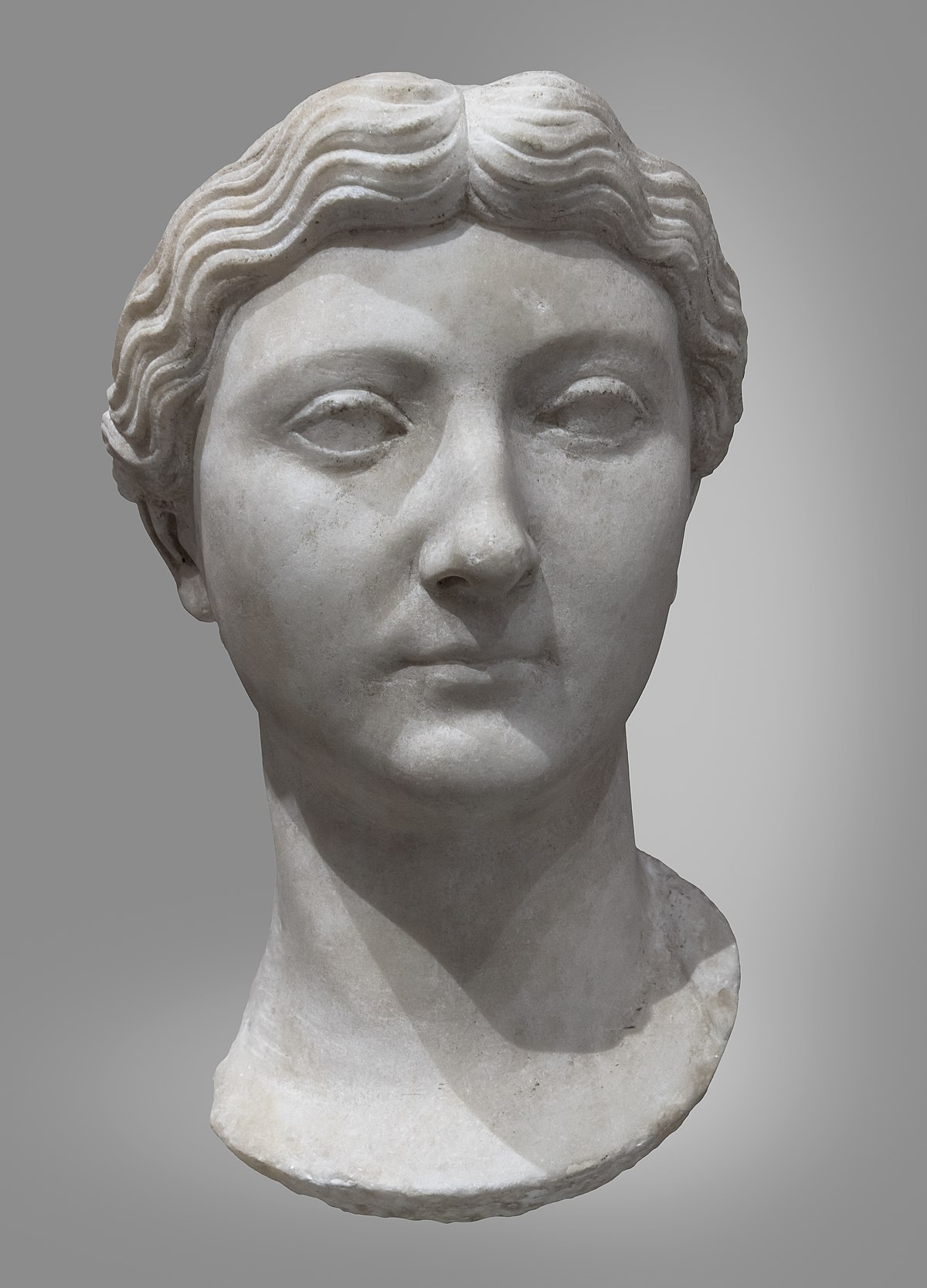
Livia Drusilla, born on January 30, 58 BC, in Rome, was a prominent figure in ancient Roman history, best known as the wife of the first Roman Emperor, Augustus. Her influence and legacy extend far beyond her role as an imperial consort; she was a central figure in the transition from the Roman Republic to the Roman Empire. Livia’s life, marked by political astuteness, personal ambition, and enduring loyalty, made her one of the most powerful women in Roman history. Over time, she was deified, reflecting the profound impact she had on the Roman state and its people.
Early Life and Marriage to Tiberius Claudius Nero
Livia Drusilla was born into the powerful Claudian family, which was deeply entrenched in the political and military life of Rome. Her father, Marcus Livius Drusus Claudianus, was a prominent figure, and her upbringing was typical of the Roman elite, preparing her for a life of influence and power. The diminutive “Drusilla” suggests that she was the second daughter in her family, a common practice in Roman naming conventions.
At the age of 16, Livia was married to her cousin, Tiberius Claudius Nero, a patrician who was deeply involved in the political turmoil of the time. Tiberius Claudius Nero sided with the assassins of Julius Caesar, Brutus and Cassius, and later with Mark Antony against Octavian (the future Augustus). This political alignment forced Livia and her family into exile in Sicily and later in Greece after the defeat of Brutus and Cassius at the Battle of Philippi in 42 BC.
During her marriage to Tiberius Claudius Nero, Livia bore two sons, Tiberius and Drusus. Despite the chaotic political environment and her husband’s opposition to Octavian, Livia’s life took a dramatic turn when she returned to Rome in 39 BC.
Marriage to Octavian (Augustus) and Rise to Power
Upon her return to Rome, Livia caught the eye of Octavian, who was then solidifying his power as the leader of Rome. Despite the fact that both Livia and Octavian were already married—Livia to Tiberius Claudius Nero and Octavian to Scribonia—their mutual attraction and likely political calculations led to swift divorces on both sides. Octavian divorced Scribonia on the same day she gave birth to their daughter, Julia, and Livia was similarly compelled to separate from her husband, despite being pregnant with Drusus.
Three days after the birth of Drusus in January 38 BC, Livia and Octavian married. This union was not only a personal alliance but also a strategic political move. By marrying into the powerful Claudian family, Octavian strengthened his position among the Roman elite. Their marriage, which lasted over 50 years, became one of the most enduring and politically significant unions in Roman history.
Despite the lack of children from their marriage, Livia held a significant place in Augustus’s life. She was his confidante and adviser, playing a crucial role in his decisions and the administration of the empire. Livia was known for her modesty, wearing simple clothing and refraining from ostentatious displays of wealth, which endeared her to the Roman people and set a moral example for Roman women.
Livia as the First Roman Empress
With the defeat of Mark Antony in 31 BC and Octavian’s rise to absolute power, the Roman Republic began its transformation into the Roman Empire. In 27 BC, Octavian was given the title “Augustus” by the Senate, marking the beginning of his reign as the first Roman Emperor. As Augustus’s wife, Livia became the first Roman Empress, though the title was not officially recognized as it would be in later centuries.
Livia’s influence grew as Augustus consolidated his power. She was granted the unprecedented right to manage her own finances, a privilege rarely afforded to Roman women. Augustus even dedicated a public statue to her, further solidifying her status in Roman society. Livia worked tirelessly to secure the political future of her sons, Tiberius and Drusus, from her first marriage, ensuring their place in the line of succession.
Her role as an empress was not limited to ceremonial duties. Livia was deeply involved in the political life of Rome, presenting petitions to Augustus and advising him on various matters. Her influence extended beyond the domestic sphere, affecting imperial policies and the administration of the empire.
The Influence and Power of Livia Drusilla
Augustus’s death in AD 14 marked a pivotal moment for Livia. In his will, Augustus adopted Livia into the Julian family and granted her the title “Augusta,” a significant honor that further elevated her status. This adoption allowed Livia to fully integrate into the patrician Julian gens, aligning her more closely with the imperial family and consolidating her power.
After Augustus’s death, Livia played a crucial role in the succession of her son Tiberius, who became the second Roman Emperor. Initially, Tiberius and Livia maintained a close relationship, and Tiberius honored his mother by passing laws that protected her reputation and elevated her status. In AD 20, Tiberius enacted a law that made it a crime to slander his mother, reflecting the respect and authority she commanded.
However, Livia’s influence eventually created tension between her and Tiberius. As she continued to wield significant power, Tiberius began to feel overshadowed by his mother. This strain in their relationship grew over time, leading to a rift that persisted until Livia’s death. Despite this tension, Livia remained a formidable figure in Roman politics, and her actions helped shape the early years of the Roman Empire.
Later Years and Legacy
In AD 22, Livia fell ill and moved to Capri, a popular retreat for the Roman elite. Tiberius, showing filial duty, joined her on the island. However, her health declined over the following years, and she returned to Rome, where she passed away on September 28, AD 29, at the age of 87. Her death marked the end of an era, and her passing was deeply felt throughout the empire.
Despite their estrangement, Tiberius delivered the funeral oration for his mother but refused to deify her, a significant decision given the precedent set by Augustus’s deification. Tiberius also vetoed numerous honors the Senate proposed for Livia, reflecting the complex and strained relationship they shared in her later years. It was not until AD 42, during the reign of her grandson Claudius, that Livia was officially deified, becoming the “Diva Augusta.”
Livia’s legacy is multifaceted. She was a symbol of the ideal Roman matron, embodying virtues such as modesty, loyalty, and piety. Yet, she was also a shrewd political operator, skillfully navigating the treacherous waters of Roman politics to secure her family’s future. Her life and actions had a lasting impact on the Roman Empire, influencing the succession and shaping the imperial household.
Historical and Cultural Influence
Livia Drusilla has remained a figure of fascination throughout history. Ancient historians such as Tacitus and Suetonius often portrayed her as a powerful, sometimes manipulative figure who exerted immense influence over Augustus and the imperial court. Tacitus, in particular, suggested that Livia was instrumental in the exile of Augustus’s only remaining natural grandson and heir, Agrippa Postumus, thereby clearing the path for her son Tiberius to succeed.
Livia’s image has also been shaped by literary and cultural depictions. In Robert Graves’s historical novel “I, Claudius,” Livia is portrayed as the mastermind behind the political intrigues of the early empire, responsible for numerous deaths and the ultimate ascension of her descendants. This portrayal, though fictionalized, has contributed to the enduring image of Livia as a powerful and sometimes ruthless figure.
In modern times, Livia’s story has continued to captivate audiences. The 2021 television series “Domina” centers on Livia Drusilla, exploring her life and influence during the formative years of the Roman Empire. This renewed interest in Livia reflects her lasting significance as one of the most powerful women in ancient history.
Conclusion: The Enduring Legacy of Livia Drusilla
Livia Drusilla’s life is a testament to the complex and often contradictory roles women could play in ancient Rome. As the wife of Augustus, she was both a supportive spouse and a key political adviser, shaping the direction of the Roman Empire during its formative years. Her influence extended beyond her lifetime, affecting the course of Roman history and the development of the imperial system.
Livia’s legacy as the first Roman Empress and one of the most influential women in ancient Rome is undeniable. Her life was marked by political acumen, personal ambition, and a deep commitment to her family and the Roman state. Whether viewed as a paragon of Roman virtue or a master of political manipulation, Livia Drusilla remains a central figure in the history of the Roman Empire, and her story continues to inspire and intrigue scholars, writers, and audiences alike.


