
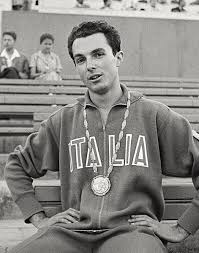
Livio Berruti is a name that resonates profoundly in the annals of athletics, particularly within the sphere of Italian sports history. Born on May 19, 1939, in Turin, Italy, Berruti’s life and career encapsulate the quintessence of determination, talent, and historical significance in the world of track and field. His story is a tapestry woven with moments of sheer brilliance, defiance of expectations, and enduring legacy.
Early Life and Discovery of Talent
Hailing from a well-to-do bourgeois family in Piedmont, Berruti’s initial foray into sports was somewhat serendipitous. He began his athletic journey at the prestigious Liceo Cavour in Turin, where he initially dabbled in high jump, a discipline that honed his explosive power and agility—qualities that would later prove invaluable in his sprinting career. Berruti’s true potential as a sprinter was discovered almost by accident when, at seventeen, he defeated the school’s reigning champion in the 100 meters, a feat that steered him towards sprinting as his primary focus.
By the age of eighteen, Berruti had already etched his name in the national records, equaling the Italian 100 meters record (10.4 seconds) set in 1938 by Orazio Mariani. Despite his father Michele’s concerns about the physical demands of sprinting, which led him to caution the national team against overburdening his son, Berruti’s talent was undeniable and continued to flourish.
Rise to Fame: Breaking Records
Berruti’s rise in the sprinting world was meteoric. In 1958, he set a new world junior record in the 100 meters with a time of 10.3 seconds. This was followed by a series of record-breaking performances, including a remarkable 20.8 seconds in the 200 meters at Malmö, Sweden, and a 20.7 seconds at the Arena di Milano on a 500-meter track, which had a shorter curve. These achievements solidified his reputation as one of the premier sprinters in Italy and the world.
The 1960 Rome Olympics: A Historic Triumph
The pinnacle of Berruti’s career came during the 1960 Summer Olympics held in Rome. Competing in front of a home crowd, Berruti’s performance in the 200 meters was nothing short of legendary. He entered the competition as an underdog, with formidable opponents including American sprinters Norton, Johnson, and Carney, as well as the European record-holder Abdoulaye Seye from France.
In the heats and quarterfinals, Berruti demonstrated exceptional form, consistently posting the fastest times. The semi-finals were a significant mental and physical test, as Berruti lined up against three world record holders. Despite the pressure, he ran a flawless curve and entered the final stretch in the lead. A symbolic moment occurred when a dove took flight from Berruti’s lane as he powered through the finish line, equaling the world record with a time of 20.5 seconds.
The final race, held just hours later, saw Berruti dominate once again, maintaining his lead throughout and finishing first with another world record-equalling time of 20.5 seconds. This victory not only made him the first Italian to win an Olympic sprint title but also broke the American stronghold on the event, marking a historic moment in Olympic history.
Post-Olympic Career and Legacy
Berruti’s success at the Rome Olympics catapulted him to national hero status. He was awarded a Fiat 500 and received significant monetary rewards for his achievements. Despite experiencing ups and downs in his subsequent athletic career, including a fifth-place finish in the 200 meters at the 1964 Tokyo Olympics and a seventh-place finish in the 4×100 meters relay, Berruti’s legacy was firmly established.
His final years at the top level of competition culminated in the 1968 Mexico City Olympics, where he once again competed in the 4×100 meters relay, setting a new Italian record. However, persistent tendon issues ultimately led to his retirement from competitive athletics.
In recognition of his enduring legacy, Berruti played a prominent role in the opening ceremonies of the 2006 Winter Olympics in Turin, symbolizing his lasting impact on Italian sports.
Historical and Cultural Context
Berruti’s achievements must be viewed within the broader context of post-war Italy, a period marked by significant social and economic transformation. His Olympic triumph in 1960 coincided with Italy’s “economic miracle,” a time of rapid industrial growth and modernization. Berruti’s success not only provided a source of national pride but also symbolized the country’s resurgence on the global stage.
Moreover, Berruti’s victory had profound implications for the sport of athletics. His ability to compete and win against the traditionally dominant American sprinters challenged the existing hierarchy in the sport and inspired future generations of European and Italian athletes. The fact that he wore distinctive dark glasses and white socks during his races added to his unique persona, making him a memorable and iconic figure in the history of athletics.
Livio Berruti’s Enduring Legacy
Livio Berruti’s legacy extends beyond his athletic achievements. His story is one of perseverance, excellence, and breaking barriers. He remains an inspirational figure for athletes worldwide, exemplifying how talent, hard work, and determination can overcome even the most formidable challenges.
In addition to his athletic prowess, Berruti’s character and sportsmanship have left an indelible mark. His elegant running style, described by famed sports journalist Gianni Brera as “muscles exploding with frenzy yet with incredible elegance,” continues to be celebrated as one of the most beautiful in the history of sprinting.
Today, Livio Berruti’s name is synonymous with excellence in Italian sports. His achievements are commemorated in numerous ways, including his participation as a torchbearer in the 2006 Winter Olympics and various accolades that honor his contributions to athletics.
Conclusion
Livio Berruti’s journey from a young high jumper in Turin to an Olympic champion is a testament to his extraordinary talent and determination. His triumphs in the face of formidable competition and his lasting impact on the world of athletics ensure that his legacy will endure for generations to come. As a symbol of Italian pride and a beacon of inspiration, Livio Berruti’s life and career continue to be celebrated, embodying the spirit of perseverance and excellence that defines the greatest athletes.


