
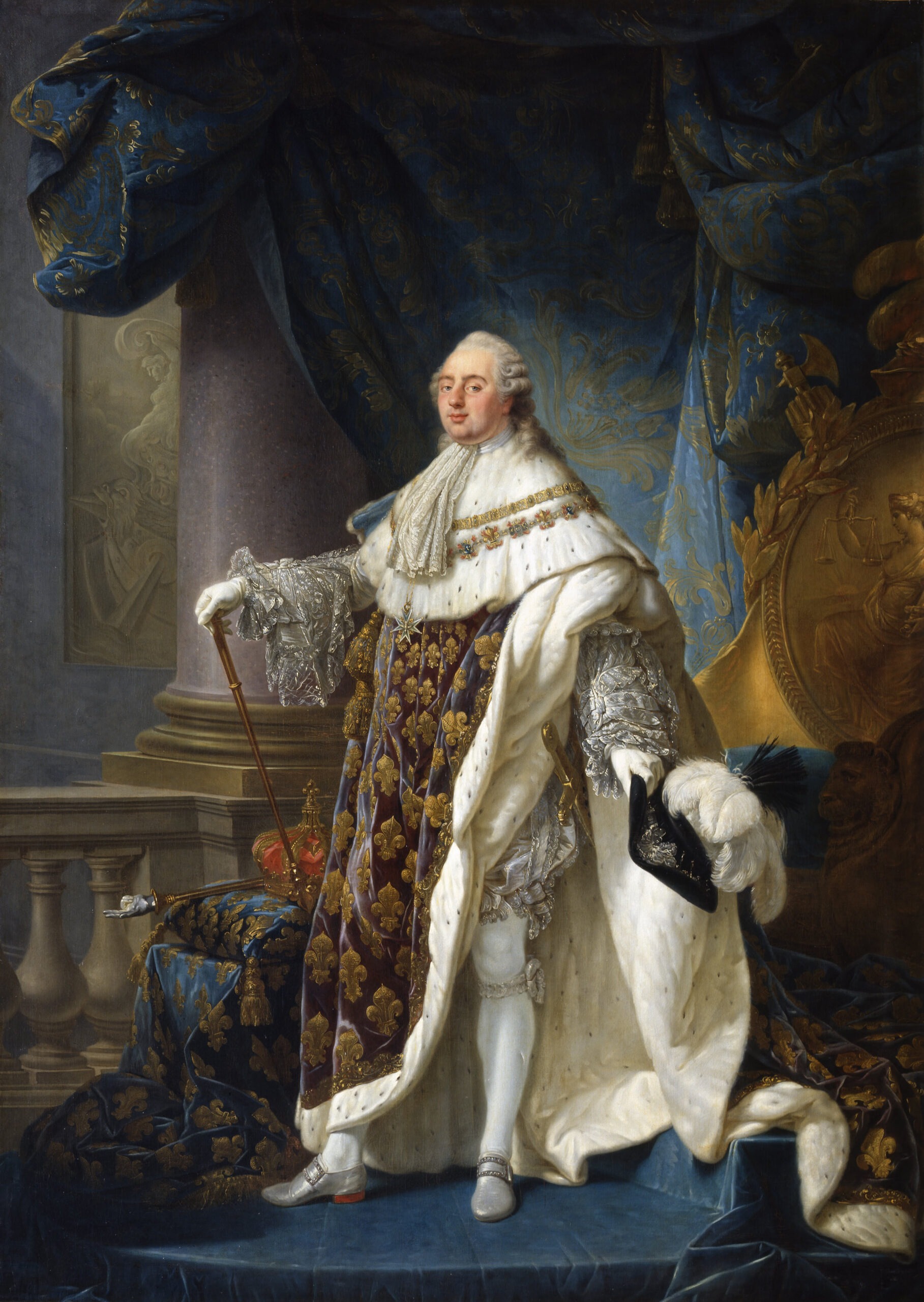
Louis XVI of France, born on August 23, 1754, in Versailles, is one of history’s most notable monarchs, remembered for his reign during a time of significant political and social upheaval. His life, characterized by the complexities of leadership, personal struggles, and ultimately, his tragic fate, offers a compelling narrative about the challenges of monarchy in the face of revolution. As the last King of France before the fall of the monarchy during the French Revolution, Louis XVI’s reign is marked by a series of events that would change the course of French and global history.
Early Life and Ascension to the Throne
Louis XVI was born as Louis-Auguste, the second son of the Dauphin of France, Louis Ferdinand, and Maria Josepha of Saxony. His early life was shaped by the opulent and rigid environment of the French court at Versailles, where he was educated in preparation for his future role as king. His education was comprehensive, covering grammar, history, geography, languages, Latin, as well as the fundamentals of international politics and economics. However, despite this rigorous training, Louis was known for his introverted and indecisive nature, traits that would later impact his reign.
Louis was only 11 years old when his father died in 1765, and nine years later, in 1774, he ascended to the throne after the death of his grandfather, Louis XV. At the age of 20, he was crowned King of France, a role for which he was neither fully prepared nor particularly enthusiastic. His marriage to Marie Antoinette, the daughter of Empress Maria Theresa of Austria, had taken place in 1770, forming a political alliance between France and Austria. However, this union, meant to solidify relations between the two nations, was fraught with personal difficulties and public scrutiny.
Challenges and Struggles of Reign
Louis XVI inherited a kingdom facing severe economic distress. France’s involvement in the Seven Years’ War and its subsequent support for the American Revolution had drained the royal coffers, leaving the country on the brink of financial collapse. The French economy was further burdened by an outdated and inefficient taxation system that placed the heaviest burdens on the poorest citizens while the nobility and clergy enjoyed significant tax exemptions.
Recognizing the need for reform, Louis XVI appointed several finance ministers, including the renowned economist Jacques Necker, who proposed various measures to alleviate the fiscal crisis. These included reducing court expenditures and implementing new taxes on the nobility. However, these reforms were met with resistance from the privileged classes, who viewed them as an attack on their traditional rights. Louis’s inability to support his ministers and enforce these necessary reforms highlighted his indecisiveness and reluctance to challenge the status quo.
In 1788, facing mounting pressures, Louis XVI made the momentous decision to summon the Estates-General, an assembly representing the three estates of French society: the clergy, the nobility, and the commoners. This was the first time the Estates-General had been convened since 1614, and it was a clear indication of the dire state of the nation. However, the king’s failure to manage the proceedings effectively led to further unrest. The Third Estate, representing the commoners, declared itself the National Assembly and took the famous Tennis Court Oath, vowing not to disband until a new constitution was established.
The French Revolution and the Fall of the Monarchy
The convening of the Estates-General and the subsequent actions of the National Assembly marked the beginning of the French Revolution. As the political situation in France deteriorated, Louis XVI found himself increasingly isolated and powerless. His decision to dismiss Necker in July 1789 provoked widespread outrage, culminating in the storming of the Bastille on July 14, 1789—a symbolic act of rebellion against the monarchy.
In the following months, the Revolution gained momentum. The National Assembly moved to dismantle the feudal system, abolish the privileges of the nobility, and pass the Declaration of the Rights of Man and of the Citizen, a landmark document that laid the foundation for modern human rights. Louis XVI, reluctant to embrace these changes, hesitated to ratify the new laws, further eroding his authority and credibility.
By October 1789, the situation had become untenable. A massive crowd of Parisians, angered by food shortages and economic hardship, marched on Versailles and forced the royal family to relocate to the Tuileries Palace in Paris. From this point on, Louis XVI was effectively a prisoner of the Revolution, his powers severely curtailed by the increasingly radical National Assembly.
In June 1791, in a desperate bid to regain control, Louis XVI and his family attempted to flee Paris and seek refuge in the Austrian Netherlands. However, the royal family’s escape plan was poorly executed, and they were apprehended in the town of Varennes and brought back to Paris in disgrace. This failed escape, known as the Flight to Varennes, further damaged Louis’s reputation and undermined any remaining support for the monarchy.
The End of the Monarchy and Execution
The Revolution continued to spiral out of control, with growing calls for the abolition of the monarchy and the establishment of a republic. In 1792, the French Revolutionary Wars broke out, and the country found itself at war with several European powers, including Austria and Prussia. Louis XVI’s perceived support for the enemy—particularly his alleged communications with Austria—led to his arrest on August 10, 1792, and the monarchy was officially abolished on September 21, 1792, when France was declared a republic.
Louis XVI was put on trial by the National Convention, the new revolutionary government, on charges of treason. Despite his efforts to defend himself, the evidence against him was overwhelming. On January 15, 1793, the Convention found him guilty by a majority vote. A subsequent vote determined his fate: 387 deputies voted for his execution, while 334 voted for imprisonment. The decision to execute the king was a controversial one, dividing the revolutionary leaders and shocking the world.
On January 21, 1793, Louis XVI was led to the guillotine in the Place de la Révolution (now Place de la Concorde) in Paris. In his final moments, he attempted to address the crowd, but his speech was drowned out by the drums of the National Guard. Louis XVI was beheaded, his death marking the end of the French monarchy and the beginning of a new, tumultuous chapter in French history.
Historical Legacy and Reassessment
The legacy of Louis XVI is a complex and contested one. For many years, he was remembered primarily as a weak and indecisive monarch whose poor leadership contributed to the downfall of the French monarchy and the outbreak of the Revolution. His inability to navigate the political challenges of his time and his failure to implement necessary reforms have often been cited as key factors in the collapse of the Ancien Régime.
However, modern historians have offered a more nuanced view of Louis XVI. While acknowledging his flaws, they also recognize the immense difficulties he faced as a ruler during one of the most volatile periods in French history. The structural problems within the French state, the entrenched privileges of the nobility, and the rising demands of the common people created a situation that might have been insurmountable for any monarch. Moreover, some historians argue that Louis XVI’s intentions were not entirely misguided; he genuinely sought to address the kingdom’s financial problems and attempted to work within the framework of a constitutional monarchy, albeit with limited success.
Louis XVI’s execution also had far-reaching consequences. It sent shockwaves throughout Europe and deepened the divide between revolutionary France and the conservative monarchies that surrounded it. The king’s death paved the way for the radical phase of the Revolution, known as the Reign of Terror, during which thousands of perceived enemies of the Revolution were executed. In this context, Louis XVI’s fate can be seen as a turning point that accelerated the Revolution’s descent into violence and chaos.
Conclusion
Louis XVI of France was a monarch caught in the crossfire of history. His reign, marked by indecision and missed opportunities, ended in one of the most dramatic and tragic events of the French Revolution—his execution by guillotine. While his leadership was undoubtedly flawed, the challenges he faced were immense, and his legacy is a reflection of the complex and turbulent times in which he lived.
Today, Louis XVI is remembered not only as the last king of France before the Revolution but also as a symbol of the end of an era. His life and reign offer valuable lessons about the dangers of political inertia, the importance of responsive leadership, and the ways in which historical forces can shape the fate of nations. As historians continue to reassess his legacy, Louis XVI remains a figure of enduring interest, his story intertwined with the broader narrative of the French Revolution and the birth of modern France.


