
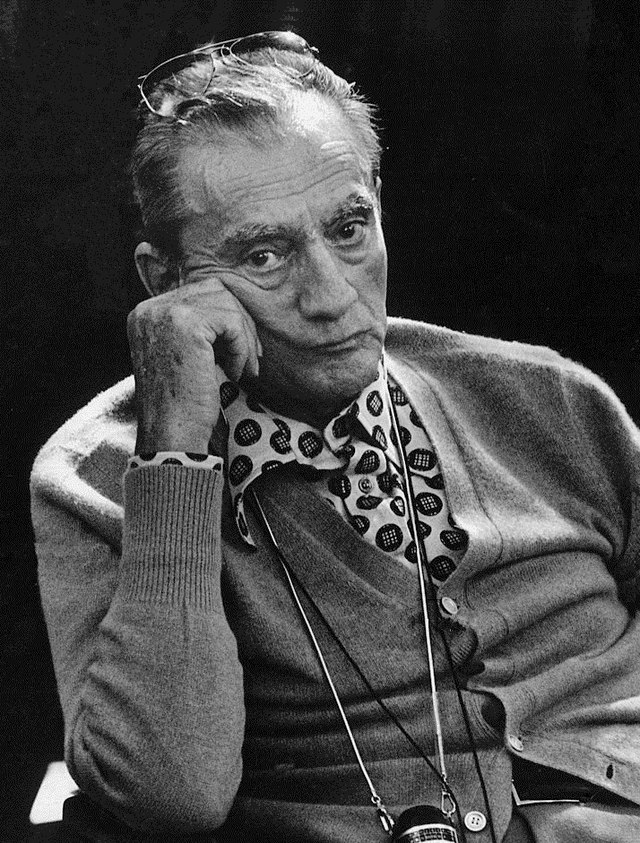
Luchino Visconti, born in Milan in 1906, was a towering figure in the world of cinema, theater, and opera. His life and career are a study in contrasts: aristocratic by birth, yet passionately committed to socialist ideals; a creator of grand, often controversial works that spanned multiple genres; and a man whose personal life was as complex and intense as the stories he brought to life on screen and stage.
Early Life and Aristocratic Roots
Visconti was born into an aristocratic family, which provided him with a privileged upbringing and early exposure to the arts. His childhood was steeped in the cultural richness of Milan, with regular visits to the Teatro alla Scala, where his love for melodrama and theater began to take root. His early education included studies in music, specifically the cello, under the careful guidance of his mother, who played a significant role in shaping his artistic sensibilities.
Despite his noble background, Visconti’s youth was marked by rebellion. He was an unruly student and ran away from both home and school on several occasions. However, he was also an avid reader, and his intellectual curiosity eventually led him to Paris, where he would begin to immerse himself in the world of cinema and theater.
Paris and the Birth of a Filmmaker
In Paris, Visconti’s life took a decisive turn. He was introduced to prominent cultural figures such as André Gide, Jean Cocteau, and Leonard Bernstein, who would influence his artistic development. During this period, he also began experimenting with filmmaking, producing an amateur film in Milan. His passion for cinema was further fueled by his friendship with Coco Chanel, who introduced him to Jean Renoir, one of the great French directors of the time. Visconti became Renoir’s assistant and costume designer, working on the film Une Partie de Campagne (A Day in the Country).
It was also during his time in Paris that Visconti’s ideological leanings began to crystallize. He was drawn to the intellectual circles associated with the Popular Front and the Communist Party, which had a lasting impact on his worldview. These influences would later manifest in his work, particularly in his association with Italian antifascist movements upon his return to Italy.
The Birth of Neorealism: Ossessione and Beyond
Visconti made his directorial debut in 1943 with Ossessione, a film that would come to be seen as a precursor to the Italian Neorealism movement. Ossessione was a stark departure from the sanitized, propagandistic films of the Fascist era, offering instead a gritty, unflinching portrayal of human passion and violence. The film’s raw realism and its focus on the lives of ordinary people were revolutionary at the time, and while it was controversial, it also established Visconti as a formidable new voice in Italian cinema.
Following the success of Ossessione, Visconti continued to explore the themes of class struggle and social injustice in his work. His 1948 film La Terra Trema is perhaps the most radical example of this, blending fiction with documentary-style realism to depict the lives of Sicilian fishermen. Although the film was not commercially successful, it remains a landmark in the history of Italian cinema and a key work in the Neorealist canon.
Theatrical Innovations and Operatic Triumphs
Parallel to his career in cinema, Visconti was also a prolific and innovative theater director. After World War II, he revolutionized Italian theater by introducing a new approach to direction and repertory selection. He favored modern and often controversial works that had previously been neglected by Italian theaters. Notable productions from this period include his 1949 staging of Troilus and Cressida at the Maggio Musicale Fiorentino and his collaborations with iconic actors such as Anna Magnani in Bellissima.
Visconti’s impact on the world of opera was equally profound. His collaboration with Maria Callas in the 1950s led to some of the most celebrated operatic productions of the 20th century, including La Traviata and La Sonnambula. These productions were noted for their meticulous attention to detail and their innovative staging, which brought a new level of psychological depth and dramatic intensity to the operatic form.
The 1960s: Il Gattopardo and Beyond
The 1960s were a particularly fruitful period for Visconti, marked by a series of films that further solidified his reputation as one of the great auteurs of European cinema. Il Gattopardo (The Leopard), released in 1963, is perhaps his most famous work. Based on the novel by Giuseppe Tomasi di Lampedusa, the film is a sweeping historical epic that explores the decline of the Sicilian aristocracy during the Risorgimento. Featuring a star-studded cast including Burt Lancaster, Claudia Cardinale, and Alain Delon, Il Gattopardo was both a critical and commercial success, winning the Palme d’Or at the Cannes Film Festival.
Visconti’s other notable films from this period include Rocco e i Suoi Fratelli (Rocco and His Brothers), a powerful exploration of family dynamics and social dislocation, and Vaghe Stelle dell’Orsa… (Sandra), which won the Golden Lion at the Venice Film Festival. These films continued to explore Visconti’s recurring themes of class conflict, family, and the passage of time.
The German Trilogy: La Caduta degli Dei, Morte a Venezia, and Ludwig
In the late 1960s and early 1970s, Visconti embarked on a project that would come to be known as his “German Trilogy.” These three films—La Caduta degli Dei (The Damned), Morte a Venezia (Death in Venice), and Ludwig—are among his most ambitious and controversial works.
La Caduta degli Dei, released in 1969, is a chilling portrait of a wealthy German family that becomes embroiled in the rise of Nazism. The film’s unflinching depiction of moral decay and political corruption shocked audiences but also earned Visconti widespread acclaim.
Morte a Venezia, released in 1971, is a haunting adaptation of Thomas Mann’s novella about an aging composer who becomes infatuated with a young boy while on vacation in Venice. The film’s exploration of beauty, decay, and the inevitability of death is rendered with Visconti’s characteristic visual sumptuousness and attention to detail.
The trilogy concludes with Ludwig (1973), a sprawling biopic of Ludwig II of Bavaria. The film’s portrayal of the “Mad King” and his descent into isolation and madness is both tragic and deeply sympathetic, reflecting Visconti’s own preoccupations with power, beauty, and the burdens of history.
Personal Life and Legacy
Visconti’s personal life was as dramatic and complex as his films. He was openly gay at a time when homosexuality was still largely taboo, and his relationships often fueled public speculation and gossip. His long-term partnerships with actor Helmut Berger and theater director Franco Zeffirelli were particularly significant, both personally and professionally.
In 1972, Visconti suffered a stroke that left him partially paralyzed. Despite this, he continued to work with undiminished passion, directing Gruppo di Famiglia in un Interno (Conversation Piece) and L’Innocente in the final years of his life. He passed away in 1976, leaving behind a body of work that continues to influence filmmakers, theater directors, and opera producers around the world.
Conclusion: The Enduring Legacy of Luchino Visconti
Luchino Visconti’s legacy is one of artistic brilliance, innovation, and uncompromising vision. His films and theatrical productions are not only masterpieces in their own right but also reflections of the social and political currents of his time. Whether exploring the lives of the aristocracy, the struggles of the working class, or the complexities of human desire, Visconti’s work remains as relevant and powerful today as it was during his lifetime.
His ability to blend the personal with the political, the historical with the contemporary, and the aesthetic with the emotional has ensured that his influence will endure for generations to come. Visconti was not just a filmmaker or a theater director; he was a storyteller of unparalleled depth and sensitivity, whose work continues to captivate and inspire audiences around the world.


