
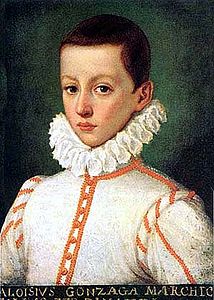
Luigi Gonzaga, known as Saint Aloysius Gonzaga, was born on March 9, 1568, in Castiglione delle Stiviere, a small town in the province of Mantua, Italy. He is one of the most revered saints in the Roman Catholic Church, particularly celebrated for his youthful piety and dedication to the spiritual life. Gonzaga’s life, though brief, was marked by a deep commitment to his faith, which ultimately led him to renounce his noble title and embrace a life of religious devotion. This article delves into the life of Luigi Gonzaga, exploring his early years, spiritual journey, and the legacy he left behind.
Early Life and Noble Heritage
Luigi Gonzaga was born into the illustrious Gonzaga family, a prominent noble house in Renaissance Italy. His father, Ferrante Gonzaga, was the Marquis of Castiglione, and his mother, Marta Tana di Chieri, was a member of the noble Tana family. As the eldest of eight children, Luigi was destined to inherit the title of Marquis, and from a young age, he was educated in the ways of the court and the military, as was customary for young nobles of his time.
At just five years old, Luigi was introduced to the rigors of military life, a path his father envisioned for him. However, it quickly became apparent that Luigi was more inclined toward spiritual pursuits than martial ones. By the age of seven, he experienced what he later described as a profound spiritual conversion. This early awakening marked the beginning of his lifelong devotion to prayer and religious contemplation. Even as a child, Luigi spent hours in prayer, reciting the Seven Penitential Psalms and the Office of the Blessed Virgin Mary daily.
The Turning Point: Spiritual Awakening in Florence
In 1576, when Luigi was eight years old, his life took a significant turn. Due to an outbreak of plague in his family’s lands, his father decided to send Luigi and his younger brother, Rodolfo, to Florence, the capital of the Grand Duchy of Tuscany. There, they were placed under the care of Francesco I de’ Medici, the Grand Duke of Tuscany. The cultural and intellectual environment of the Medici court had a profound impact on Luigi, further deepening his spiritual inclinations.
It was during his time in Florence that Luigi made a vow of perpetual virginity, a commitment that would define the rest of his life. This vow was made in the Basilica of the Santissima Annunziata, a place that held great spiritual significance for Luigi. The decision to dedicate himself entirely to God, even at such a young age, set Luigi apart from his peers and foreshadowed his future path as a Jesuit.
Renouncing Nobility: The Return to Mantua
After three years in Florence, Luigi returned to Mantua, where he made a momentous decision that would shape his destiny. Despite being the heir to the marquisate, Luigi chose to renounce his title and inheritance in favor of his younger brother, Rodolfo. This act of renunciation was not only a rejection of worldly power and wealth but also a clear indication of Luigi’s commitment to a life of spiritual poverty and humility.
In 1580, at the age of 12, Luigi received his First Communion from Saint Charles Borromeo, one of the most influential figures of the Counter-Reformation. This sacrament further solidified his resolve to pursue a religious vocation. Luigi’s spiritual journey was characterized by a deepening of his prayer life, frequent fasting, and the adoption of ascetic practices. His life was one of self-denial and discipline, driven by an intense desire to grow closer to God.
The Jesuit Novitiate: A Life of Study and Service
In 1581, at the age of 13, Luigi was sent to Madrid, Spain, where he served as a page to Prince Diego, the son of King Philip II of Spain. During his time in Madrid, Luigi continued his education, studying logic, philosophy, theology, and mathematics. His academic performance was outstanding, reflecting his keen intellect and dedication to learning.
However, Luigi’s heart was set on a religious vocation, specifically with the Society of Jesus (Jesuits). Despite his father’s initial opposition, Luigi persisted in his desire to join the Jesuits. In 1585, at the age of 17, he officially entered the Jesuit novitiate in Rome. This marked the beginning of a new chapter in his life, one dedicated entirely to spiritual growth, study, and service.
As a novice, Luigi continued to study theology and philosophy while immersing himself in the rigorous spiritual practices of the Jesuits. His time in the novitiate was marked by a deepening of his prayer life and a growing commitment to serving others, particularly the poor and sick. Despite the loss of his father, Ferrante Gonzaga, in 1586, Luigi remained steadfast in his vocation, viewing his father’s death as a call to deepen his commitment to his religious path.
Luigi Gonzaga’s Final Years: Service and Sacrifice
In 1590, after spending time in his family’s home to assist with a succession dispute, Luigi returned to Rome, where he found the city in the grip of a deadly epidemic. Despite the risks to his own health, Luigi devoted himself to caring for the victims of the plague, particularly those who had been abandoned by their families. His work in the hospitals and streets of Rome exemplified his selfless devotion to others, even at the cost of his own life.
Tragically, Luigi contracted the plague himself while caring for a dying man he had found on the streets. Despite receiving the best care available, he succumbed to the disease on June 21, 1591, at the age of 23. His death was a profound loss to the Jesuit community and to all who had witnessed his extraordinary piety and dedication to serving others.
Canonization and Legacy: Saint Aloysius Gonzaga
Luigi Gonzaga’s life and death left an indelible mark on the Catholic Church. His selfless service, deep spirituality, and unwavering commitment to his faith were recognized shortly after his death. In 1605, just 14 years after his passing, he was beatified by Pope Paul V. His canonization followed in 1726 under Pope Benedict XIII, who also declared him the patron saint of youth, a title that reflects his youthful dedication to God.
Saint Aloysius Gonzaga, as he is now known, is celebrated on June 21, the anniversary of his death. He is often depicted in religious iconography holding a crucifix, symbolizing his piety and sacrifice, a lily, representing his innocence, and a skull, a reminder of his premature death. These symbols encapsulate the essence of his life—a life of purity, devotion, and a profound awareness of the fleeting nature of earthly existence.
In addition to being the patron saint of youth, Saint Aloysius Gonzaga is also the patron of students, Jesuit novices, and the sick, particularly those suffering from AIDS. His legacy continues to inspire young people around the world to live lives of service, humility, and faith.
Educational Institutions and Religious Congregations
The legacy of Saint Aloysius Gonzaga extends far beyond his lifetime, with numerous educational institutions and religious congregations named in his honor. In Italy, the Collegio San Luigi in Bologna and the Istituto Gonzaga in Palermo are among the many schools that bear his name. These institutions continue the tradition of academic excellence and spiritual formation that characterized Luigi’s own life.
Beyond Italy, the influence of Saint Aloysius Gonzaga is felt worldwide. The Gonzaga College in Dublin, Gonzaga University in Spokane, Washington, and Gonzaga College High School in Washington, D.C., are just a few examples of the many educational institutions that draw inspiration from his life and teachings. These schools are dedicated to fostering the intellectual and spiritual development of their students, in line with the values that Saint Aloysius exemplified.
Religious congregations dedicated to Saint Aloysius Gonzaga also play a significant role in preserving his legacy. The Fratelli di San Luigi Gonzaga in the Netherlands, the Suore Oblate di San Luigi Gonzaga in Albania, and the Nobili Vergini di Gesù, a community of women founded by Luigi’s nieces in Castiglione delle Stiviere, are just a few of the many religious groups that continue to honor his memory through their work.
Conclusion: The Enduring Relevance of Saint Aloysius Gonzaga
Saint Aloysius Gonzaga’s life, though short, was filled with profound spiritual insight and selfless service. His unwavering commitment to his faith, his dedication to helping others, and his rejection of worldly honors in favor of a life devoted to God make him a timeless example of Christian virtue. As the patron saint of youth, students, and the sick, his legacy continues to inspire people around the world to live lives of faith, service, and humility.
In a world often driven by the pursuit of material success and power, the life of Saint Aloysius Gonzaga serves as a powerful reminder of the importance of spiritual values and the call to serve others. His life story challenges us to consider what truly matters and to seek out ways to make a positive difference in the lives of those around us. Through his example, Saint Aloysius Gonzaga continues to guide and inspire new generations to pursue a life of purpose, grounded in faith and love.


