
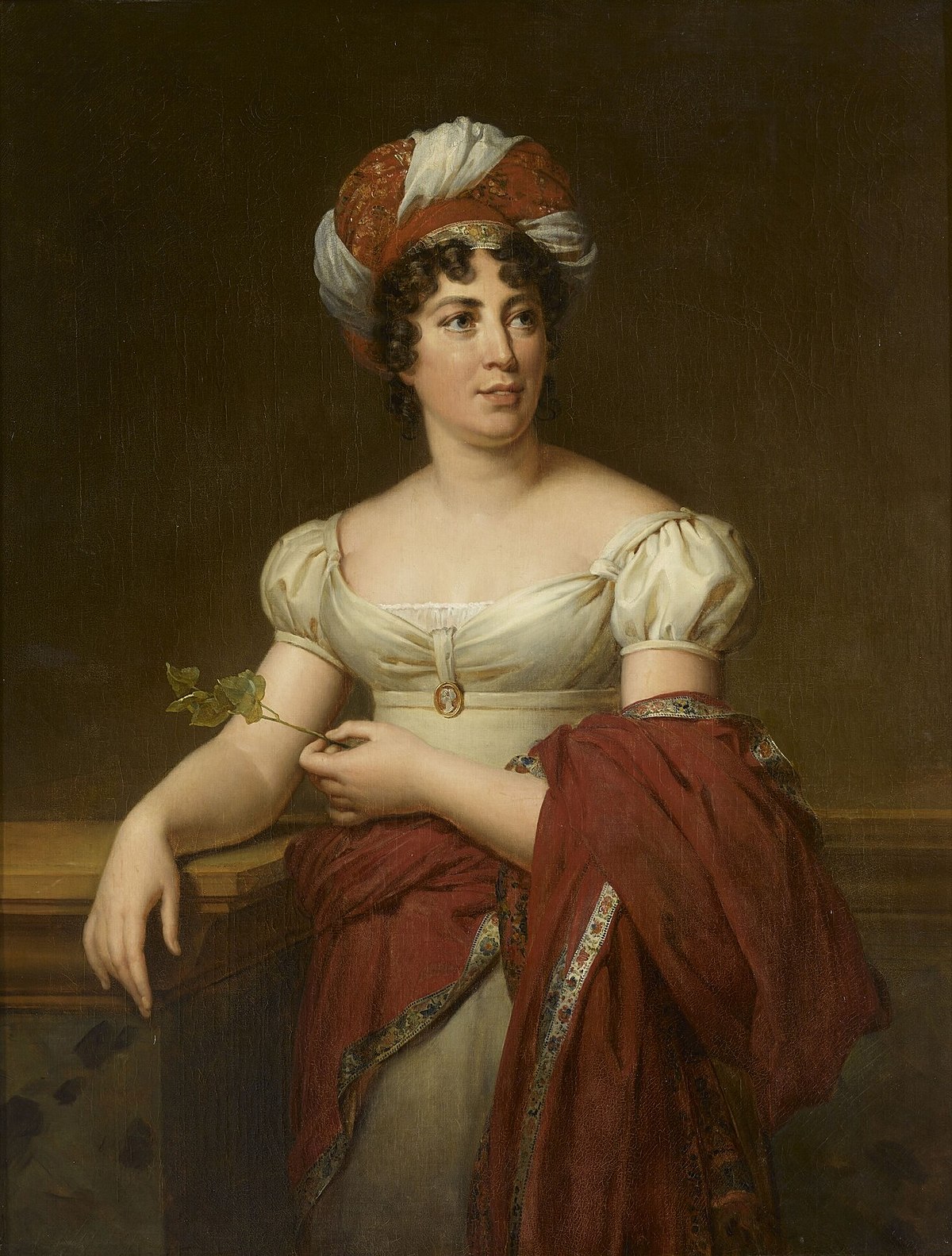
Madame de Staël, born Anne-Louise Germaine Necker on April 22, 1766, in Paris, is a name that resonates with the cultural, intellectual, and political spheres of late 18th and early 19th-century Europe. Her life and work offer a window into the turbulent times of the French Revolution and the Napoleonic era. As a writer, philosopher, and socialite, Madame de Staël was a force of nature, whose influence extended far beyond the borders of France, shaping the intellectual landscape of Europe.
Early Life and Education
Born into an affluent family, Madame de Staël was the daughter of Jacques Necker, a Swiss banker who served as the finance minister for King Louis XVI, and Suzanne Curchod, the daughter of a Protestant pastor. Suzanne was an intellectual force in her own right, having once been romantically involved with the famous British historian Edward Gibbon. Growing up in this intellectually stimulating environment, Anne-Louise was exposed to a world of ideas from a young age.
Her mother’s literary salon, frequented by the leading thinkers of the time, played a crucial role in her education. Here, she was introduced to the works of Rousseau, Voltaire, and other Enlightenment thinkers. This early exposure to literature and philosophy cultivated her passion for learning and set the stage for her future as a writer and thinker.
First Literary Works
At the tender age of 22, in 1788, Madame de Staël published her first work, a series of letters titled “Lettres sur les ouvrages et le caractère de Jean-Jacques Rousseau” (“Letters on the Works and Character of Jean-Jacques Rousseau”). This work demonstrated her intellectual prowess and her deep understanding of Rousseau’s philosophy, marking her entry into the literary world. Her admiration for Rousseau’s ideas, particularly his emphasis on emotion and individual freedom, would later influence her own contributions to Romanticism.
The French Revolution and the Birth of a Salon
The outbreak of the French Revolution in 1789 was a turning point in Madame de Staël’s life. The political upheaval saw her salon in Paris become a hub for intellectual and political discourse. Here, she hosted a mix of politicians, writers, and thinkers who debated the future of France. Her salon became a breeding ground for liberal ideas, where the principles of freedom, equality, and fraternity were passionately discussed.
During this period, she became romantically involved with Benjamin Constant, a Swiss-French political activist and writer. Their relationship was intense and complex, marked by intellectual collaboration and personal turmoil. Constant’s ideas about liberty and representative government deeply influenced Madame de Staël, and together, they advocated for constitutional monarchy and political liberalism.
Exile and Intellectual Growth
Madame de Staël’s outspoken opposition to Napoleon Bonaparte’s authoritarian rule led to her exile in 1800. Forced to leave France, she settled in Coppet, Switzerland, in her family’s château. This period of exile, though challenging, was also one of immense intellectual productivity. The Château de Coppet became the center of a vibrant intellectual community, often referred to as the “Coppet Group.” This group included prominent figures such as the poet Lord Byron, the historian Edward Gibbon, and the economist Jean-Baptiste Say.
In 1800, she completed one of her most significant works, “De la littérature considérée dans ses rapports avec les institutions sociales” (“On Literature Considered in Its Relation to Social Institutions”). In this treatise, she applied Montesquieu’s theories of the influence of climate and geography on societies to literature. She argued that literature is deeply intertwined with the social, political, and cultural institutions of its time, laying the groundwork for what would later be known as the Romantic movement.
Contribution to Romanticism
Madame de Staël’s intellectual journey led her to challenge the classical notion of beauty as a universal, immutable ideal. She argued instead for the relativity of aesthetic values, emphasizing the importance of cultural and historical context in shaping artistic expression. This shift in perspective was crucial in the development of Romanticism, a movement that prioritized emotion, individualism, and the sublime in nature.
Her work “De l’Allemagne” (“On Germany”), published in 1810, was a seminal text that introduced French readers to German Romanticism. This book was an exploration of German culture, philosophy, and literature, and it played a significant role in shaping the Romantic movement in France. Napoleon, recognizing the subversive potential of her ideas, ordered the book to be banned and its copies destroyed. However, it was later published in London, spreading her ideas across Europe.
In “De l’Allemagne,” Madame de Staël praised the German people for their intellectual depth and philosophical rigor. She contrasted this with what she perceived as the superficiality of French culture under Napoleon. Her work celebrated the medieval past, the Christian tradition, and the natural world, elements that would become central themes in Romantic literature.
Travels and Encounters
Madame de Staël’s intellectual curiosity and desire to escape the political constraints of France led her to travel extensively across Europe. Her journeys took her to Germany, where she met and befriended key figures of the Romantic movement, including Goethe, Schiller, and Friedrich Schlegel. These encounters deepened her understanding of Romanticism and solidified her role as a bridge between the intellectual traditions of France and Germany.
In Italy, she engaged with the prominent thinkers of the time, such as Pietro Verri, Ippolito Pindemonte, and Vincenzo Monti. Her interactions with these figures further enriched her intellectual perspective and influenced her later works.
Return to Paris and Final Years
The fall of Napoleon in 1814 allowed Madame de Staël to return to Paris, where she resumed her role as a leading cultural figure. Her return to France marked a period of renewed literary activity. In 1816, she published an influential article in the “Biblioteca Italiana” titled “Sulla maniera e l’utilità delle traduzioni” (“On the Manner and Utility of Translations”). In this article, she argued for the importance of translations in expanding literary horizons and fostering cross-cultural understanding. She criticized the classicists for their adherence to outdated themes and called for a more open and dynamic approach to literature.
Her critique of classicism and advocacy for Romanticism positioned her at the center of the cultural debates of the time. Her ideas sparked a lively controversy, drawing responses from leading intellectuals such as Pietro Giordani, a staunch defender of Italian classicism.
Legacy and Influence
Madame de Staël passed away on July 14, 1817, in Paris, leaving behind a legacy that would continue to influence European thought for generations. Her works, including “Réflexions sur le suicide” (“Reflections on Suicide”) and “Considérations sur les principaux événements de la Révolution française” (“Considerations on the Principal Events of the French Revolution”), offer profound insights into the human condition and the political dynamics of her time.
Her role as a mediator between different intellectual traditions, particularly between French and German thought, was instrumental in shaping the Romantic movement. Moreover, her advocacy for individual freedom, social progress, and the importance of cultural exchange remains relevant to this day.
Madame de Staël’s life was a testament to the power of ideas and the enduring influence of literature and philosophy. She was a pioneer who bridged the Enlightenment and Romanticism, leaving an indelible mark on the cultural and intellectual history of Europe. Her works continue to be studied and admired, not only for their literary merit but also for their profound contributions to the understanding of society, culture, and human nature.
Conclusion
In the grand tapestry of European intellectual history, Madame de Staël stands out as a figure of immense significance. Her life, marked by political exile, intellectual rigor, and a deep commitment to the principles of liberty and cultural exchange, offers rich material for reflection. As we revisit her contributions to literature and philosophy, we are reminded of the enduring relevance of her ideas in today’s world.


