
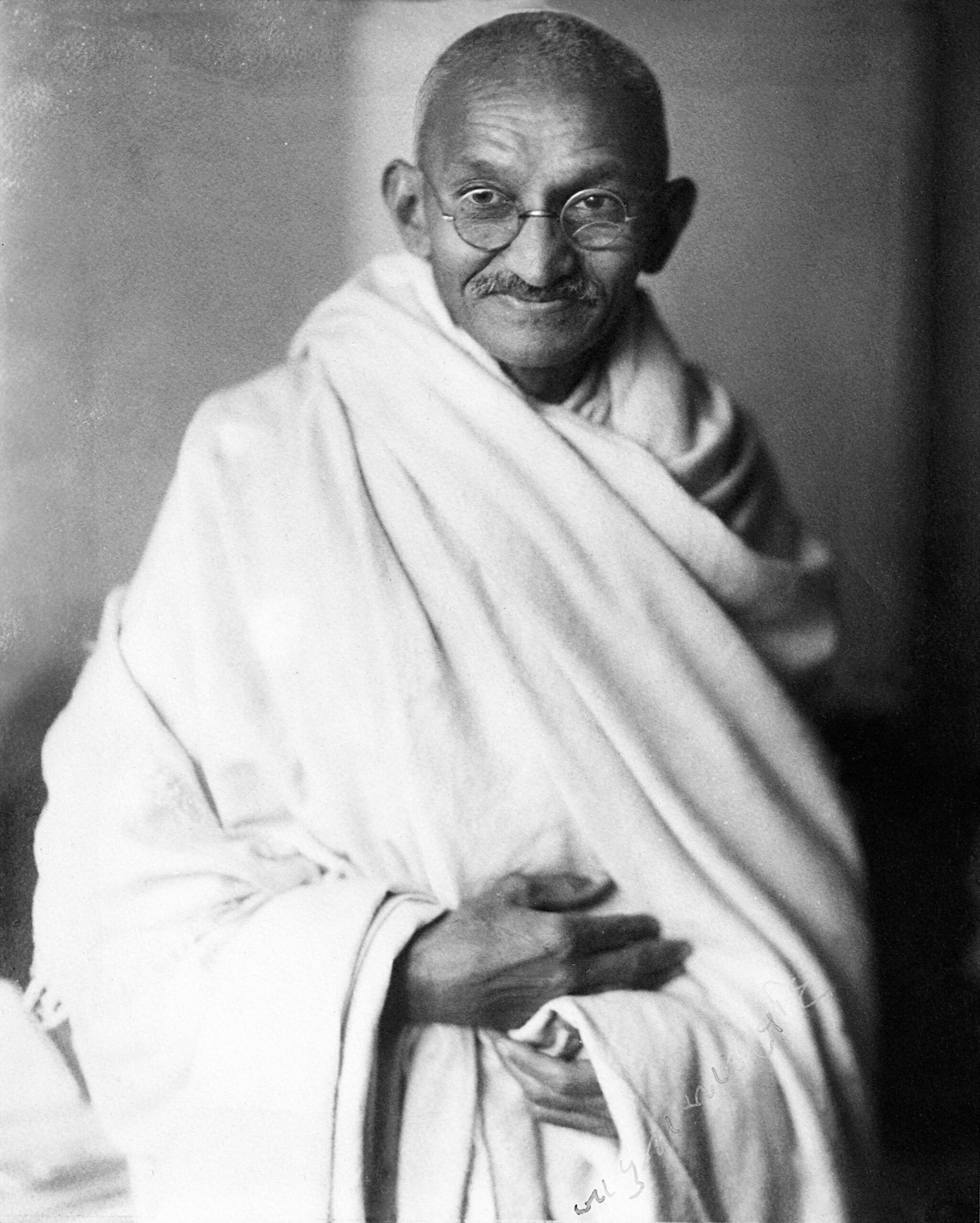
Mahatma Gandhi, a name synonymous with nonviolence and the fight for Indian independence, is one of the most influential figures in modern history. Born Mohandas Karamchand Gandhi on October 2, 1869, in Porbandar, India, Gandhi’s life was a testament to the power of peaceful resistance and the unwavering pursuit of justice. His journey from a modest upbringing to becoming the “Father of the Nation” in India is a tale of determination, sacrifice, and an unyielding commitment to truth.
Early Life and Education
Gandhi was born into a well-off family with strong religious roots. His family was part of the Vaishnava sect of Hinduism, which emphasized devotion to the deity Vishnu. His father, Karamchand Gandhi, held the position of prime minister in the small princely state of Rajkot, which provided young Gandhi with a stable and privileged upbringing.
Gandhi’s early education took place in India, but his academic journey eventually led him to London, where he studied law at University College London. This phase of his life was crucial in shaping his character and beliefs. It was in London that Gandhi first encountered the Western ideals of civil rights and justice, which would later influence his methods of nonviolent resistance.
Legal Career and Awakening in South Africa
After completing his studies, Gandhi returned to India and began practicing law in Bombay (now Mumbai). However, it was not long before he was offered a position as a legal advisor in South Africa, where he would spend 21 years of his life—years that would profoundly change him and set the course for his future activism.
South Africa was where Gandhi first encountered the brutal realities of racial discrimination. The Indian community in South Africa was subjected to severe racial segregation, and Gandhi himself experienced these injustices firsthand. His indignation at the discrimination faced by his fellow Indians led him to initiate a campaign for their rights.
This was the period when Gandhi began to develop and refine his philosophy of Satyagraha, or nonviolent resistance. This concept of “truth-force” or “soul-force” became the cornerstone of his approach to social and political change. Gandhi’s campaigns in South Africa were largely successful, resulting in significant reforms that improved the rights of the Indian community.
Return to India and Leadership in the Independence Movement
In 1915, Gandhi returned to India, where the struggle for independence from British rule was gaining momentum. He quickly rose to prominence as a leader of the Indian National Congress, advocating for the rights of farmers, laborers, and the disenfranchised. Gandhi’s approach to the independence movement was unique—he believed in achieving freedom through nonviolent means.
One of Gandhi’s most notable campaigns was the Non-Cooperation Movement of 1920-1922. This movement urged Indians to withdraw their cooperation with the British government by boycotting British goods, institutions, and honors. It was a massive civil disobedience movement that shook the foundations of British rule in India.
Another pivotal moment in Gandhi’s life was the Salt March of 1930. In defiance of British-imposed taxes on salt, Gandhi led a 240-mile march to the Arabian Sea, where he and his followers made salt from seawater. This act of civil disobedience galvanized the Indian population and attracted global attention to the cause of Indian independence.
Philosophical Beliefs and Influence
Gandhi’s philosophy was deeply rooted in the principles of Ahimsa (nonviolence) and Satyagraha. He believed that nonviolence was not just a tactic but a way of life that required immense courage and self-discipline. For Gandhi, true power lay in the ability to resist oppression without resorting to violence.
His beliefs were influenced by various sources, including Hindu scriptures like the Bhagavad Gita, the teachings of Jesus Christ, and the works of Leo Tolstoy and Henry David Thoreau. Gandhi’s commitment to nonviolence was also linked to his belief in Sarvodaya—the welfare of all. He envisioned an India where all communities lived in harmony, free from poverty and exploitation.
Gandhi’s emphasis on self-reliance and simplicity was evident in his promotion of Khadi (hand-spun cloth) as a symbol of resistance to British industrial goods. He encouraged Indians to spin their own cloth as a means of economic independence and to reject foreign products.
Challenges and Controversies
Despite his widespread influence, Gandhi’s methods and ideas were not without controversy. His insistence on nonviolence in the face of brutal repression often drew criticism from more militant factions within the independence movement. Figures like Subhas Chandra Bose advocated for a more aggressive approach, arguing that Gandhi’s methods were too passive.
Gandhi’s role during the partition of India in 1947 also remains a subject of debate. The partition led to the creation of two separate states, India and Pakistan, and resulted in one of the largest and most violent mass migrations in history. Gandhi’s attempts to quell the violence and his efforts to promote Hindu-Muslim unity were met with mixed reactions. While some praised his efforts, others blamed him for the bloodshed that followed.
Assassination and Legacy
On January 30, 1948, Gandhi’s life was tragically cut short when he was assassinated by Nathuram Godse, a Hindu nationalist who opposed Gandhi’s perceived leniency towards Muslims. Gandhi’s death was a significant loss to India and the world, but his legacy lives on.
Gandhi’s influence extends far beyond India. His philosophy of nonviolence inspired civil rights movements across the globe, including the American civil rights movement led by Martin Luther King Jr., and the anti-apartheid struggle in South Africa led by Nelson Mandela. His life and work have left an indelible mark on history, making him a global symbol of peace and justice.
Historical Context and Influence on Modern Movements
To fully appreciate Gandhi’s impact, it is essential to understand the historical context in which he operated. The late 19th and early 20th centuries were marked by the rise of nationalist movements worldwide, as colonized peoples sought to reclaim their sovereignty. Gandhi’s approach to Indian nationalism was distinctive because it rejected both the violent methods employed by some revolutionaries and the accommodationist strategies of other leaders.
Gandhi’s influence is also evident in the global spread of nonviolent resistance as a strategy for social and political change. His methods have been adapted and applied in various contexts, from the civil rights movement in the United States to the struggle against apartheid in South Africa. The principles of Satyagraha continue to inspire activists and movements advocating for justice, equality, and human rights worldwide.
Gandhi’s Personal Life and Human Side
While Gandhi is often revered as a saintly figure, he was also a man with personal struggles and contradictions. His commitment to celibacy, simplicity, and self-discipline was part of his broader spiritual journey, but it also placed significant strains on his relationships with his family. Gandhi’s experiments with diet, health, and spirituality were often unconventional, reflecting his quest for self-mastery.
Gandhi’s writings, letters, and speeches provide valuable insights into his thoughts and motivations. His autobiography, “The Story of My Experiments with Truth,” offers a candid account of his life, including his moral dilemmas, failures, and triumphs. This personal narrative is essential for understanding the man behind the Mahatma, his evolution as a leader, and the inner conflicts that shaped his philosophy.
Conclusion: The Enduring Legacy of Mahatma Gandhi
Mahatma Gandhi’s life is a testament to the power of nonviolence, truth, and the human spirit’s capacity for resilience and compassion. His contributions to India’s independence, his advocacy for social justice, and his influence on global movements for civil rights and freedom have cemented his place as one of the most important figures of the 20th century.
Gandhi’s legacy is not just a historical artifact but a living philosophy that continues to inspire and challenge us today. His teachings remind us that the struggle for justice requires not just courage and conviction but also a deep commitment to the principles of nonviolence, truth, and the welfare of all humanity.


