
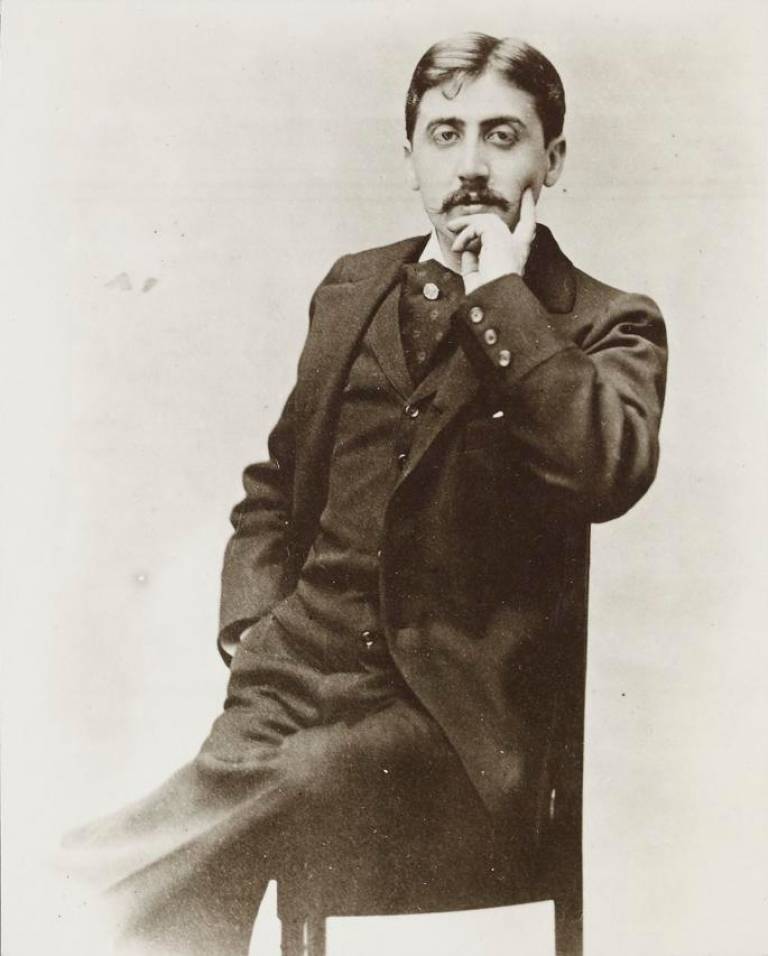
Marcel Proust, born on July 10, 1871, in Auteuil, a suburb of Paris, is one of the most significant literary figures of the 20th century. His monumental work, “À la recherche du temps perdu” (In Search of Lost Time), has secured his place in the pantheon of great writers. Proust’s life, like his work, was characterized by deep introspection, profound sensitivity, and an acute awareness of the passing of time. His literary achievements, combined with his complex personal life, make him a fascinating figure whose influence continues to resonate in the literary world today.
Early Life and Education
Marcel Proust was born into an affluent Parisian family. His father, Adrien Proust, was a prominent physician renowned for his work in epidemiology, while his mother, Jeanne Weil, was the daughter of a wealthy Jewish stockbroker. The cultural and intellectual environment in which Proust was raised played a significant role in shaping his literary sensibilities. From an early age, he was exposed to the arts, literature, and the refined society of Parisian high culture.
Proust’s childhood was marked by illness. He suffered from severe asthma, a condition that plagued him throughout his life. This fragile health led to a cloistered lifestyle, often preventing him from engaging in the outdoor activities typical of children his age. Instead, he turned inward, developing a rich inner world fueled by reading and reflection.
He attended the Lycée Condorcet, one of Paris’s most prestigious schools, where he formed friendships with the sons of influential families. These connections provided Proust with access to the elite social circles of Paris, which would later become the setting for much of his literary work. Despite his delicate health, Proust was a brilliant student, particularly in literature, where he began to show signs of the extraordinary talent that would later define his career.
Early Literary Endeavors and Social Life
Proust’s entry into the literary world began during his school years. In 1892, he became involved with the literary magazine Le Banquet, founded by his friends Jacques Bizet, Daniel Halévy, and Léon Blum. His contributions to this magazine, as well as his early essays and short stories, showcased his burgeoning talent and his fascination with the themes of memory, time, and social observation.
During this period, Proust also developed a deep interest in Parisian high society. Despite his reserved nature, he was drawn to the salons of the Parisian elite, where he mingled with artists, writers, and aristocrats. Proust had a remarkable ability to charm these gatherings with his wit and insights, and he quickly became a fixture in these social circles. His experiences in these salons provided him with a wealth of material for his later works, particularly his detailed observations of the intricacies of social interactions.
One of the most significant influences on Proust during this time was his encounter with the French composer Reynaldo Hahn. Their relationship, both personal and intellectual, was pivotal in Proust’s development as a writer. Hahn introduced Proust to many of the artistic and intellectual figures of the time, further expanding his social and cultural horizons.
The Dreyfus Affair and Literary Maturity
The Dreyfus Affair, a political scandal that divided France in the late 19th and early 20th centuries, was a turning point in Proust’s life. Captain Alfred Dreyfus, a Jewish officer in the French army, was falsely accused of treason, leading to a widespread national controversy. Proust, who was deeply affected by the anti-Semitism and injustice of the case, became an ardent supporter of Dreyfus.
This period marked a shift in Proust’s literary focus. He began to engage more directly with social and political issues, and his writing took on a more serious and reflective tone. In 1896, he published his first book, Les Plaisirs et les Jours (Pleasures and Days), a collection of short stories and essays that was well-received but did not achieve significant commercial success. The book was notable for its exploration of themes that would later dominate Proust’s work: the passage of time, the complexity of human relationships, and the interplay between memory and identity.
Proust’s engagement with the Dreyfus Affair also solidified his position within the French intellectual community. He counted among his friends and allies prominent figures like Anatole France and Émile Zola, both of whom were vocal supporters of Dreyfus. This involvement in a major national controversy helped to shape Proust’s understanding of the complexities of human nature, which would become a central theme in his later work.
The Genesis of “In Search of Lost Time”
The early 1900s were a period of profound personal and professional development for Proust. Following the deaths of his father in 1903 and his beloved mother in 1905, Proust’s health declined further, and he began to withdraw from the social life that had previously occupied much of his time. This period of seclusion was crucial in the genesis of his magnum opus, “À la recherche du temps perdu” (In Search of Lost Time).
Proust moved to a new apartment on Boulevard Haussmann in Paris, where he had his bedroom lined with cork to block out noise. It was in this self-imposed isolation that he began the monumental task of writing his seven-volume novel, a work that would take him the rest of his life to complete. “In Search of Lost Time” is a deeply introspective exploration of memory, time, and the nature of human experience. It is widely regarded as one of the greatest literary works of the 20th century.
The novel is not merely a reflection of Proust’s own experiences but a profound investigation into the ways in which time and memory shape our perceptions of the world. Through the character of the narrator, who is often seen as a stand-in for Proust himself, the novel delves into the intricate connections between past and present, and the elusive nature of reality as filtered through human consciousness.
Literary Fame and Later Life
The publication of the first volume of “In Search of Lost Time,” titled Du côté de chez Swann (Swann’s Way), in 1913, marked the beginning of Proust’s rise to literary fame. The novel was initially published at Proust’s own expense after being rejected by several publishers, including the prestigious Nouvelle Revue Française. However, it quickly garnered critical acclaim, and Proust’s reputation as a literary genius began to solidify.
Over the next few years, Proust continued to work on the subsequent volumes of his novel, even as his health deteriorated. The outbreak of World War I in 1914 further isolated Proust, but he remained dedicated to his writing. His brother, Robert, served as a doctor on the front lines, adding to the personal toll that the war took on Proust.
Despite these challenges, Proust’s literary output during this time was prolific. In 1919, he was awarded the prestigious Prix Goncourt for the second volume of “In Search of Lost Time,” À l’ombre des jeunes filles en fleurs (In the Shadow of Young Girls in Flower). This recognition brought him greater fame and solidified his place in the French literary canon.
As Proust’s health continued to decline, he became increasingly reclusive. He spent the last years of his life largely confined to his cork-lined room, where he continued to write and revise the later volumes of his novel. The final volume, Le Temps retrouvé (Time Regained), was published posthumously in 1927, five years after Proust’s death.
Historical Context and Influence
Marcel Proust’s life and work must be understood within the broader context of the cultural and intellectual currents of late 19th and early 20th century France. This was a period marked by rapid social and technological change, as well as significant political upheaval. The rise of modernism in literature and the arts was a response to these changes, and Proust’s work is often seen as a key contribution to this movement.
Proust’s exploration of memory and time was deeply influenced by the philosophical ideas of his era, particularly those of Henri Bergson, whose concept of la durée (duration) had a profound impact on Proust’s understanding of time as a fluid, subjective experience rather than a fixed, linear progression. This philosophical approach is evident throughout “In Search of Lost Time,” where the boundaries between past and present are constantly blurred, and memories are experienced as living, dynamic phenomena.
Proust’s work also reflects the social realities of his time, particularly the rigid class structures and the complexities of social life in the Belle Époque. His detailed depictions of Parisian society, with its salons, aristocrats, and artists, provide a rich tapestry of the cultural life of the time. Yet, his work transcends its historical context, addressing universal themes that continue to resonate with readers today.
SEO Considerations and Keyword Usage
To optimize content about Marcel Proust for search engines, it is essential to incorporate relevant keywords that align with user search intent. Phrases such as “Marcel Proust biography,” “In Search of Lost Time summary,” “Proust’s literary influence,” and “Proust’s exploration of memory” should be strategically included throughout the article. Additionally, variations like “Proust’s life and works,” “Proust’s impact on modern literature,” and “analysis of In Search of Lost Time” can help capture a broader audience.
Maintaining a balanced keyword density is crucial for SEO success. Keywords should be integrated naturally into the content to ensure readability and engagement while optimizing for search engine algorithms. Overuse of keywords can lead to keyword stuffing, which can negatively impact the article’s ranking on search engine results pages (SERPs). Therefore, a thoughtful approach to keyword usage is necessary to achieve the best results.
Conclusion
Marcel Proust’s contribution to literature is unparalleled. His magnum opus, “In Search of Lost Time,” is not just a novel but a profound meditation on time, memory, and the essence of human experience. Proust’s ability to capture the subtleties of emotion and the complexities of social interaction has made his work a touchstone for literary scholars and enthusiasts alike.
Though his life was marked by illness and seclusion, Proust’s intellectual and creative vigor never waned. His work continues to influence writers, philosophers, and thinkers across the globe. As readers delve into the intricacies of Proust’s prose, they are reminded of the power of literature to explore the deepest corners of the human psyche.
Proust’s legacy is one of introspection, artistic innovation, and an unyielding commitment to capturing the ephemeral nature of life. His work stands as a testament to the enduring power of memory and the written word, ensuring his place as one of the greatest literary figures of all time.


