
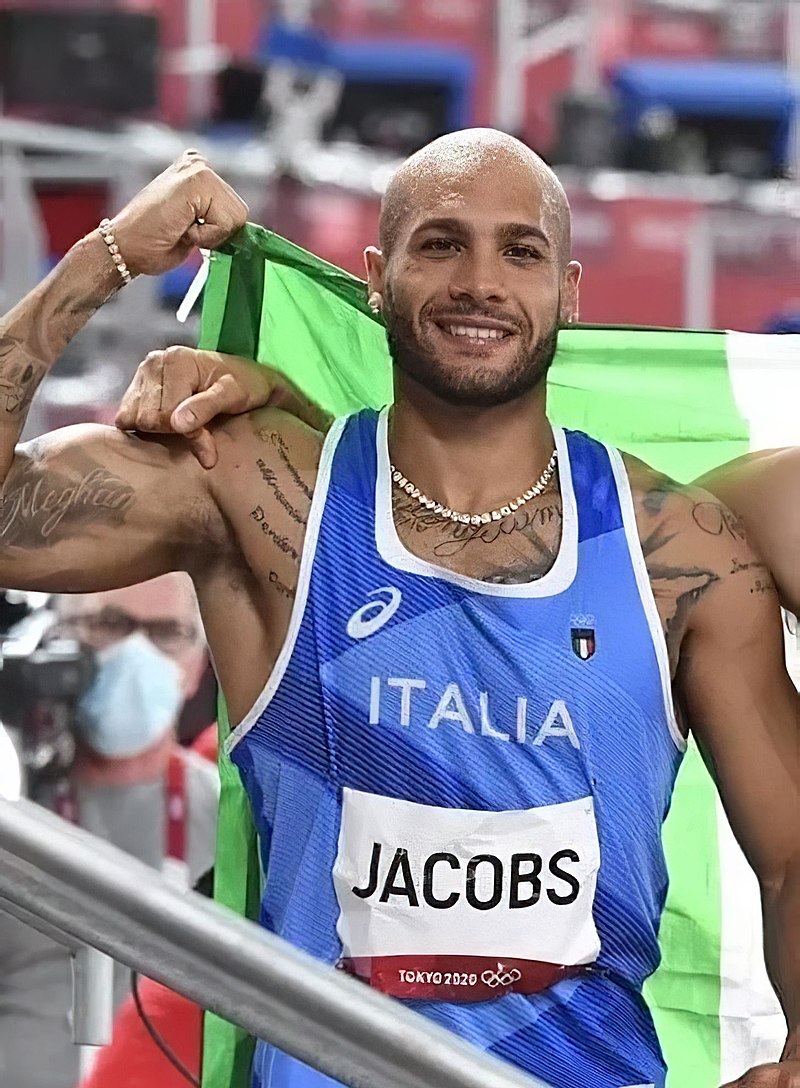
Marcell Jacobs, born Lamont Marcell Jacobs on September 26, 1994, in El Paso, Texas, has emerged as one of the most significant figures in the world of athletics. Known for his incredible speed and agility, Jacobs has cemented his legacy by winning the gold medal in the 100 meters at the 2021 Tokyo Olympics, a victory that not only marked a historic moment for Italian sports but also catapulted him to global fame. This article provides a comprehensive look into Marcell Jacobs’ life, from his early years to his rise to stardom, and explores the highlights that have defined his illustrious career.
Early Life and Background
Marcell Jacobs was born to a Texan father, who served in the U.S. military, and an Italian mother, Viviana Masini. Shortly after his birth, his father was stationed in South Korea, a move that led Jacobs’ mother to relocate with her newborn son to Desenzano del Garda in Italy, where Jacobs would grow up. This early separation from his father had a profound impact on Jacobs, but it also solidified his bond with his mother, who played a pivotal role in his upbringing.
Growing up in Italy, Jacobs showed a natural inclination toward sports from a young age. At just ten years old, he began participating in athletics, initially focusing on sprinting. His early interest in speed was apparent, but it wasn’t until his teenage years that he began to seriously consider a career in athletics.
The Journey into Athletics
Jacobs’ journey in athletics officially began when he started competing in local track and field events. However, it was not sprinting that first brought him into the spotlight. Instead, Jacobs initially found success in the long jump. In 2013, he set the Italian junior indoor record in the long jump with a distance of 7.75 meters, breaking a record that had stood since 1976. This achievement marked him as a rising star in Italian athletics.
Two years later, in 2015, Jacobs further improved his personal best in the indoor long jump with a leap of 8.03 meters, tying with the fourth-best Italian performance of all time. Despite this success, Jacobs faced significant challenges, including a major injury that forced him to rethink his athletic career. In 2015, he suffered a severe quadriceps injury that sidelined him for almost a year. This setback led Jacobs to shift his focus from the long jump to sprinting, a decision that would ultimately change the course of his career.
Overcoming Adversity: The Shift to Sprinting
The transition from long jump to sprinting was not without its difficulties. Jacobs’ decision to focus on sprinting came after a series of injuries that had hampered his progress in the long jump. In 2016, he started working with coach Paolo Camossi, a former world indoor champion in the triple jump, who played a crucial role in Jacobs’ development as a sprinter.
Under Camossi’s guidance, Jacobs quickly began to make a name for himself in the sprinting world. In 2016, he recorded a wind-assisted long jump of 8.48 meters at the Italian U23 Championships in Bressanone, the best jump ever by an Italian, although it could not be ratified as a national record due to excessive wind assistance. This performance demonstrated Jacobs’ raw athletic ability and hinted at his potential as a sprinter.
In the years that followed, Jacobs continued to improve his sprinting times, consistently lowering his personal best in the 100 meters. By 2018, he had clocked a time of 10.03 seconds in the 100 meters at the Città di Padova meeting, making him the third-fastest Italian sprinter of all time, behind only Filippo Tortu and the legendary Pietro Mennea. His performances earned him a spot on the Italian team for the 2019 World Championships in Doha, where he ran 10.07 seconds in the heats.
The Breakthrough: 2021 – A Year of Triumph
The year 2021 proved to be a turning point in Marcell Jacobs’ career. In March of that year, he won the gold medal in the 60 meters at the European Indoor Championships in Toruń, Poland, setting a new Italian record with a time of 6.47 seconds, which was also the world’s fastest time that year.
Just two months later, at the Savona meeting, Jacobs broke the 10-second barrier in the 100 meters, clocking 9.95 seconds to set a new Italian record. This performance solidified his status as one of the fastest sprinters in the world and set the stage for his historic performance at the Tokyo Olympics.
At the Tokyo 2020 Olympics, postponed to 2021 due to the COVID-19 pandemic, Jacobs made history. In the 100-meter heats, he broke his own Italian record, running 9.94 seconds. In the semifinals, he further lowered the national record to 9.84 seconds, becoming the first Italian to qualify for the 100-meter final at the Olympics. But it was in the final that Jacobs truly shocked the world.
Running a time of 9.80 seconds, Jacobs won the gold medal in the 100 meters, becoming the first Italian and the first European since 1992 to win the Olympic title in this event. His victory was celebrated around the globe, and he was hailed as the new “fastest man on the planet,” a title previously held by the legendary Usain Bolt.
Just days after his individual triumph, Jacobs anchored the Italian 4×100 meter relay team to victory, securing his second gold medal of the Games. The team, consisting of Lorenzo Patta, Fausto Desalu, Filippo Tortu, and Jacobs, set a new national record with a time of 37.50 seconds, completing an extraordinary Olympic campaign for Jacobs.
Personal Life and Beyond the Track
Away from the track, Marcell Jacobs is a devoted family man. He is the father of three children: Jeremy, born from a previous relationship when Jacobs was just 19, and Anthony and Megan, born from his relationship with Nicole Daza. Jacobs and Daza married in September 2022, solidifying their partnership both on and off the track.
Jacobs’ life has been shaped by his early experiences, including his complex relationship with his father, from whom he was estranged for much of his life. In recent years, Jacobs has spoken publicly about reconnecting with his father and the impact this has had on his life and career.
In addition to his athletic pursuits, Jacobs has also ventured into the literary world. In May 2022, he published his autobiography, Flash: La mia storia (“Flash: My Story”), in which he recounts his journey from a young boy in Desenzano del Garda to becoming an Olympic champion. The book provides an intimate look at the challenges and triumphs that have defined his life and offers inspiration to those who face adversity in their own lives.
The Challenges of 2022 and Beyond
Following his triumphs in 2021, Jacobs faced a challenging period in 2022. After a series of injuries, he was forced to miss several key competitions, including the European Championships in Munich. However, Jacobs made a triumphant return to the track later that year, winning the gold medal in the 100 meters at the European Championships, once again proving his resilience and determination.
In 2023, Jacobs faced further challenges as he struggled with injuries and form. Although his performances in the 100 meters were not up to his usual standard, he redeemed himself by helping the Italian 4×100 meter relay team win a silver medal at the World Championships in Budapest. This performance demonstrated Jacobs’ ability to rise to the occasion, even in the face of adversity.
In September 2023, Jacobs made a significant decision to part ways with his long-time coach Paolo Camossi. This decision was met with controversy in Italy, particularly because Jacobs chose to train under American coach Rana Reider, a figure who had been involved in several scandals, including a doping case and allegations of misconduct. Despite the controversy, Jacobs moved to Florida to train with Reider, a move that he hopes will help him regain his form ahead of the 2024 Paris Olympics.
The Road to Paris 2024
As Jacobs looks ahead to the Paris 2024 Olympics, he remains focused on regaining his status as the world’s fastest man. In June 2024, he competed at the European Championships in Rome, where he won the 100 meters with a time of 10.02 seconds, once again proving that he is a force to be reckoned with on the track. He also helped Italy secure another gold medal in the 4×100 meter relay, dominating the competition.
With the Paris Olympics just weeks away, Jacobs is determined to defend his Olympic title in the 100 meters and lead Italy to victory in the 4×100 meter relay. His journey from a young boy in Desenzano del Garda to an Olympic champion is a testament to his perseverance, resilience, and unwavering commitment to excellence.
Conclusion: The Legacy of Marcell Jacobs
Marcell Jacobs’ story is one of triumph over adversity, of a young man who overcame personal and physical challenges to become the fastest man in the world. His achievements on the track have made him a national hero in Italy and a global icon in the world of athletics.
As he continues to compete at the highest level, Jacobs remains focused on his goals, driven by the desire to inspire others and leave a lasting legacy in the sport. Whether he is winning gold medals or overcoming setbacks, Marcell Jacobs embodies the spirit of a true champion.


