
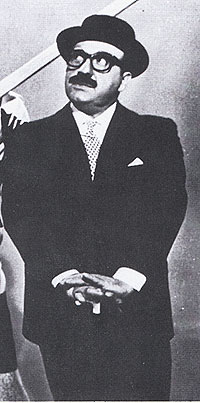
Marcello Marchesi, born on April 4, 1912, in Milan, Italy, was an influential figure in the Italian entertainment industry. Known for his multifaceted talents as a comedian, journalist, screenwriter, director, lyricist, and copywriter, Marchesi’s career spanned several decades and mediums, leaving an indelible mark on Italian culture. This article explores the life and legacy of Marcello Marchesi, providing insights into his rise to fame, significant achievements, and the impact he had on the Italian media landscape.
Early Life and Education
Marcello Marchesi’s early life was shaped by an unconventional family background. He was the product of an extramarital affair between his mother, Enrica Volpi, and a well-known Milanese lawyer. Despite these circumstances, Marchesi was raised in a large family, with five older siblings. His upbringing in Rome, where he was sent to live with his uncle Guido, played a crucial role in his development. Marchesi would later reflect on this period in his semi-autobiographical novel “Le Sette Zie” (“The Seven Aunts”), which offers a glimpse into his childhood and the influences that shaped him.
Marchesi’s educational journey was marked by academic excellence. He pursued a degree in law, graduating with top honors. However, his true passion lay in the world of entertainment, particularly in theater and journalism. It was during his university years that Marchesi’s creative talents began to emerge. He wrote and performed in student plays, one of which caught the attention of Andrea Rizzoli, the editor of the humor magazine “Il Bertoldo.” This encounter would set the stage for Marchesi’s future career in media and entertainment.
The Dawn of a Career: Journalism and Radio
Marchesi’s entry into the world of journalism began with his work at “Il Bertoldo,” where he collaborated with other literary figures such as Giovannino Guareschi, Carlo Manzoni, and his close friend Vittorio Metz. These early experiences honed Marchesi’s skills as a humorist and cultural commentator, setting the tone for his later work in various media.
In the 1930s, Marchesi expanded his horizons by venturing into radio, a medium that was rapidly gaining popularity in Italy and around the world. He wrote scripts for several radio programs, including “AZ Radio Enciclopedia” in 1937 and “Cinquemilalire per un Sorriso” in 1939, the latter hosted by the famous Corrado Mantoni. These programs showcased Marchesi’s versatility, as he seamlessly moved between educational content and entertainment, all while maintaining his signature wit and charm.
Marchesi’s involvement in radio not only solidified his reputation as a talented writer but also allowed him to reach a broader audience. Radio was the dominant medium of the time, and Marchesi’s work contributed to the shaping of Italian popular culture during this era.
World War II and the Post-War Era
The outbreak of World War II marked a significant turning point in Marchesi’s life. He served in the Italian military during the North African Campaign and was injured during the Battle of El Alamein. Despite suffering from a severe back injury that affected his lung, Marchesi’s resilience saw him return to civilian life with renewed vigor.
After the war, Marchesi continued to build his career, this time focusing on theater. He became a prominent figure in the “teatro di rivista” (revue theater), a popular form of entertainment in post-war Italy that combined comedy, music, and satire. Marchesi wrote and directed numerous successful productions, working with some of Italy’s most beloved performers, including Carlo Dapporto, Walter Chiari, Ugo Tognazzi, Gino Bramieri, Wanda Osiris, and Alberto Sordi. His collaborations with these actors helped shape the post-war Italian theater scene, and his influence extended beyond the stage to other forms of entertainment.
The Golden Age of Italian Television
The 1950s and 1960s were transformative years for Marcello Marchesi, as he transitioned into the burgeoning world of Italian television. The launch of RAI, Italy’s national public broadcasting company, in 1954, provided Marchesi with new opportunities to showcase his talents to an even wider audience.
Marchesi’s contributions to television were significant, particularly in the realm of variety shows and entertainment programs. He was instrumental in the creation and success of several iconic television shows, including “L’Uomo di Mezza Età” (“The Middle-Aged Man”), “Ti Conosco Mascherina” (“I Know You, Little Mask”), and “La Prova del Nove” (“The Acid Test”). However, it was his work on “Canzonissima,” one of Italy’s most popular variety shows, that truly cemented his legacy in Italian television history.
“Canzonissima,” which aired from 1956 to 1975, was a groundbreaking show that combined musical performances with comedy sketches and a song competition, all tied to the highly anticipated Lotteria Italia, a national lottery drawn on New Year’s Eve. Marchesi’s innovative approach to the show’s format, blending entertainment with suspense, made “Canzonissima” a staple of Italian television, attracting millions of viewers each year.
In addition to his work on television, Marchesi continued to write prolifically during this period. He authored several books, including the critically acclaimed trilogy “Essere o Benessere” (“To Be or To Well-Being”) in 1962, “Diario Futile di un Signore di Mezza Età” (“Futile Diary of a Middle-Aged Man”) in 1963, and “Il Sadico del Villaggio” (“The Sadist of the Village”) in 1964. These works, which blended humor with social commentary, further established Marchesi as a leading intellectual figure of his time.
Personal Life and Later Years
Marchesi’s personal life was as eventful as his professional career. In 1948, he married Olga Barberis, whom he affectionately nicknamed “Aloha.” The couple moved back to Milan, where they built a life together, with Marchesi continuing to work in both Rome and Milan. However, their marriage eventually ended in the late 1960s, prompting Marchesi to return to Rome.
In the later years of his life, Marchesi experienced a resurgence in his literary pursuits. His final novel, “Le Sette Zie,” published in 1977, was a reflective and autobiographical work that offered readers a glimpse into his early life and the experiences that shaped him. The novel was well-received, and it remains a testament to Marchesi’s enduring literary talent.
During this period, Marchesi also experienced a new chapter in his personal life. He fell in love with Enrica Sisti, a woman much younger than himself, and the couple married in 1976. Together, they had a son, Massimo, who was born shortly before Marchesi’s untimely death.
Tragically, Marcello Marchesi’s life was cut short on June 19, 1978, when he was struck by a rogue wave while swimming in the sea near San Giovanni di Sinis, Sardinia. He was 66 years old. His death was a significant loss to the Italian entertainment industry, but his legacy lived on through the countless works he left behind.
The Legacy of Marcello Marchesi
Marcello Marchesi’s contributions to Italian culture are vast and varied. He was a pioneer in multiple fields, from journalism and radio to theater and television. His ability to blend humor with social critique made him a unique and influential voice in 20th-century Italian media. Marchesi’s work as a copywriter also left a lasting impact, with many of his slogans and commercials becoming iconic in Italian advertising history.
As a television innovator, Marchesi played a crucial role in shaping the landscape of Italian entertainment during the golden age of television. His shows captivated audiences and set new standards for variety programming, influencing generations of television producers and entertainers.
In literature, Marchesi’s novels and essays continue to be appreciated for their wit, insight, and reflection of Italian society. His writing offers a window into the cultural and social changes that Italy underwent during his lifetime, making his works not only entertaining but also historically significant.
Marcello Marchesi’s life and career were characterized by a relentless pursuit of creativity and innovation. He was a true Renaissance man, whose talents spanned multiple disciplines, and his influence can still be felt in Italian culture today. As we look back on his life, it is clear that Marcello Marchesi was not just a figure of his time, but a timeless icon whose work will continue to inspire and entertain for generations to come.


