
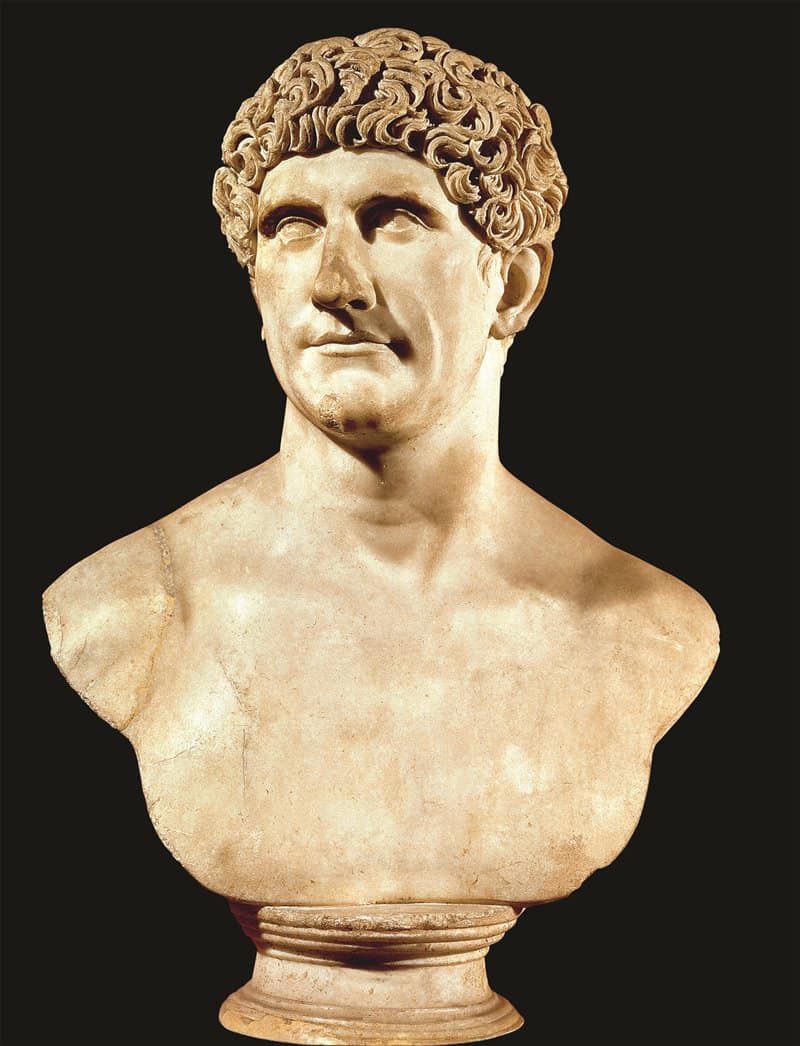
Marco Antonio, also known as Mark Antony, was a significant figure in Roman history whose life was marked by power, intrigue, and romance. Born on January 14, 83 B.C., in Rome, and dying on August 1, 30 B.C., in Alexandria, Egypt, his story is one of the most captivating tales from the ancient world. He was a man who rose to great heights in the Roman Republic, both as a military leader and as a politician, before his tragic downfall, largely influenced by his love affair with Cleopatra. This article delves into the life of Marco Antonio, exploring his early years, military achievements, political career, and his infamous relationship with Cleopatra, all while considering the broader historical context in which he lived.
Early Life and Background
Marco Antonio was born into a prestigious Roman family, part of the nobilitas, which was the class of Roman aristocrats who had reached the highest offices in the Republic. His grandfather had been a consul, one of the highest political offices in Rome, which gave the Antonio family significant status. However, his early life was not without hardship. After becoming an orphan at a young age, he was not adopted by his stepfather, which led to his social status being reduced to that of an equites or knight, a lower tier of Roman aristocracy.
During his youth, Marco Antonio was known for his indulgent lifestyle, marked by excessive drinking, gambling, and other forms of debauchery. These behaviors were common among the Roman elite, but they did little to enhance his reputation. It was only when he traveled to Greece that his life began to change direction. In Greece, he studied rhetoric and became a skilled orator, following the Asiatic style of speech, which was characterized by its florid and elaborate nature. This training would serve him well in his later political career.
Rise to Power and Military Glory
Marco Antonio’s rise to prominence began when he joined the military campaigns of the Roman Republic. In 54 B.C., he became a lieutenant to Julius Caesar during the conquest of Gaul, which is present-day France and Belgium. Serving under Caesar for ten years, Antonio proved himself to be a capable and courageous military leader. His bravery was particularly noted during the campaign against the Gallic leader Vercingetorix, where he distinguished himself in battle.
In 50 B.C., Marco Antonio was elected as a tribune of the plebs, a crucial political office that gave him significant influence over the Roman Senate and the power to veto its decisions. His close alliance with Julius Caesar further solidified his position. When the Senate, under the influence of Pompey, opposed Caesar’s return to Rome, it was Antonio who vetoed the Senate’s orders, leading to his expulsion from the Curia and his subsequent decision to join Caesar.
Marco Antonio’s loyalty to Caesar was unwavering. He fought alongside him in the decisive Battle of Pharsalus in 48 B.C., where Caesar defeated Pompey and solidified his control over the Roman Republic. After Caesar became dictator, Antonio was appointed as his magister equitum, or Master of the Horse, effectively making him the second-in-command of both the military and internal affairs of the Republic.
The Aftermath of Caesar’s Assassination
The year 44 B.C. was a turning point in Marco Antonio’s life. As consul, he was one of the most powerful men in Rome. However, the assassination of Julius Caesar on the Ides of March by a group of senators, including Brutus and Cassius, threw Rome into chaos. In the immediate aftermath, Antonio sought to maintain order and prevent the Republic from descending into civil war. He cleverly negotiated an amnesty for the assassins while simultaneously securing a state funeral for Caesar, during which he delivered a powerful eulogy that incited the Roman populace against the conspirators.
Despite his initial success in calming the situation, Rome soon split into three factions: those loyal to the assassins, those loyal to Antonio, and those loyal to Caesar’s adopted heir, Octavian, who would later become Augustus, the first Roman emperor. The Senate, swayed by Cicero and Octavian, eventually turned against Antonio, stripping him of his positions and powers.
Formation of the Second Triumvirate
In response to the Senate’s actions, Marco Antonio formed an alliance with Octavian and Lepidus, creating the Second Triumvirate in 43 B.C. This political alliance was formalized by the Lex Titia, which effectively divided the Roman territories among the three men. Antonio was granted control over the eastern provinces, Octavian took the western provinces, and Lepidus was given control of Africa. To solidify their alliance, Octavian married Clodia Pulcra, Antonio’s stepdaughter.
The Second Triumvirate marked the end of the Roman Republic in many ways, as it concentrated power in the hands of these three men, bypassing the traditional republican institutions. The triumvirs engaged in a ruthless campaign of proscriptions, where their political enemies, including Cicero, were executed, and their properties confiscated. This period of political purges further deepened the divisions within Rome and set the stage for the eventual conflict between Antonio and Octavian.
Marco Antonio and Cleopatra: The Love Affair That Changed History
One of the most famous aspects of Marco Antonio’s life is his relationship with Cleopatra, the Queen of Egypt. Their affair began in 41 B.C. when Antonio met Cleopatra in Tarsus, in what is now modern-day Turkey. Cleopatra, known for her beauty and intelligence, quickly captivated Antonio, and he followed her back to Alexandria. Their relationship was not merely a romantic one; it was also a strategic alliance. Cleopatra provided Antonio with the financial resources needed to support his military campaigns, while Antonio offered her protection and influence in Roman politics.
The relationship between Marco Antonio and Cleopatra was controversial in Rome. Many Romans viewed it as a betrayal, accusing Antonio of abandoning his Roman wife and children for a foreign queen. The scandal was further fueled when Cleopatra bore Antonio three children, including a son named Caesarion, who was also the son of Julius Caesar.
Antonio’s relationship with Cleopatra had significant political ramifications. In 34 B.C., he celebrated a triumph in Alexandria, during which he declared Cleopatra the “Queen of Kings” and divided the eastern territories of the Roman Republic among her children. This act outraged many in Rome, including Octavian, who used it as propaganda to portray Antonio as a traitor who was more loyal to Egypt than to Rome.
The Final Conflict: The Battle of Actium
The tension between Marco Antonio and Octavian reached its peak in 31 B.C. The conflict culminated in the Battle of Actium, a naval engagement off the coast of Greece. Antonio and Cleopatra’s forces were decisively defeated by Octavian’s fleet, led by the admiral Agrippa. Following the defeat, Antonio and Cleopatra retreated to Alexandria, where they prepared for their final stand.
The aftermath of the Battle of Actium marked the beginning of the end for Marco Antonio. With Octavian’s forces closing in, Antonio was faced with the inevitable collapse of his power. On August 1, 30 B.C., as Octavian’s troops entered Alexandria, Antonio chose to end his life by falling on his sword, a death considered honorable in Roman tradition. Cleopatra, not wanting to be paraded in Octavian’s triumph, followed suit by committing suicide a few days later, reportedly by allowing an asp (a venomous snake) to bite her.
Historical Impact and Legacy
Marco Antonio’s life and death marked the end of the Roman Republic and the beginning of the Roman Empire under Octavian, who would become Augustus. Antonio’s story, intertwined with that of Cleopatra, has been immortalized in literature, art, and film. Their tragic romance has captivated audiences for centuries, symbolizing the conflict between love and duty, and the downfall that can come from personal ambition.
Historically, Marco Antonio is remembered as a skilled military leader and a shrewd politician, but also as a man whose personal choices ultimately led to his downfall. His alliance with Cleopatra, while strategically advantageous in the short term, alienated him from Rome and provided Octavian with the opportunity to portray him as a traitor. This narrative, skillfully crafted by Octavian, ensured that Antonio would be remembered as a cautionary tale of how personal desires can undermine political power.
Conclusion: The Complex Legacy of Marco Antonio
Marco Antonio’s life is a study in contrasts. He was a man of immense talent and ambition, who achieved great power and military success. Yet, his personal life, particularly his relationship with Cleopatra, overshadowed his political and military accomplishments, leading to his eventual downfall. His story serves as a reminder of the complex interplay between personal and political life, and how the two can often be at odds.
In the end, Marco Antonio’s legacy is one of both greatness and tragedy. He was a key figure in one of the most turbulent periods of Roman history, and his actions helped shape the transition from the Roman Republic to the Roman Empire. While his life ended in defeat and suicide, his story continues to be told, a testament to the enduring fascination with his life and times.


