
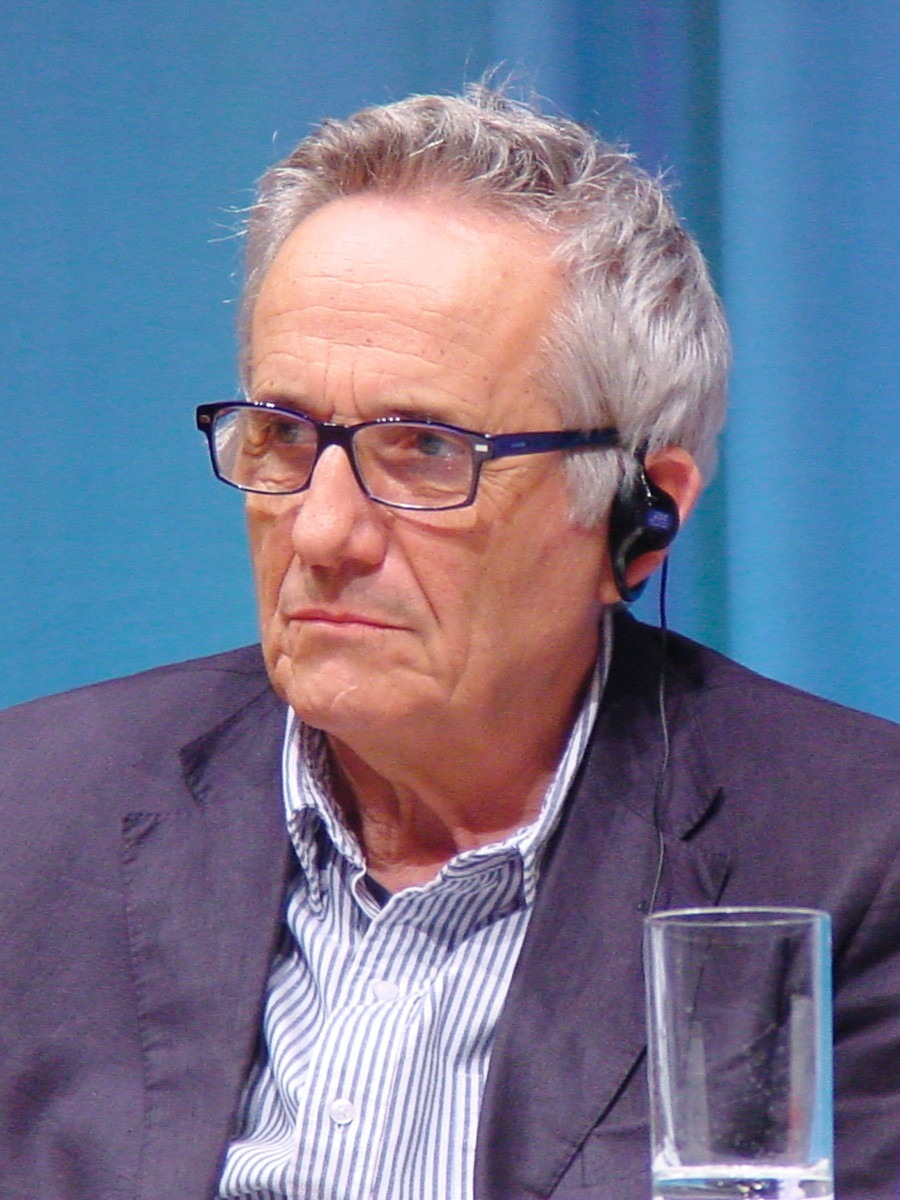
Marco Bellocchio is a prominent Italian filmmaker renowned for his profound explorations of religion, politics, and psychiatry through cinema. Born on November 9, 1939, in Piacenza, Italy, Bellocchio’s career spans several decades and is marked by a continuous engagement with the socio-political issues of his time.
Early Life and Education
Marco Bellocchio was born into an educated family; his mother was a teacher, and his father, an attorney, passed away during Marco’s adolescence. He received a rigorous Catholic education, attending religious schools for both middle and high school. This early exposure to Catholicism would later become a significant theme in his work.
Bellocchio’s initial academic pursuit was in philosophy at the Catholic University of Milan. However, he abandoned these studies in 1959 to enroll at the Centro Sperimentale di Cinematografia in Rome. His early film work was influenced by notable directors like Federico Fellini and Michelangelo Antonioni. Furthering his education, Bellocchio moved to London to study at the Slade School of Fine Arts, completing a dissertation on Antonioni and Bresson.
Cinematic Debut and Early Controversies
Bellocchio’s cinematic debut came in 1965 with the controversial film “I pugni in tasca” (“Fists in the Pocket”). This film, which critiques bourgeois family values through the story of a young epileptic man attempting to kill his family, stirred significant debate. Although rejected by the Venice Film Festival, it won the Silver Sail at the Locarno Festival and a Silver Ribbon.
Bellocchio was quickly associated with the leftist political movements of the time, drawing comparisons to Bernardo Bertolucci due to their similar backgrounds and styles. However, Bellocchio soon began to critique not only bourgeois values but also the passivity and contradictions within the Italian left.
The 1970s: Artistic Maturation
The 1970s marked a period of artistic maturation for Bellocchio. His 1972 film “Nel nome del padre” (“In the Name of the Father”) delved into the structures of power and their coercive effects on individuals. This exploration continued in “Matti da slegare” (1975), a documentary highlighting the repressive nature of asylums, and “Marcia trionfale” (1976), which examined the military life.
During this decade, significant legislative changes in Italy, such as the introduction of the right to conscientious objection in 1972 and the abolition of asylums in 1978, paralleled the themes of Bellocchio’s work, reflecting the broader social and political currents of the time.
Shift in Style and Themes
Bellocchio’s style evolved significantly with the release of “Il Gabbiano” (“The Seagull”) in 1977, an adaptation of Anton Chekhov’s play. This film marked the beginning of a new phase, where his films combined critiques of bourgeois society with introspective analysis of the responses provided by the political left.
This introspective approach became more pronounced in the 1980s with films like “Salto nel vuoto” (“Leap into the Void”), “Gli occhi, la bocca” (“The Eyes, the Mouth”), “Diavolo in corpo” (“Devil in the Flesh”), and “La visione del sabba” (“The Vision of the Sabbath”). These films delved deeper into personal and psychological themes, maintaining a strong connection to social and political realities.
The 1990s: Recognition and Awards
The 1990s saw Bellocchio gaining international recognition. His film “La condanna” (“The Condemnation”), based on a screenplay by psychiatrist Massimo Fagioli, won the Silver Bear at the Berlin Film Festival in 1991. This collaboration with Fagioli continued with “Il sogno della farfalla” (“The Butterfly’s Dream”) in 1994, although it was less successful.
Bellocchio’s ongoing engagement with religion culminated in “L’ora di religione” (“The Religion Hour”) in 2001, which won a Silver Ribbon. The film, starring Sergio Castellitto, portrays an atheist artist grappling with the beatification of his mother and his son’s decision to attend religion classes.
21st Century and Continued Impact
In 2003, Bellocchio directed “Buongiorno, notte” (“Good Morning, Night”), a film about the kidnapping of Aldo Moro by the Red Brigades, based on Anna Laura Traghetti’s novel “Il prigioniero” (“The Prisoner”). The film imagines the relationship between Moro and one of his captors, a young woman torn between her terrorist activities and her human affinity with Moro.
Bellocchio’s historical film “Vincere” (2009) tells the story of Benito Albino Dalser, the secret son of Benito Mussolini. This film was the only Italian entry at the 2009 Cannes Film Festival and won eight David di Donatello awards.
Recent Work and Accolades
In the 2010s, Bellocchio continued to garner acclaim. He directed a live television production of the opera “Rigoletto” in 2010, and in 2011, he received the Golden Alabarda for Lifetime Achievement in Cinema. At the 68th Venice International Film Festival, he was awarded the Golden Lion for Lifetime Achievement.
Despite production challenges, Bellocchio released “Bella addormentata” (“Dormant Beauty”) in 2012, addressing the contentious issue of euthanasia. The film premiered at the Venice Film Festival and won the Mario Monicelli Award for Best Director at the Bari International Film Festival in 2013.
In 2016, he released “Fai bei sogni” (“Sweet Dreams”), based on Massimo Gramellini’s autobiographical novel. The film explores themes of loss and emotional struggle.
Bellocchio’s 2019 film “Il traditore” (“The Traitor”), about the Mafia informant Tommaso Buscetta, starred Pierfrancesco Favino and Luigi Lo Cascio. It competed at the Cannes Film Festival and was Italy’s submission for the Best International Feature Film at the 2020 Oscars.
Latest Projects
In recent years, Bellocchio has continued to work on significant projects. “Esterno notte” (2022) and “Rapito” (2023) are among his latest films. “Rapito” focuses on the historical case of Edgardo Mortara, reflecting Bellocchio’s ongoing interest in historical and religious themes.
Personal Life and Legacy
Marco Bellocchio is part of a family deeply involved in the arts and humanities. His brother, Piergiorgio Bellocchio, is a critic, and his son, Pier Giorgio Bellocchio, is an actor. His sister-in-law, Lella Ravasi Bellocchio, is a psychologist, and his niece, Violetta Bellocchio, is a writer.
Bellocchio’s filmography is extensive, spanning over six decades and including numerous short films, documentaries, and feature films. His work has consistently challenged societal norms and provoked thought on complex issues, from family dynamics and mental illness to political ideologies and personal introspection.
Conclusion
Marco Bellocchio remains a towering figure in Italian cinema, known for his fearless exploration of controversial themes and his ability to intertwine personal narratives with broader socio-political contexts. His films continue to inspire and challenge audiences, cementing his legacy as one of Italy’s most influential filmmakers.


