
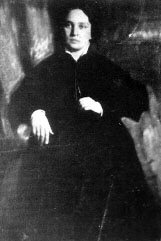
Maria Veniaminovna Yudina, born on September 9, 1899, in Nevel, a small town in western Russia near the Belarusian border, was a Soviet pianist renowned for her profound musical talent, unyielding spirit, and defiance against the oppressive regime under which she lived. Yudina’s legacy is not only marked by her exceptional contributions to classical music but also by her courageous stance on faith, freedom, and intellectual integrity during one of the most repressive periods in Soviet history.
Early Life and Education
Maria Yudina was born into a Jewish family that valued education and culture. Her early exposure to music and the arts set the stage for what would become a remarkable career. Yudina’s musical journey began at the Conservatory of Saint Petersburg, where she studied piano under the tutelage of the renowned teacher Leonid Nikolaev. Among her peers were future musical luminaries such as Dmitrij Shostakovich and Vladimir Sofronickij, with whom she shared a classroom and formative experiences.
The Russian Revolution of 1917 and the subsequent upheaval profoundly impacted Yudina’s life. She witnessed the fall of the Romanov dynasty, the brief existence of the Kerensky government, and the Bolshevik coup. These events shaped her worldview, leading her to make a significant personal and spiritual decision in 1919: she converted to Christianity and became a devout member of the Russian Orthodox Church. This conversion was particularly daring, given that it occurred during a time when the Soviet regime was intensifying its persecution of religious institutions.
The Pianist and Her Relationship with Stalin
Maria Yudina is perhaps most famously remembered as Joseph Stalin’s favorite pianist, a title that came with a remarkable and perilous story. According to legend, one night, Stalin heard a performance of Mozart’s Piano Concerto No. 23 in A major on the radio, performed by Yudina. So moved was he by the performance that he immediately demanded a recording of it. However, the performance had been live, and no recording existed.
Stalin’s subordinates, terrified of displeasing the dictator, rushed to Yudina’s home in the middle of the night and hastily assembled an orchestra to recreate the performance. The recording session was fraught with tension, and it reportedly took three conductors to complete it, as the first two were overwhelmed by the pressure of meeting Stalin’s expectations. The final recording, completed under these intense circumstances, was delivered to Stalin, who was said to have been deeply moved to tears by the music.
After receiving the recording, Stalin ordered that Yudina be paid a significant sum of money as a token of his appreciation. In an act of extraordinary courage and defiance, Yudina reportedly sent Stalin a letter of thanks, stating that she had donated the money to her church and that she would pray for him, asking God to forgive him for the atrocities he had committed against the people. Given the context of the time, when the Church was outlawed and Stalin’s rule was absolute, it is nothing short of miraculous that Yudina suffered no immediate consequences for this bold act.
Musical Contributions and Artistic Style
Musically, Maria Yudina was renowned for her interpretations of the works of Johann Sebastian Bach and Ludwig van Beethoven. Her performances were characterized by a bold, almost audacious virtuosity, coupled with deep spiritual intensity. Yudina’s style was marked by intellectual rigor and emotional depth, qualities that distinguished her from many of her contemporaries. She was not merely a performer; she was an interpreter who sought to explore and convey the profound spiritual and philosophical dimensions of the music she played.
Yudina was also a passionate advocate for contemporary music, particularly that of her friend and former classmate, Dmitrij Shostakovich. She championed his work, as well as the compositions of other modern composers, despite the Soviet regime’s frequent censorship and suppression of new artistic expressions. Her willingness to promote contemporary music, often at great personal risk, highlighted her commitment to artistic freedom and intellectual integrity.
Despite her extraordinary talent and contributions to music, Yudina was marginalized by the Soviet regime, which feared her unyielding faith, indomitable spirit, and independence of thought. Consequently, she remained relatively unknown in the West during her lifetime, though those who knew of her work regarded her as a musical prodigy of unparalleled skill and insight.
Personal Beliefs and the Soviet Regime
Maria Yudina’s life was a constant struggle against the oppressive Soviet regime. Her conversion to Christianity, her open expression of religious faith, and her intellectual independence made her a target in a state that sought to control all aspects of life, including art and religion. Yudina’s unwavering commitment to her beliefs, even in the face of potential persecution, is a testament to her courage and moral fortitude.
The Soviet authorities were particularly wary of Yudina’s influence because of her refusal to conform to the state’s expectations. She was an intellectual and spiritual beacon who inspired others to question the regime’s narratives and seek deeper truths. Yudina’s friendships with prominent intellectuals and artists, including the writer Boris Pasternak, further underscored her role as a cultural dissident. Pasternak, who would later win the Nobel Prize in Literature, famously read from his novel Doctor Zhivago at Yudina’s apartment in 1947, long before the book’s publication and its subsequent ban in the Soviet Union.
Yudina’s personal writings and letters, published posthumously thanks to the efforts of her friends in Russia, offer insight into her complex character. They reveal a woman of deep faith, unshakable principles, and a profound love for music and the arts. These writings also reflect her struggles with the moral and ethical dilemmas posed by life under a totalitarian regime.
Legacy and Posthumous Recognition
Maria Yudina passed away in Moscow on November 19, 1970, at the age of 71. In the years following her death, her legacy as both a musician and a symbol of intellectual and spiritual resistance began to gain wider recognition. Her recordings, which had been difficult to obtain during her lifetime, became more accessible, allowing new generations to appreciate her unique artistry.
Yudina’s influence extends beyond her musical achievements. She is remembered as a figure of moral authority and artistic integrity, whose life and work continue to inspire those who value freedom of thought and the pursuit of truth. Her story has been the subject of various cultural references, including in literature and film, where she is often depicted as a symbol of the artist’s struggle against oppression.
One of the most striking tributes to Yudina came from the Russian composer Alfred Schnittke, who described her as a master who opened doors to new worlds for her students and followers. He noted that while some masters guide their disciples every step of the way, Yudina was the kind of master who embarked on a solitary path, not needing anyone to accompany her but still leading others by showing them the essential direction to follow.
The Complexity of Yudina’s Persona in Literature and Memory
In addition to her musical legacy, Yudina’s persona has been explored and sometimes misunderstood in literature and popular memory. One example is the portrayal of her in an autobiographical novel by the Russian philosopher Aleksei Losev, where she was unfairly depicted as a cynical and promiscuous woman. This portrayal was later revealed to be a form of personal retaliation after Yudina rejected Losev’s romantic advances. Such misrepresentations serve as a reminder of the complex and often contentious ways in which historical figures are remembered and interpreted.
Despite such controversies, the true essence of Maria Yudina’s life and work continues to resonate with those who value the intersection of art, faith, and freedom. Her story is a powerful reminder of the role that artists can play in challenging oppressive systems and inspiring others to seek justice and truth, even in the darkest of times.
Conclusion
Maria Yudina’s life was marked by extraordinary talent, moral courage, and a steadfast commitment to her beliefs. As a pianist, she brought a unique intensity and intellectual depth to her performances, leaving an indelible mark on the world of classical music. As an individual, she stood as a beacon of resistance against the oppressive Soviet regime, using her art and her faith as tools of defiance.
Yudina’s legacy is one of artistic excellence and unwavering principle. Her story continues to inspire musicians, intellectuals, and activists around the world, reminding us that the pursuit of truth and beauty is a powerful act of resistance in the face of tyranny. Through her music and her life, Maria Yudina demonstrated the enduring power of the human spirit to transcend the confines of oppression and to find expression in the pursuit of higher ideals.


