
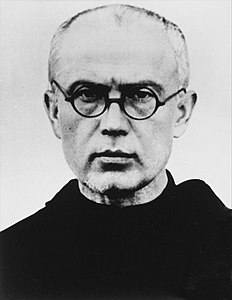
Massimiliano Maria Kolbe, born as Raimondo Kolbe on January 8, 1894, in Zdunska-Wola, central Poland, is one of the most revered figures in Catholic history. His life is a testament to unwavering faith, deep devotion to the Virgin Mary, and extraordinary self-sacrifice. This article delves into the life of Kolbe, exploring his age, fame, and the most significant highlights of his life.
Early Life and Religious Calling
From a young age, Raimondo Kolbe exhibited a strong inclination towards a religious life. His childhood was marked by a profound devotion to the Virgin Mary, a devotion that would define his entire life. In 1907, at just 13 years old, he joined the Seminary of the Conventual Franciscans in Lviv, recognizing that the Franciscan order, founded by St. Francis of Assisi, was where he truly belonged.
On September 4, 1910, Raimondo officially began his novitiate, taking the name Massimiliano, which would later be expanded to Massimiliano Maria in honor of the Virgin Mary. His dedication to his faith led him to Rome in 1912, where he pursued further religious studies. Between 1912 and 1919, Kolbe studied at the Seraphic College International of the Franciscan Order. During this period, he obtained degrees in philosophy (1915) and theology (1919), demonstrating his commitment to deepening his theological understanding.
Founding the Militia of the Immaculata
Kolbe’s time in Rome was not just marked by academic achievements. In 1917, inspired by his devotion to the Virgin Mary, he founded the Militia of the Immaculata (M.I.), an organization dedicated to promoting the veneration of the Immaculate Virgin. The Militia aimed to bring souls closer to God through the intercession of the Virgin Mary, a mission that resonated deeply with Kolbe’s own spiritual journey.
The Militia of the Immaculata quickly gained traction. With the support of the Archbishop of Kraków, Kolbe established the organization’s headquarters in Poland, where it became a beacon of Marian devotion. Despite suffering from tuberculosis, a disease that plagued him throughout his life, Kolbe tirelessly worked to expand the reach of the Militia. In 1922, he began publishing the organization’s official magazine, The Knight of the Immaculata, which would later reach a staggering circulation of one million copies by 1938.
Expanding the Mission: The City of the Immaculata
Kolbe’s vision for spreading Marian devotion was not limited to Poland. In 1927, he founded the Niepokalanów, also known as the City of the Immaculata, near Warsaw. This convent-city became a significant center for the Franciscan order and a hub for evangelization efforts. Niepokalanów was not just a religious center; it was a thriving community dedicated to spreading the message of the Militia of the Immaculata.
In 1930, Kolbe extended his mission to Japan, where he established another convent-city, named the Garden of the Immaculata, in Nagasaki. His efforts in Japan were remarkably successful, leading to numerous conversions and further solidifying his reputation as a dedicated missionary. Kolbe’s dream was to establish similar centers worldwide, but his declining health forced him to return to Poland in 1936.
The Outbreak of World War II and Imprisonment
The late 1930s saw Europe on the brink of war, and Kolbe’s activities did not go unnoticed by the Nazi regime. As World War II erupted, Kolbe and his fellow friars at Niepokalanów offered refuge to thousands of displaced people, including Jews, a brave act that would soon draw the ire of the Nazis.
On September 19, 1939, Kolbe and the other friars were arrested by the Gestapo and imprisoned in Amtitz, Germany. Despite the harsh conditions, Kolbe encouraged his fellow prisoners to continue their spiritual practices, providing hope and solace during a dark time. By December of that year, the friars were released and returned to Niepokalanów, but Kolbe’s reprieve was short-lived.
In February 1941, Kolbe was arrested again, this time under the pretext of political subversion due to his influential position within the Militia of the Immaculata. He was taken to the infamous Pawiak prison in Warsaw and, on May 28, 1941, transferred to the Auschwitz concentration camp. There, he was assigned prisoner number 16670 and forced into the gruesome labor of transporting corpses.
Ultimate Sacrifice and Legacy
A defining moment of Kolbe’s life occurred in July 1941. When a fellow prisoner, Franciszek Gajowniczek, was selected to die by starvation in reprisal for an escape attempt by another inmate, Kolbe volunteered to take his place. This act of selfless courage left an indelible mark on those who witnessed it. Kolbe, along with nine other prisoners, was confined to a starvation bunker where they spent their final days praying and singing hymns.
Even after two weeks of starvation, Kolbe remained alive, demonstrating a remarkable strength of spirit. On August 14, 1941, the eve of the Feast of the Assumption of the Virgin Mary, the Nazis, frustrated by his endurance, ended his life with a lethal injection of carbolic acid. Kolbe’s martyrdom became a powerful symbol of Christian faith and sacrifice.
Canonization and Recognition
Kolbe’s sacrifice did not go unnoticed. On October 10, 1982, Pope John Paul II canonized him as a saint and martyr of charity. His canonization was a recognition of his life’s work and his ultimate act of love, offering his life for another. Kolbe’s story continues to inspire millions worldwide, especially those in the Catholic faith.
Massimiliano Maria Kolbe’s legacy is not just one of martyrdom; it is a testament to the power of faith, the importance of devotion to the Virgin Mary, and the strength found in selfless love. His life serves as a reminder that even in the darkest times, acts of kindness, courage, and unwavering faith can shine through, leaving a legacy that transcends time.
Conclusion
Massimiliano Maria Kolbe’s life is a remarkable journey of faith, sacrifice, and devotion. From his early years in Poland to his missionary work in Japan, and ultimately to his martyrdom in Auschwitz, Kolbe’s story is one of deep spiritual commitment and extraordinary courage. His legacy as a saint continues to inspire and guide those who seek to live a life dedicated to faith and service to others.
His life is a beacon of hope, showing that in the face of unimaginable suffering, one can still choose to act with love and compassion. Kolbe’s story is not just a historical account but a powerful lesson in the enduring impact of selfless sacrifice.


