
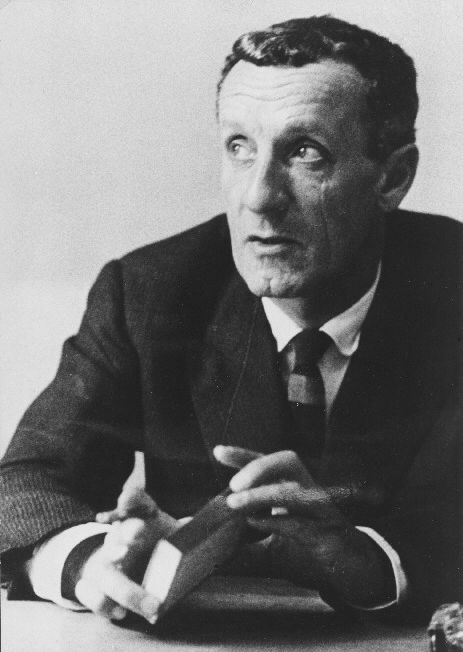
Maurice Merleau-Ponty, a name that resonates within the halls of 20th-century philosophy, stands as one of the most influential figures in phenomenology and existentialism. His work, characterized by a deep exploration of perception, embodiment, and the human experience, continues to shape philosophical discourse today. This article provides an in-depth look into the life of Maurice Merleau-Ponty, his rise to intellectual prominence, and the lasting impact of his ideas.
Early Life and Intellectual Formation
Maurice Jean Jacques Merleau-Ponty was born on March 14, 1908, in Rochefort-sur-Mer, a coastal town in southwestern France. The son of a military officer, Merleau-Ponty experienced the profound loss of his father during World War I when he was only six years old. This early tragedy influenced his outlook on life and philosophy, instilling in him a deep sense of the fragility of existence.
Despite the early loss, Merleau-Ponty’s childhood was marked by a strong familial bond and a nurturing environment that fostered his intellectual curiosity. His mother played a significant role in his education, encouraging him to pursue his interests in literature and philosophy. After completing his secondary education, Merleau-Ponty’s passion for philosophy led him to Paris, where he enrolled in the prestigious École Normale Supérieure (ENS) in 1926.
Philosophical Influences and Academic Pursuits
During his time at ENS, Merleau-Ponty was heavily influenced by the works of Henri Bergson, whose ideas on perception and consciousness left a lasting imprint on him. Bergson’s emphasis on the fluidity of time and the importance of lived experience resonated deeply with Merleau-Ponty, who would later expand on these themes in his own work.
Merleau-Ponty’s intellectual development was also shaped by his interactions with fellow students and future luminaries such as Jean-Paul Sartre and Simone de Beauvoir. The debates and discussions that took place among this circle of young intellectuals were crucial in shaping the trajectory of French existentialism and phenomenology.
In 1929, Merleau-Ponty attended a series of lectures by Edmund Husserl, the father of phenomenology, at the Sorbonne. These lectures, which were later published as “Cartesian Meditations,” introduced Merleau-Ponty to the phenomenological method, a philosophical approach that seeks to describe the structures of experience as they present themselves to consciousness, without recourse to theories or presuppositions.
The Phenomenology of Perception and Academic Success
After completing his studies at ENS, Merleau-Ponty began his teaching career in various lycées (secondary schools) across France. During this time, he also worked on his doctoral thesis, which would later be published as “The Structure of Behavior” (1942). In this work, Merleau-Ponty critiqued both behaviorism and classical intellectualism, arguing that human behavior cannot be fully understood through either deterministic models or abstract theorization. Instead, he emphasized the role of perception in shaping our understanding of the world.
Merleau-Ponty’s magnum opus, “Phenomenology of Perception,” was published in 1945. This work marked a significant departure from traditional philosophy, offering a new way of thinking about the relationship between the body, the mind, and the world. In “Phenomenology of Perception,” Merleau-Ponty argued that perception is not a passive reception of sensory data but an active, embodied process through which we engage with the world.
Central to this work is the concept of “embodiment,” which posits that our bodily experience is fundamental to our understanding of reality. For Merleau-Ponty, the body is not merely an object in the world but a subject through which we experience the world. This idea challenged the Cartesian dualism of mind and body, suggesting instead that the mind is always already situated within a physical, social, and historical context.
“Phenomenology of Perception” was groundbreaking in its exploration of the lived experience and has since become a foundational text in existential and phenomenological philosophy. The work was widely acclaimed, establishing Merleau-Ponty as a leading figure in French philosophy.
Collaboration with Sartre and Political Engagement
Following the publication of “Phenomenology of Perception,” Merleau-Ponty became closely associated with Jean-Paul Sartre, one of the most prominent intellectuals of the time. Together, they co-founded the influential journal “Les Temps Modernes” in 1945, which became a platform for existentialist thought and political engagement. Through this journal, Merleau-Ponty and Sartre sought to address contemporary social and political issues, particularly those related to Marxism, existentialism, and human rights.
Merleau-Ponty’s political writings during this period reflect his deep concern with issues of freedom, oppression, and the role of the intellectual in society. In works such as “Humanism and Terror” (1947), Merleau-Ponty grappled with the ethical dilemmas posed by Marxist ideology and the realities of political action. While sympathetic to Marxism, he was critical of its more dogmatic aspects, advocating for a more nuanced and humanistic approach to political theory.
However, the relationship between Merleau-Ponty and Sartre eventually became strained due to their differing views on Marxism and political activism. Merleau-Ponty’s growing skepticism towards Soviet communism and his criticism of Sartre’s unyielding support for it led to a rift between the two philosophers. This intellectual divergence was most clearly expressed in Merleau-Ponty’s work “Adventures of the Dialectic” (1955), in which he critiqued the Marxist notion of dialectical materialism and its application to social and political life.
Later Work and Philosophical Innovations
In 1952, Merleau-Ponty was appointed to the prestigious Chair of Philosophy at the Collège de France, a position that affirmed his status as one of the leading philosophers of his time. His lectures at the Collège de France attracted students from around the world and covered a wide range of topics, from phenomenology and existentialism to psychology and linguistics.
During the 1950s, Merleau-Ponty’s work took on a new direction, as he began to explore the relationship between language, perception, and meaning. His interest in linguistics, particularly the work of Ferdinand de Saussure, led him to investigate how language shapes our experience of the world. This line of inquiry culminated in his unfinished work “The Prose of the World,” in which he sought to develop a phenomenology of language.
Merleau-Ponty’s later work also reflected a deep engagement with the philosophy of art and aesthetics. He was particularly interested in how art, particularly painting, reveals aspects of human experience that are often obscured by everyday perception. In his essay “Eye and Mind” (1961), Merleau-Ponty explored the relationship between the artist and the world, arguing that art offers a unique insight into the fundamental structures of perception.
One of Merleau-Ponty’s most significant contributions to philosophy during this period was his concept of “the flesh,” introduced in his unfinished work “The Visible and the Invisible.” This concept sought to describe the fundamental continuity between the perceiver and the perceived, suggesting that both are intertwined in a reciprocal relationship. For Merleau-Ponty, the flesh represents the primordial element of existence, a kind of pre-objective reality that underlies all experience.
The Legacy of Maurice Merleau-Ponty
Maurice Merleau-Ponty’s untimely death on May 3, 1961, at the age of 53, cut short a brilliant intellectual career that had already made a profound impact on 20th-century thought. His sudden passing left many of his projects unfinished, yet the body of work he left behind continues to influence a wide range of disciplines, from philosophy and psychology to literary theory and cognitive science.
Merleau-Ponty’s emphasis on embodiment, perception, and the lived experience has had a lasting impact on contemporary philosophy. His ideas have been taken up by thinkers in fields as diverse as phenomenology, existentialism, feminist theory, and environmental philosophy. In recent years, there has been a resurgence of interest in Merleau-Ponty’s work, as scholars continue to explore the implications of his thought for contemporary issues.
Moreover, Merleau-Ponty’s critique of Cartesian dualism and his emphasis on the embodied nature of consciousness have resonated with developments in cognitive science and neuroscience, which increasingly recognize the importance of the body in shaping cognitive processes. His work has also influenced the field of embodied cognition, which seeks to understand how bodily states influence mental states.
In addition to his contributions to philosophy, Merleau-Ponty’s engagement with political and social issues remains relevant today. His nuanced approach to Marxism and his concern with the ethical implications of political action continue to offer valuable insights for contemporary debates on social justice, freedom, and human rights.
Conclusion: A Philosopher of the Lived Experience
Maurice Merleau-Ponty was a philosopher who sought to bridge the gap between abstract thought and lived experience. His work challenges us to rethink the nature of perception, embodiment, and consciousness, offering a vision of philosophy that is deeply rooted in the complexities of human existence. While his life was cut short, his intellectual legacy endures, continuing to inspire and challenge thinkers across disciplines.
Merleau-Ponty’s contributions to phenomenology and existentialism have secured his place as one of the most important philosophers of the 20th century. His ideas on the body, perception, and language have not only influenced philosophical thought but have also opened new avenues of inquiry in the human sciences. As we continue to grapple with the questions he raised, Maurice Merleau-Ponty’s work remains a vital source of insight into the nature of human experience.


