
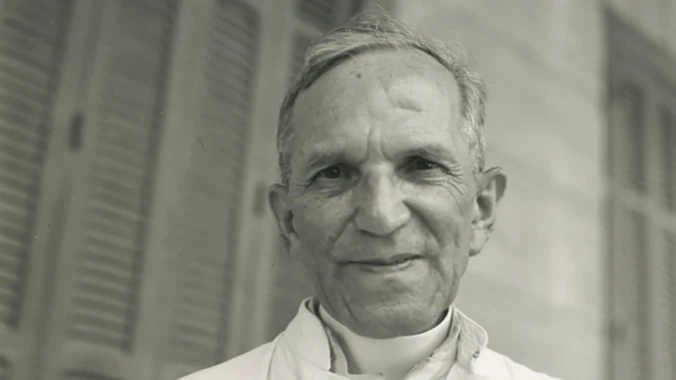
Maurice Zundel, born on January 21, 1897, in Neuchâtel, Switzerland, was a Swiss Catholic priest and theologian whose work continues to influence both Catholic and Protestant theological discourse. A man of profound thought and spirituality, Zundel’s life was marked by a commitment to bridging gaps between different theological traditions and engaging deeply with existential philosophy.
Early Life and Education
Zundel’s early years in Neuchâtel were characterized by a strong inclination towards spirituality and intellectual exploration. From a young age, he was drawn to the mysteries of faith, which set the foundation for his later work as a theologian. His education was rigorous, steeped in both classical studies and modern philosophical thought, which allowed him to approach theology with a unique perspective.
In 1919, Maurice Zundel was ordained as a priest in the Diocese of Lausanne-Geneva. This marked the beginning of a long and fruitful career in the service of the Church, during which he sought to deepen his understanding of theology and philosophy. His quest for knowledge led him to Rome, where he earned a doctorate in philosophy from the Pontifical University of Saint Thomas Aquinas in 1927. During his time in Rome, Zundel delved into the interplay between literature, art, and theology, seeking to uncover the deeper connections between these fields.
Theological Contributions and Philosophical Stance
Zundel’s theological approach can best be described as being at the crossroads of Protestant and Catholic theologies, existential philosophy, and a focus on the dignity and uniqueness of the human person. He believed that theology could not be divorced from the lived experience of individuals and that the divine is most fully encountered in the depths of human existence.
Zundel was a prolific writer, and his body of work includes around thirty books, in which he explored various themes such as the nature of God, the meaning of existence, and the role of the Church in the modern world. His writings reflect a deep concern for the individual’s relationship with God, emphasizing personal freedom, responsibility, and the intrinsic value of every human being. Zundel’s thought was heavily influenced by his encounters with existentialist philosophy, particularly the works of Kierkegaard and Nietzsche, which he integrated into his theological reflections.
One of Zundel’s key contributions to theology was his emphasis on the concept of “God as Absolute Poverty,” a notion that highlighted God’s complete self-giving and humility. For Zundel, the incarnation of Christ was the ultimate expression of this divine poverty, where God emptied Himself to become fully human. This idea challenged the traditional views of God’s omnipotence and majesty, proposing instead a God who is intimately involved in the human condition.
International Influence and Encounters
Zundel’s life as a priest and theologian was one of constant movement and engagement with different cultures and traditions. His role as a teacher and lecturer took him to various parts of the world, including Switzerland, France, Palestine, Egypt, and Lebanon. These experiences enriched his theological perspective, allowing him to interact with a diverse array of religious and philosophical ideas.
In 1926, while in Paris, Zundel had a significant encounter with Father Giovanni Battista Montini, who would later become Pope Paul VI. This meeting marked the beginning of a lifelong friendship and intellectual exchange between the two men. Pope Paul VI would later invite Zundel to preach the Lenten retreat at the Vatican in 1972, a testament to the deep respect and admiration he had for Zundel’s theological insights.
Zundel’s international influence was further solidified through his extensive travels and lectures. His time in the Middle East, particularly in Palestine and Lebanon, exposed him to the rich spiritual traditions of Eastern Christianity, which left a lasting impact on his thought. He also spent time in Egypt, where he engaged with the Coptic Christian community, further broadening his understanding of Christian theology.
Writings and Legacy
Maurice Zundel’s literary output is vast, with his works encompassing a wide range of topics, from theology and philosophy to poetry and spirituality. Some of his most notable works include “The Splendor of the Human Condition,” “The Poverty of God,” and “The Divine Presence in the Heart of Man.” In these writings, Zundel explored the relationship between God and humanity, often challenging his readers to reconsider their preconceived notions about faith and existence.
Zundel’s theological contributions were not confined to his books alone. He was also an influential preacher and spiritual director, known for his ability to communicate complex theological ideas in a way that was accessible to a broad audience. His sermons and spiritual retreats were highly sought after, drawing people from all walks of life who were eager to hear his insights on faith and spirituality.
Zundel’s influence extended beyond the Catholic Church. His ideas found resonance among Protestant theologians, particularly those interested in existential theology and personalism. Zundel’s focus on the individual’s encounter with God and the importance of personal freedom and responsibility made his work relevant to a wide audience, regardless of denominational boundaries.
Historical Context and Impact
To fully appreciate Zundel’s contributions, it is essential to understand the historical context in which he lived and worked. The early 20th century was a time of significant upheaval in Europe, with the aftermath of World War I, the rise of totalitarian regimes, and the existential crises that these events precipitated. In this environment, many people were searching for new ways to understand their place in the world and their relationship with God.
Zundel’s theology offered a response to these existential questions, providing a framework for understanding the human condition in light of divine love and grace. His emphasis on God’s humility and self-giving was a radical departure from the traditional views of a distant, all-powerful deity. Instead, Zundel presented a God who is deeply involved in the struggles and joys of human life, offering hope and comfort in times of uncertainty.
The impact of Zundel’s thought can also be seen in the broader theological movements of the 20th century. His work anticipated many of the themes that would later be explored in liberation theology, particularly the idea of God’s preferential option for the poor and marginalized. Zundel’s emphasis on the dignity of the human person and the importance of personal freedom also resonated with the emerging human rights discourse of the post-war era.
Later Life and Death
As Maurice Zundel grew older, his influence continued to expand. His theological ideas gained a wider audience, and his writings were translated into several languages, reaching readers around the world. Despite his growing fame, Zundel remained a humble and dedicated servant of the Church, committed to his pastoral duties and his role as a spiritual guide.
Zundel’s later years were marked by a deepening of his spiritual insights. He continued to write and lecture, drawing on his extensive travels and experiences to inform his work. His health, however, began to decline, and in 1975, Maurice Zundel passed away in Ouchy, Lausanne, Switzerland. He was buried in the Basilica of Our Lady of the Assumption in Neuchâtel, where his legacy continues to be honored.
Legacy and Continuing Influence
Maurice Zundel’s legacy lives on through his writings, which continue to inspire theologians, philosophers, and spiritual seekers. His work is characterized by a deep respect for the mystery of the human person and a profound belief in the transformative power of God’s love. Zundel’s theology offers a path for those seeking a deeper understanding of their faith, one that is grounded in the realities of human existence and the presence of the divine in everyday life.
In the years since his death, Zundel’s ideas have continued to be studied and discussed, particularly within academic circles. His influence can be seen in the works of contemporary theologians who share his concern for the dignity of the individual and the importance of personal freedom. Zundel’s thought also resonates with those who are searching for a spirituality that is both intellectually rigorous and deeply personal.
As we reflect on Maurice Zundel’s life and work, it becomes clear that his contributions to theology and spirituality are as relevant today as they were during his lifetime. His emphasis on the encounter between God and the individual, his focus on the importance of personal freedom and responsibility, and his vision of a God who is intimately involved in the human condition offer a timeless message of hope and inspiration.


