
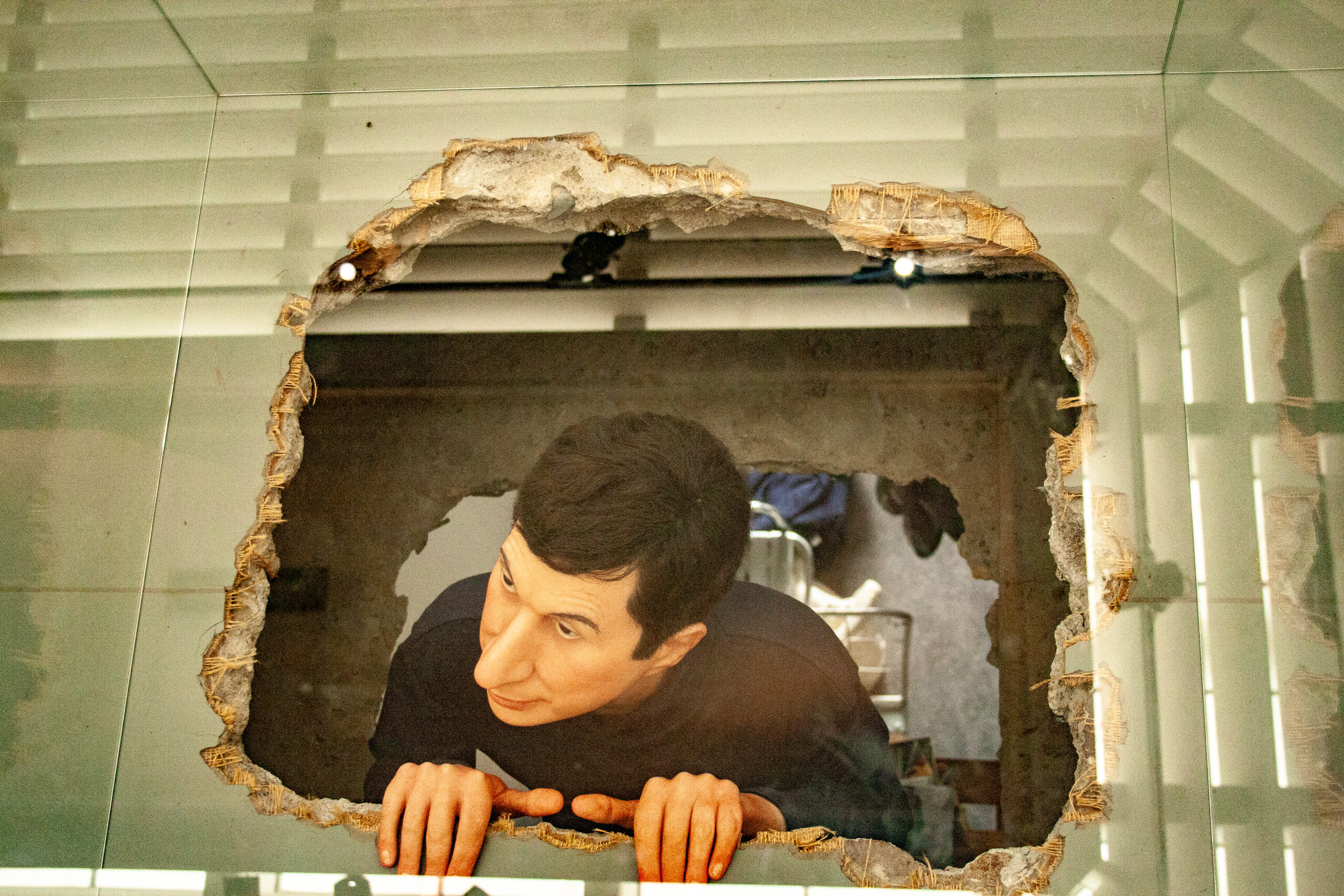
Maurizio Cattelan, born on September 21, 1960, in Padua, Italy, is an Italian contemporary artist renowned for his provocative, often controversial works. Despite never attending an art academy, Cattelan emerged as a self-taught artist in the 1980s, initially making his mark in Forlì, Emilia Romagna. Over the decades, he has gained international recognition for his unique approach to art, which often blurs the lines between art and provocation, humor and critique, and reality and absurdity.
Early Life and Artistic Beginnings
Maurizio Cattelan’s journey into the art world began in an unconventional manner. Unlike many of his contemporaries, Cattelan did not pursue formal education in the arts. Instead, he developed his skills through self-learning and by immersing himself in the vibrant artistic community of Forlì. It was in Forlì that Cattelan began to develop his distinctive style, one that would later define his career. His early works were characterized by a blend of theatricality and irreverence, often incorporating objects and texts in ways that challenged traditional notions of art.
Breakthrough and Provocative Art
Cattelan’s first significant breakthrough came in 1991 with his work “Stadium 1991,” exhibited at the Galleria d’Arte Moderna in Bologna. This piece featured a large foosball table with eleven Senegalese players and eleven Cesena players, a striking commentary on race and globalization. The work was well-received and marked the beginning of Cattelan’s rise to fame.
In the following years, Cattelan continued to push the boundaries of contemporary art with his provocative creations. One of his most infamous works from this period is “Lavorare è un brutto mestiere” (Working is a Bad Job), presented at the Venice Biennale. In this piece, Cattelan offered his exhibition space for sale to an advertising agency, a move that shocked and baffled the art world.
The Nona Ora and International Recognition
In 1999, Cattelan created what is perhaps his most controversial work, “La Nona Ora” (The Ninth Hour). This sculpture depicts Pope John Paul II struck down by a meteorite, surrounded by shattered glass. The piece, made from latex, wax, and fabric, was exhibited at the Royal Academy of London and sparked a significant amount of debate. While many saw it as a powerful critique of the Catholic Church, others found it deeply offensive. Despite—or perhaps because of—the controversy, the work was sold at a Christie’s auction in 2003 for an astonishing $886,000, solidifying Cattelan’s status as a major figure in the art world.
Hollywood and Continued Provocations
Cattelan’s penchant for provocation did not wane in the 2000s. In 2005, he installed a massive “Hollywood” sign on the Bellolampo hill near Palermo, Sicily. The installation was a stark commentary on the influence of American culture and its pervasive reach, even in remote parts of Italy. This work, like many of his others, was met with a mix of admiration and criticism.
That same year, Cattelan ventured into the world of filmmaking with the documentary “È morto Cattelan! Evviva Cattelan!” (Cattelan is Dead! Long Live Cattelan!), in which he imagined his own death and how it would be reported by the media. The film further demonstrated Cattelan’s fascination with the intersection of art, media, and reality.
Him and The Power of Historical Memory
In 2001, Cattelan created “Him,” another controversial piece that portrays Adolf Hitler kneeling in prayer. The sculpture, which was designed to evoke both empathy and revulsion, challenges viewers to confront the complexities of forgiveness and the enduring impact of historical trauma. “Him” is a stark reminder of the atrocities of the Holocaust and the difficulty in reconciling with such a dark past. It is a work that underscores Cattelan’s ability to provoke deep reflection and discomfort in equal measure.
The Wrong Gallery and Curatorial Ventures
In addition to his sculptural works, Cattelan has also made significant contributions to the art world through curatorial projects. In New York, he opened “The Wrong Gallery,” a tiny exhibition space that was little more than a storefront window. Despite its size, the gallery became a focal point for contemporary art, showcasing works by both established and emerging artists.
Cattelan also co-founded two influential art publications: “Permanent Food,” a magazine featuring appropriated images, and “Charley,” a publication that sought to capture the zeitgeist of contemporary art. These ventures, along with his role in curating the 2006 Berlin Biennale, demonstrate Cattelan’s multifaceted influence on the art world.
Recognition and Legacy
Maurizio Cattelan’s contributions to art have been recognized with numerous accolades. In 2008, he was awarded the prestigious Career Prize at the XV Quadriennale d’Arte in Rome, a testament to his impact on contemporary art. His works have been exhibited in major museums and galleries around the world, from the Guggenheim in New York to the Palazzo Grassi in Venice.
Despite his success, Cattelan has remained a figure of controversy. His works often provoke strong reactions, with some critics accusing him of being a provocateur for provocation’s sake. However, there is no denying that Cattelan’s art challenges viewers to think critically about the world around them, confronting uncomfortable truths with a mix of humor, irony, and pathos.
Personal Life and Ongoing Influence
Maurizio Cattelan’s personal life has also been the subject of public interest. He was previously in a relationship with television presenter Victoria Cabello, and he has continued to live and work between Italy and the United States. His influence extends beyond the art world, with his works often referenced in discussions about the role of art in society.
Cattelan’s ability to engage with contemporary issues through his art has made him a central figure in the ongoing conversation about the purpose and power of art. His works, which often blur the lines between art and life, continue to inspire and provoke, ensuring that his legacy will endure for years to come.
Conclusion
Maurizio Cattelan is a seminal figure in contemporary art, known for his ability to push the boundaries of what art can be. His works, whether they provoke outrage or admiration, always leave a lasting impression. Cattelan’s career is a testament to the power of art to challenge, to provoke, and to inspire. As he continues to create and to influence the world of art, his legacy as a provocateur and a visionary remains firmly intact.
In conclusion, Maurizio Cattelan’s life and work offer a rich tapestry of creativity, controversy, and cultural commentary. His unique approach to art has not only earned him fame but also sparked important conversations about the role of art in society. As we reflect on his career, it is clear that Cattelan is not just an artist; he is a provocateur, a critic, and a cultural icon whose influence will be felt for generations.


