
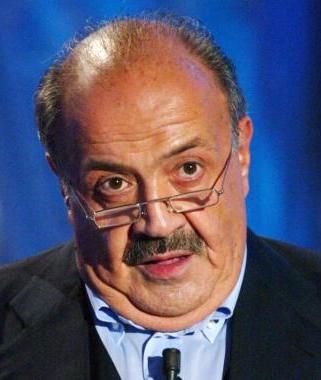
Early Life and Background
Maurizio Costanzo was born on August 28, 1938, in Pescara, Italy, not in Rome as is commonly believed. His upbringing was modest; his father worked for the Ministry of Transport, and his mother was a homemaker. From an early age, Costanzo was drawn to journalism, a passion that would define much of his life. By the age of eighteen, he had already taken his first steps into the world of journalism, joining the staff of the newspaper Paese Sera. His rapid rise continued, and by 1960, at just 22 years old, he was the head of the Rome bureau for the weekly magazine Grazia.
The 1960s and 1970s: A Rising Star in Journalism and Television
The 1960s marked a significant shift in Costanzo’s career. In 1962, he transitioned from traditional print journalism to the emerging media of radio and television. This move proved to be pivotal, as it allowed Costanzo to showcase his versatility and creativity. He became known for his eclectic approach, contributing not only to journalistic endeavors but also to popular culture. For instance, Costanzo co-wrote the lyrics to the famous song “Se telefonando,” performed by the legendary Italian singer Mina.
Costanzo’s personal life during this period was as eventful as his professional one. In 1963, he married Lori Sammartini, a woman fourteen years his senior. However, their marriage did not last, and by the early 1970s, Costanzo had remarried. His second wife, Flaminia Morandi, was a journalist who left her previous husband to be with him. The couple had two children, Camilla, a screenwriter for Rai, born in 1973, and Saverio, a sociologist and documentary filmmaker, born in 1975.
The mid-1970s was a transformative period for Costanzo as he became a central figure in Italian media. In 1976, he created and hosted Bontà loro, widely regarded as Italy’s first talk show. This program set the stage for Costanzo’s future successes in television. It was followed by other popular shows like Acquario, Grand’Italia, Fascination, and Buona Domenica.
The 1980s: Scandal and Resilience
The 1980s were a period of both triumph and turmoil for Maurizio Costanzo. On one hand, he founded Fortuna Audiovisivi, a production company that became a cornerstone of his media empire. He also ventured into politics, running as a candidate for the Radical Party in 1986. Although the Radical Party was historically one of the least powerful political entities in Italy, Costanzo’s candidacy was a testament to his diverse interests and his ability to navigate different spheres of influence.
However, the early 1980s also brought scandal. In 1981, the discovery of the P2 Masonic Lodge, a secret organization with members in high-ranking positions across Italy, shocked the nation. Maurizio Costanzo was listed among the members, which led to widespread criticism and a blow to his reputation. Costanzo defended himself by claiming he had been unwittingly included in the list and had only agreed to join to protect his professional future. Despite the controversy, Costanzo managed to continue his career, demonstrating resilience in the face of adversity.
In the midst of these challenges, Costanzo’s television career flourished. In 1987, he launched the Maurizio Costanzo Show, a late-night talk show that would become one of the longest-running programs in Italian television history. Filmed at the Teatro Parioli in Rome, where Costanzo also served as artistic director, the show became a cultural institution. Over the years, it featured countless guests from various walks of life, contributing to its enduring popularity.
During this time, Costanzo’s personal life also made headlines. He separated from his third wife, Simona Izzo, and quickly remarried Marta Flavi, a television presenter. Their marriage, however, lasted only three years, adding to Costanzo’s reputation as a man with a complex personal life.
The 1990s: Enduring Influence and Personal Challenges
The 1990s were marked by significant events in both Costanzo’s professional and personal life. On May 14, 1993, Costanzo narrowly escaped an assassination attempt when a car bomb exploded as he was driving through Rome. The attack was linked to Costanzo’s outspoken criticism of the Mafia, particularly his condemnation of the killings of anti-Mafia magistrates Giovanni Falcone and Paolo Borsellino. The incident highlighted the risks faced by public figures who dared to challenge organized crime in Italy.
Despite this traumatic event, Costanzo continued his work unabated. The Maurizio Costanzo Show remained a staple of Italian television, and he expanded his influence in the media industry. In 1999, he became the president of Mediatrade, a subsidiary of Mediaset that focuses on television fiction. Additionally, he launched Maurizio Costanzo Comunicazione in partnership with Alessandro Benetton, a company aimed at helping businesses manage their public image.
The late 1990s also saw a significant development in Costanzo’s personal life. In 1989, he met Maria De Filippi, a young professional working in a communication consultancy. Their relationship blossomed, and they married in 1995. Maria De Filippi would go on to become one of Italy’s most powerful television producers and hosts, further cementing the couple’s status as a media powerhouse.
The 2000s: Legacy Building and New Ventures
The new millennium brought new opportunities and challenges for Maurizio Costanzo. While continuing to host the Maurizio Costanzo Show, he also took on new roles in television and academia. He became a professor of “Theories and Techniques of Television Language” at the University of Rome La Sapienza, sharing his vast knowledge and experience with a new generation of media professionals.
Costanzo’s versatility as a writer also shone through during this period. He penned several plays, including Il marito adottivo, Con assoluta gratitudine, and Cielo mio marito, the latter co-written with Marcello Marchesi and Anna Mazzamauro and popularized by the comedian Gino Bramieri. His contributions to Italian theater further demonstrated his multifaceted talents.
In the late 2000s, Costanzo announced the final season of the Maurizio Costanzo Show, marking the end of an era in Italian television. However, this was far from a retirement. Costanzo continued to innovate, moving back to Rai after nearly thirty years to work as a writer. He also hosted Maurizio Costanzo Talk on Rai 2 and Italia mia with Enrico Vaime on Rai 1.
The 2010s and 2020s: A Continuing Legacy
Even in his later years, Maurizio Costanzo remained an active and influential figure in Italian media. In 2011, he became a regular commentator on the Roman radio station Radio Manà Manà. The following year, he took on the role of artistic director for the magazine Vero, further expanding his influence in the media world.
Costanzo also returned to Mediaset, where he produced forty episodes of Maurizio Costanzo Show – La storia, a retrospective of his iconic talk show. In 2015, he brought the Maurizio Costanzo Show back to television with a new series of episodes on Rete 4, proving that his appeal had not waned with time.
In 2016, Costanzo began hosting a daily program on Rai Premium titled Parliamone, further demonstrating his enduring passion for television. His career continued to evolve, and in 2017, he transitioned the Radio Costanzo Show to Radio 105, co-hosting the program with Carlotta Quadri.
Maurizio Costanzo’s final years were marked by a deep connection to his beloved Roma football club. From June 2021 until February 2022, he served as the club’s communications strategy advisor, a role that reflected his lifelong passion for the sport and his commitment to effective communication.
Historical Context and Legacy
Maurizio Costanzo’s career is a reflection of the evolution of Italian media over the past six decades. From the early days of print journalism to the rise of television and the advent of digital media, Costanzo was at the forefront of these changes. His ability to adapt to new mediums and his talent for engaging audiences made him a central figure in the Italian media landscape.
Costanzo’s influence extended beyond entertainment. He played a significant role in shaping public discourse in Italy, using his platform to address important social and political issues. His outspoken stance against the Mafia, for example, exemplified his commitment to justice and his willingness to take risks in pursuit of truth.
Moreover, Costanzo’s personal life, marked by multiple marriages and high-profile relationships, mirrored the complexity of his professional journey. His partnership with Maria De Filippi, in particular, was a defining aspect of his later years, as the couple became a formidable force in Italian television.
Conclusion: A Titan of Italian Media
Maurizio Costanzo passed away on February 24, 2023, at the age of 84, leaving behind a legacy that will be remembered for generations. His contributions to journalism, television, and the broader cultural landscape of Italy are unparalleled. Costanzo was more than just a television host; he was a pioneer, a mentor, and a symbol of resilience in the face of adversity.
As we look back on Maurizio Costanzo’s life and career, it is clear that he was a titan of Italian media. His ability to connect with audiences, his dedication to his craft, and his influence on Italian culture are testaments to a life well-lived. Maurizio Costanzo’s story is one of passion, perseverance, and an unwavering commitment to the power of media to inform, entertain, and inspire.


