
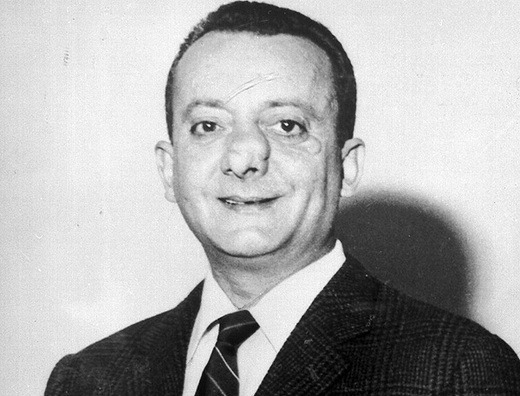
Mauro De Mauro was an influential Italian journalist whose mysterious disappearance and presumed murder in 1970 became one of Italy’s most infamous cold cases. His life, career, and untimely death are entwined with some of the most turbulent periods in Italian history, involving the Mafia, political intrigue, and the shadowy underworld of secret services. This article delves into the life of Mauro De Mauro, examining his rise to fame, his investigative work, and the circumstances surrounding his tragic end.
Early Life and Fascist Affiliation
Mauro De Mauro was born on September 6, 1921, in Foggia, Italy, into an educated family—his father was a chemist, and his mother was a mathematics teacher. From a young age, De Mauro was deeply involved in politics, joining the National Fascist Party, which held power in Italy under Benito Mussolini. His early political inclinations were significant as they shaped much of his later life and career.
During World War II, De Mauro’s allegiance to the Fascist cause led him to volunteer for the Italian Social Republic, a Nazi puppet state established in Northern Italy after Mussolini was ousted in 1943. In this capacity, he served under Pietro Caruso, the head of the police force in Rome during the German occupation. This period was marked by intense violence and repression, and De Mauro’s experiences undoubtedly left a lasting impression on him.
The war was a time of personal tragedy for De Mauro as well; he lost his brother, an aviator, in 1944. After the war ended, De Mauro found himself on the losing side of history. Like many former Fascists, he had to navigate a new Italy that was rapidly purging itself of its Fascist past. This post-war period saw De Mauro relocating to Palermo, Sicily, where he began his career in journalism—a career that would eventually make him a target for those who wished to silence him.
Career in Journalism and Rise to Fame
In Palermo, De Mauro quickly established himself as a talented and tenacious journalist. He worked for several newspapers, including “Il Tempo di Sicilia” and “Il Mattino di Sicilia,” before finally joining “L’Ora,” a Palermo-based daily known for its courageous reporting on the Mafia and organized crime. “L’Ora” was not just any newspaper; it was a bastion of resistance against the pervasive influence of Cosa Nostra, the Sicilian Mafia, and its journalists were often targets of violence and intimidation.
De Mauro’s work at “L’Ora” brought him considerable fame, particularly his investigative reporting on organized crime and corruption in Sicily. His articles were not merely news reports; they were in-depth investigations that often exposed the connections between the Mafia, business interests, and political figures. This kind of journalism was extremely dangerous, especially in a place like Sicily, where the Mafia’s influence was both deep and far-reaching.
The Enrico Mattei Investigation
One of the most significant assignments of De Mauro’s career came when he was asked to investigate the mysterious death of Enrico Mattei, the powerful president of the Italian energy conglomerate ENI. Mattei had died in a suspicious plane crash in 1962, and while the official verdict was that it was an accident, many—including De Mauro—believed it was a politically motivated assassination.
Franco Rosi, a renowned Italian filmmaker, was planning to make a film about Mattei’s life and death and asked De Mauro to reconstruct the last days of Mattei’s life in Sicily. This assignment proved to be a turning point in De Mauro’s life. He traveled to Gela and Gagliano Castelferrato, the places Mattei had visited before his death, conducting interviews and gathering information. De Mauro’s research led him to believe that Mattei had been murdered by a small explosive device planted on his plane, a conclusion that would have had explosive political implications.
De Mauro compiled his findings into a detailed report, which he planned to hand over to Rosi. However, before he could do so, he vanished. The yellow envelope containing the report disappeared along with him, leading to widespread speculation that De Mauro had uncovered something so dangerous that it cost him his life.
The Disappearance and Theories Surrounding His Death
On the evening of September 16, 1970, Mauro De Mauro was last seen outside his home in Palermo. According to witnesses, three men approached him as he was getting into his dark blue BMW. They ordered him to “amunì,” a Sicilian term meaning “let’s go,” and he was never seen again. Despite extensive searches and investigations, his body was never found, and his fate remains a mystery to this day.
The disappearance of De Mauro shocked Italy, and numerous theories emerged about who was responsible and why. The most widely accepted theory is that De Mauro was kidnapped and murdered by Cosa Nostra because of what he had uncovered about Mattei’s death. The Mafia had deep ties to various political and business interests, and Mattei’s death was likely orchestrated by those who saw him as a threat to their power. De Mauro, by getting too close to the truth, became a liability that needed to be eliminated.
Another theory posits that De Mauro’s kidnapping was linked to his past as a Fascist and his connections with Italy’s secret services. Some believe that De Mauro may have stumbled upon sensitive information related to the activities of the Italian government or intelligence agencies, leading to his abduction and murder.
There were also speculations about the involvement of foreign intelligence services, particularly the French, given Mattei’s opposition to the dominance of the Seven Sisters, a cartel of oil companies that included several French firms. De Mauro’s investigations could have uncovered information that was detrimental not only to the Mafia but also to powerful international interests.
Legal Proceedings and the Mafia’s Role
The investigation into De Mauro’s disappearance was one of the longest and most complex in Italian history. Over the decades, numerous Mafia bosses were questioned, and several were put on trial for their alleged involvement in De Mauro’s kidnapping and murder. The most high-profile trial involved Salvatore “Totò” Riina, the notorious head of the Sicilian Mafia. Riina was accused of ordering De Mauro’s murder, but in 2015, Italy’s Supreme Court upheld his acquittal due to insufficient evidence.
The investigation was hampered by the Mafia’s code of silence, or “omertà,” and by numerous instances of misinformation and deliberate obstruction. Key witnesses were intimidated or killed, and crucial evidence was lost or destroyed. Despite these challenges, the case remained open, and the mystery of De Mauro’s fate continued to captivate Italy.
One of the key revelations in the investigation came from Rosario Naimo, a Mafia turncoat who claimed that De Mauro was taken to a property owned by the Madonia family, one of Palermo’s most powerful Mafia clans. There, according to Naimo, De Mauro was killed in the presence of Totò Riina, and his body was disposed of in a well. However, despite Naimo’s testimony, the exact location of De Mauro’s remains has never been found.
The Legacy of Mauro De Mauro
Mauro De Mauro’s disappearance remains one of Italy’s most enduring mysteries, and his legacy as a journalist is defined by his commitment to uncovering the truth, no matter the personal cost. His work exemplifies the risks faced by journalists who dare to investigate organized crime and corruption, especially in regions where the rule of law is weak, and criminal organizations hold significant power.
De Mauro’s case also highlights the complex and often dangerous relationship between journalism, politics, and organized crime in Italy. His story is a sobering reminder of the lengths to which those in power will go to silence those who threaten their interests.
In the decades since his disappearance, Mauro De Mauro has become a symbol of journalistic integrity and bravery. His name is remembered alongside other Italian journalists who were killed for their work, including Carlo Alberto Dalla Chiesa and Boris Giuliano, both of whom played roles in the investigation into his disappearance before they, too, were murdered by the Mafia.
Conclusion
Mauro De Mauro’s life and work are a testament to the power of journalism to challenge corruption and expose the truth. His disappearance is a dark chapter in Italy’s history, reflecting the dangerous intersections of politics, organized crime, and media. While the full truth of what happened to De Mauro may never be known, his legacy continues to inspire journalists and truth-seekers around the world. His story serves as a powerful reminder of the importance of press freedom and the need to protect those who risk their lives to uncover the truth.


