
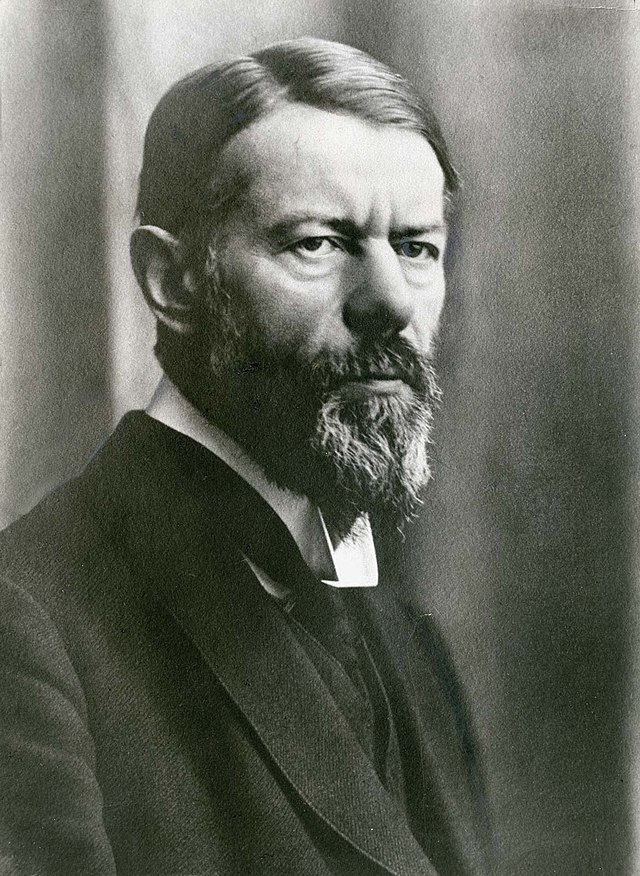
Maximilian Carl Emil Weber, born on April 21, 1864, in Erfurt, Germany, was a towering intellectual figure whose work has profoundly influenced the fields of sociology, economics, philosophy, and history. Weber is widely regarded as one of the founding fathers of modern sociology, and his ideas continue to shape academic discourse today. His work spans an array of topics, from the development of capitalism and the role of religion in society to the nature of authority and the structure of bureaucracy.
Early Life and Education
Max Weber was born into a well-off family in Erfurt, Prussia (modern-day Germany). His father, Max Weber Sr., was a prominent civil servant and politician, and his mother, Helene Fallenstein Weber, was a deeply religious woman with strong moral convictions. The intellectual environment of his household, combined with his father’s political connections, greatly influenced Weber’s early development.
Weber was an exceptionally bright student and attended some of the best schools in Germany. He studied law at the University of Heidelberg and later at the University of Berlin, where he also delved into economics, history, and philosophy. His academic prowess was evident early on, as he quickly made a name for himself in academic circles with his sharp intellect and profound insights into the social sciences.
After completing his doctorate in 1889, Weber began his career as a professor of law and later economics. His early works focused on economic history and the conditions of agrarian workers in the Roman Empire, reflecting his broad interest in the relationship between economy and society. These studies laid the foundation for his later, more comprehensive works on the sociology of religion, economics, and the development of Western civilization.
Contributions to Sociology and the Study of Capitalism
Max Weber’s most famous work, The Protestant Ethic and the Spirit of Capitalism (1904-1905), remains a cornerstone in the study of sociology and economics. In this seminal text, Weber argued that the rise of capitalism in Western Europe was closely linked to the Protestant Reformation, particularly the Calvinist emphasis on hard work, frugality, and economic success as signs of divine favor. This “Protestant ethic,” according to Weber, fostered the development of a capitalist spirit that prioritized rational calculation and efficiency over traditional and religious considerations.
Weber’s analysis of capitalism was groundbreaking because it challenged the materialistic interpretations of history put forward by thinkers like Karl Marx. While Marx emphasized the economic base as the primary driver of societal change, Weber insisted that cultural values and beliefs, particularly religious ideas, played a crucial role in shaping economic systems and social structures. This perspective opened up new avenues for understanding the complexities of social life and the interplay between culture, religion, and economics.
In addition to his work on capitalism, Weber’s contributions to the sociology of religion are equally significant. He conducted extensive comparative studies of the world’s major religions, including Hinduism, Buddhism, and Confucianism, in an attempt to understand the different paths of economic development in the East and the West. Through these studies, Weber sought to demonstrate how religious ideas and practices influenced the development of various social institutions and economic systems across cultures.
Methodological Innovations and the Concept of the Ideal Type
Weber was also a pioneering methodologist who introduced new tools and concepts to the social sciences. One of his most influential methodological contributions is the concept of the “ideal type,” a theoretical construct that serves as a tool for analyzing and comparing social phenomena. An ideal type is not a description of reality but rather a simplified, exaggerated model that highlights the essential features of a particular social phenomenon. By comparing actual cases to this ideal type, researchers can better understand the variations and complexities of real-world social structures.
Weber’s use of the ideal type was particularly effective in his analysis of bureaucracy, authority, and social action. For example, his ideal type of bureaucracy described a highly efficient, rationalized form of organization characterized by a clear hierarchy, formal rules, and impersonal relationships. Although no real-world bureaucracy perfectly matches this ideal type, the concept allows sociologists to identify and analyze the key elements that define bureaucratic structures.
Weber’s methodological approach also emphasized the importance of understanding social action from the perspective of the individuals involved. This approach, known as Verstehen (German for “understanding”), requires sociologists to interpret the meanings and motivations behind people’s actions rather than simply observing their external behavior. This emphasis on subjective understanding marked a significant departure from the positivist approaches that dominated the social sciences at the time and laid the groundwork for interpretive sociology.
The Sociology of Authority and Bureaucracy
Another major contribution of Max Weber was his analysis of authority and the development of modern bureaucratic institutions. In his work Economy and Society (published posthumously in 1922), Weber identified three types of legitimate authority: traditional, charismatic, and rational-legal. Traditional authority is based on long-established customs and practices, charismatic authority arises from the personal qualities and leadership of an individual, and rational-legal authority is grounded in formal rules and laws.
Weber argued that the modern state and other large organizations increasingly relied on rational-legal authority, which he saw as a hallmark of modernity. This form of authority is closely associated with the rise of bureaucracy, a system of administration that Weber described as the most efficient and rational way to organize human activity. However, he also warned that the growth of bureaucracy could lead to the “iron cage” of rationalization, where individuals are trapped in a system of rigid rules and procedures that stifles creativity and individuality.
Weber’s analysis of bureaucracy has had a lasting impact on the study of organizations and public administration. His insights into the strengths and limitations of bureaucratic systems continue to influence debates about the role of the state, the nature of authority, and the challenges of governance in complex societies.
Personal Challenges and Later Life
Despite his academic success, Max Weber’s personal life was marked by significant challenges. He suffered from severe mental health issues, including depression and anxiety, which led to a nervous breakdown in the late 1890s. As a result, he withdrew from academic life for several years and struggled to regain his footing. However, his return to academia in the early 1900s marked the beginning of his most productive period, during which he produced many of his most influential works.
Weber’s personal struggles were compounded by the political and social turmoil of the time. He lived through the unification of Germany, the rise of industrial capitalism, and the devastation of World War I. These events deeply influenced his thinking and fueled his concerns about the future of Western civilization.
In his later years, Weber became increasingly involved in political affairs. He was a vocal critic of the German Empire’s authoritarian tendencies and played a role in the drafting of the Weimar Constitution after the war. However, his efforts to promote democracy and social reform were often met with resistance, and he grew disillusioned with the prospects for meaningful change in Germany.
Legacy and Influence
Max Weber died on June 14, 1920, in Munich, Germany, at the age of 56, a victim of the post-World War I Spanish flu pandemic. Despite his relatively short life, Weber’s intellectual legacy is vast and continues to influence a wide range of disciplines. His work laid the foundation for modern sociology, and his ideas have been instrumental in shaping fields as diverse as political science, economics, history, and religious studies.
Weber’s contributions to the understanding of capitalism, authority, and the role of culture in social life remain central to contemporary debates in the social sciences. His methodological innovations, particularly the use of ideal types and the emphasis on Verstehen, continue to be employed by researchers seeking to understand complex social phenomena.
In addition to his academic influence, Weber’s ideas have had a profound impact on political thought and public policy. His analysis of bureaucracy and the “iron cage” of rationalization has informed critiques of modern governance and the challenges of balancing efficiency with human values in a rapidly changing world.
Conclusion
Max Weber was a towering figure whose work has left an indelible mark on the social sciences and beyond. His exploration of the relationship between religion, culture, and economic development, his analysis of authority and bureaucracy, and his methodological innovations have all contributed to a deeper understanding of the complexities of modern society. As one of the founding figures of sociology, Weber’s legacy continues to inspire and challenge scholars, policymakers, and thinkers around the world.
His work not only provides a lens through which to understand the social and economic structures of the past but also offers valuable insights into the challenges and opportunities of the present and future. As we continue to grapple with issues of authority, rationalization, and the role of culture in shaping human behavior, Weber’s contributions remain as relevant today as they were over a century ago.


