
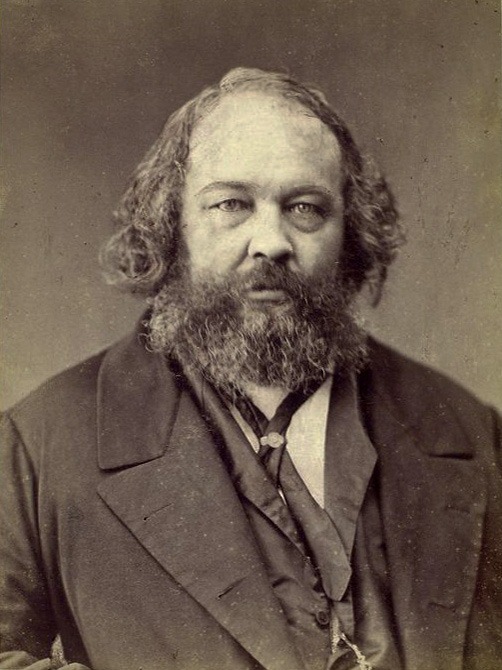
Michail Aleksandrovič Bakunin, born on May 30, 1814, in the small village of Prjamuchino near Tver, Russia, is one of the most influential figures in the history of anarchism. Known for his revolutionary ideas and his role in shaping the anarchist movement, Bakunin’s life was marked by his relentless pursuit of freedom and equality. This article delves into the life, fame, and significant highlights of Michail Bakunin, providing a comprehensive understanding of his contributions to political thought and his impact on modern anarchism.
Early Life and Intellectual Formation
Michail Bakunin was born into a noble family, and his early education reflected his privileged background. However, he soon developed a profound interest in philosophy and political theory, which led him to diverge from the expectations of his aristocratic lineage. In the 1830s, Bakunin became a follower of Hegel, translating Hegel’s works into Russian and immersing himself in the study of dialectics and idealism. This intellectual foundation played a crucial role in shaping his revolutionary ideas.
In 1842, Bakunin wrote “The Reaction in Germany,” an influential article that gained popularity among young intellectuals. The essay’s concluding assertion, “The passion for destruction is also a creative passion,” became one of his most cited quotes, encapsulating his belief in the revolutionary potential of upheaval and change.
Encounter with Marx and Early Revolutionary Activities
Bakunin first met Karl Marx and Pierre-Joseph Proudhon in Paris in 1844. This meeting marked the beginning of his deep engagement with socialist and anarchist ideas. Alongside Marx, Ludwig Feuerbach, and Arnold Ruge, Bakunin co-founded the journal Deutsch-Französische Jahrbücher, which aimed to foster intellectual and revolutionary dialogue between German and French thinkers.
In 1848, Bakunin participated in the German Revolution in Dresden, actively engaging in revolutionary activities aimed at overthrowing the existing political order. However, the following year, he was arrested in Saxony, leading to a death sentence that was eventually commuted to life imprisonment.
Imprisonment and Exile
Bakunin’s imprisonment marked a significant period in his life. After his arrest in Saxony, he was handed over to Austrian authorities, where he faced further trials, including another death sentence commuted to life imprisonment. During his incarceration, Bakunin endured severe torture and harsh conditions.
In 1851, Bakunin was extradited to Russia, where Tsar Nicholas I condemned him to lifelong imprisonment in the notorious Peter and Paul Fortress in St. Petersburg. After Nicholas I’s death in 1855, Bakunin was exiled to Siberia in 1857. Despite the harsh conditions, Bakunin’s spirit remained unbroken. In 1861, he managed to escape, traveling through Japan and the United States before seeking refuge in London.
Bakunin’s Time in Italy
In 1865, Bakunin settled in Naples, Italy, where he founded the journal “Libertà e Giustizia” (Liberty and Justice). During his time in Italy, Bakunin became a vocal critic of Giuseppe Mazzini’s nationalist and statist views, advocating instead for a federalist and anarchist approach to social organization.
Bakunin’s involvement in the Italian revolutionary movement was significant. He believed that Italy, with its fragmented political landscape and history of popular uprisings, was fertile ground for the development of revolutionary socialism. In 1868, Bakunin participated in the first congress of the League for Peace and Freedom, hoping to steer the organization towards revolutionary socialism. However, when his efforts proved futile, he and his followers split from the league and joined the International Workingmen’s Association (IWA).
Conflict with Marx and the IWA
Bakunin’s relationship with Marx and the IWA was fraught with ideological conflicts. Bakunin opposed Marx’s emphasis on centralized state control and instead advocated for a decentralized, federative approach to socialism. This ideological rift culminated in Bakunin’s expulsion from the IWA in 1872 after he expressed solidarity with the Jura Federation, a faction within the IWA that championed anti-authoritarian principles.
Despite his expulsion, Bakunin continued to work towards his vision of an anarchist society. In 1872, he organized the first congress of the Anti-Authoritarian International in Saint-Imier, which aimed to promote anarchist principles and resist authoritarian socialism.
Later Years and Death
During the Franco-Prussian War in 1871, Bakunin attempted to incite a popular uprising in Lyon, France, reflecting his unwavering commitment to revolutionary action. In 1873, he wrote his only complete work, “State and Anarchy,” which laid out his critique of the state and his vision for an anarchist society.
Bakunin’s health began to deteriorate in his later years, but he remained active in promoting his ideas. He spent his final years in Switzerland, where he continued to write and engage with fellow revolutionaries. Michail Bakunin died on July 1, 1876, in Bern, Switzerland, at the age of 62.
Bakunin’s Thought and Legacy
Bakunin’s political philosophy is rooted in his belief in the inherent potential of individuals to achieve freedom and equality through collective action. He rejected the notion of the state as a necessary instrument for achieving socialism, arguing that any form of state control would inevitably lead to tyranny and oppression. Instead, Bakunin advocated for a decentralized, federative system based on voluntary associations and mutual aid.
Bakunin’s critique of the state and his vision for a stateless society were influenced by his studies of Hegelian dialectics and his interactions with Marxist theory. However, unlike Marx, Bakunin did not believe in a transitional state phase, asserting that the state, in any form, was fundamentally antithetical to true freedom.
Revolutionary Praxis
Bakunin’s approach to revolution was characterized by his belief in the necessity of direct action and spontaneous uprisings. He argued that revolutionaries should not create a separate revolutionary army but should act as a vanguard to inspire and support popular insurrections. This belief in the power of the masses to effect change was central to his anarchist ideology.
Critique of Marxism
Bakunin’s disagreements with Marx were profound and enduring. He criticized Marx’s emphasis on centralized state power and his belief in a dictatorship of the proletariat as a necessary stage in the transition to socialism. Bakunin feared that such a state would merely replace one form of oppression with another, ultimately subjugating the working class under a new ruling elite.
Influence on Anarchist Movements
Bakunin’s ideas have had a lasting impact on anarchist movements worldwide. His writings and actions inspired subsequent generations of anarchists and influenced various strands of anarchist thought, including collectivist anarchism, syndicalism, and anarcho-communism. His emphasis on direct action, decentralization, and voluntary cooperation remains central to anarchist theory and practice.
Conclusion
Michail Bakunin’s life and work represent a pivotal chapter in the history of anarchism. His relentless pursuit of freedom and equality, coupled with his incisive critiques of state power and authoritarianism, continue to resonate with those who seek a society based on mutual aid and voluntary cooperation. Bakunin’s legacy is a testament to the enduring appeal of anarchist principles and the ongoing struggle for a world free from oppression and domination.
As we reflect on Bakunin’s contributions, it is clear that his ideas remain relevant in contemporary discussions about power, freedom, and social justice. His vision of a stateless, egalitarian society challenges us to rethink our assumptions about authority and to imagine new possibilities for collective liberation.


