
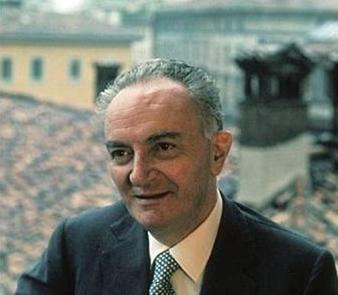
Michele Sindona is a name synonymous with financial intrigue, high-stakes banking, and one of the most complex criminal sagas in modern Italian history. Born on May 8, 1920, in Patti, a small town in the province of Messina, Sicily, Sindona’s life story is one of dramatic rise and equally dramatic fall, entwined with the economic and political fabric of post-war Italy. His journey from a humble background to becoming a key player in international finance—and eventually a central figure in one of Italy’s most notorious criminal cases—offers a compelling narrative of ambition, power, and ultimate ruin.
Early Life and Education
Michele Sindona was born into a modest family; his father was a florist, and young Michele showed early signs of a sharp intellect. Despite his family’s limited means, Sindona was determined to pursue an education. He attended a Jesuit school, where he was exposed to a rigorous academic environment. To support himself, he began working as a typist at the age of 14, a job that would help him financially through his formative years.
Sindona’s academic prowess earned him a place at the University of Messina, where he studied law. He graduated in 1942 with a thesis on Niccolò Machiavelli’s The Prince, a topic that would prove prescient given Sindona’s later life, where the themes of power, manipulation, and strategy would play a central role. His legal education provided him with a solid foundation for his future endeavors in finance, where he would navigate the complexities of international banking with the cunning of a Machiavellian figure.
Entry into the Financial World
After World War II, Sindona moved to Milan, a city that was rapidly becoming the financial hub of Italy. In 1946, he established his own tax consultancy firm, specializing in legal and financial advice for businesses. His sharp mind and understanding of the legal intricacies of finance quickly made him one of the most sought-after consultants in Milan. By the 1950s, Sindona had built a reputation as a brilliant, if somewhat unscrupulous, financial advisor.
It was during this period that Sindona became involved in the world of tax evasion and capital exportation. He specialized in creating complex financial structures that allowed his clients to hide assets in offshore accounts, primarily in Switzerland and Luxembourg. This expertise in “creative accounting” attracted a clientele that included some of Italy’s wealthiest families and corporations.
The Rise to Power: Banca Privata Finanziaria
Sindona’s success in financial consultancy allowed him to accumulate significant wealth, which he used to make a strategic entry into the banking sector. In 1961, he purchased Banca Privata Finanziaria, a small bank that would serve as the cornerstone of his financial empire. Through this bank, Sindona began to expand his influence, acquiring stakes in various companies and financial institutions both in Italy and abroad.
One of Sindona’s key strategies was to use his banking network to facilitate the movement of large sums of money across borders, often involving dubious or outright illegal transactions. By the mid-1960s, Sindona had established connections with several powerful figures in the international financial community, including members of the American mafia. His bank became a conduit for laundering money generated from narcotics trafficking and other criminal activities.
The Dark Side of Success: Allegations and Investigations
As Sindona’s wealth and influence grew, so did the scrutiny of his operations. By the late 1960s, he had attracted the attention of law enforcement agencies, particularly in the United States, where the Interpol began investigating his connections to organized crime. Despite mounting evidence of his involvement in money laundering and other illegal activities, Sindona managed to avoid prosecution for several years, thanks in part to his powerful connections in both Italy and the United States.
One of the most significant relationships Sindona cultivated was with Giovanni Battista Montini, the Archbishop of Milan, who would later become Pope Paul VI. Through this connection, Sindona gained access to the Vatican’s financial network, eventually involving the Vatican Bank (IOR) in his financial schemes. This association provided Sindona with a veneer of legitimacy, even as his criminal activities continued to expand.
The Franklin National Bank and International Notoriety
Sindona’s ambitions reached new heights in the early 1970s when he set his sights on the United States. In 1972, he acquired a controlling interest in Franklin National Bank, one of the largest banks in the United States at the time. This move marked the pinnacle of Sindona’s financial career, as he was now at the helm of a major American financial institution.
However, Sindona’s control of Franklin National Bank would prove to be his undoing. In 1974, the bank collapsed in what was then the largest bank failure in U.S. history. The collapse was the result of reckless financial practices, including speculative currency trading and fraudulent loans. Sindona had used the bank to cover massive losses incurred through his other business dealings, leading to its insolvency.
The fallout from the Franklin National Bank scandal was immense. Sindona, once hailed as a financial genius and “the savior of the lira” by Italian politicians, was now exposed as a fraudster. The scandal also revealed the extent of his criminal activities, including his connections to the mafia and his involvement in laundering drug money.
The Fall: Legal Battles and Criminal Convictions
In the wake of the Franklin National Bank collapse, Michele Sindona’s life began to unravel. He faced multiple charges in both Italy and the United States, including fraud, perjury, and embezzlement. In Italy, Giorgio Ambrosoli, a lawyer appointed to liquidate Sindona’s Italian assets, uncovered extensive evidence of financial malpractice. Ambrosoli’s investigation would lead to one of the most infamous chapters in Sindona’s life.
In July 1979, Ambrosoli was assassinated outside his home in Milan. The murder was later traced back to Sindona, who had ordered the hit to prevent Ambrosoli from exposing further details of his criminal empire. This murder, combined with the financial scandals, turned Sindona into a symbol of the corruption that plagued Italy during the 1970s.
In the United States, Sindona was convicted on more than 60 counts, including fraud and embezzlement, and was sentenced to 25 years in federal prison. Meanwhile, in Italy, he was tried in absentia and received additional sentences, including life imprisonment for his role in Ambrosoli’s murder.
The Final Years: Imprisonment and Mysterious Death
Michele Sindona’s final years were marked by a series of desperate attempts to regain his freedom and power. In 1979, he staged a fake kidnapping in Palermo, hoping to negotiate a return to the United States under more favorable conditions. The plan failed, and Sindona was eventually recaptured and extradited to Italy, where he was imprisoned.
In 1986, while serving his sentence in a high-security prison in Voghera, Italy, Sindona died under mysterious circumstances. He was found in his cell after ingesting a cup of coffee laced with cyanide. His death was officially ruled a suicide, though many speculate that it was an assassination orchestrated by those who feared what Sindona might reveal if he were ever released.
The Legacy of Michele Sindona
Michele Sindona’s life is a cautionary tale of ambition unchecked by ethics, a story that intertwines the worlds of high finance, organized crime, and political corruption. His rise to power was fueled by a keen intellect and an ability to manipulate complex financial systems, but his downfall was precipitated by the very same traits—ambition and ruthlessness—that had brought him success.
Sindona’s legacy is a dark one, marked by scandal, crime, and the tragic murder of Giorgio Ambrosoli. His actions exposed the vulnerabilities in the global financial system and highlighted the dangers of unchecked financial power. Today, Sindona is remembered not as a financial genius, but as a symbol of the corruption and moral decay that can arise in the pursuit of wealth and power.
The story of Michele Sindona continues to resonate, particularly in Italy, where his life and crimes are a reminder of a turbulent era in the nation’s history. His connections to the mafia, the Vatican, and the political elite have made him a subject of endless fascination and study, with many of the mysteries surrounding his life and death still unresolved.
As financial systems and regulatory frameworks continue to evolve, the lessons from Sindona’s life remain relevant. His story serves as a stark reminder of the need for transparency, accountability, and integrity in the world of finance.


