
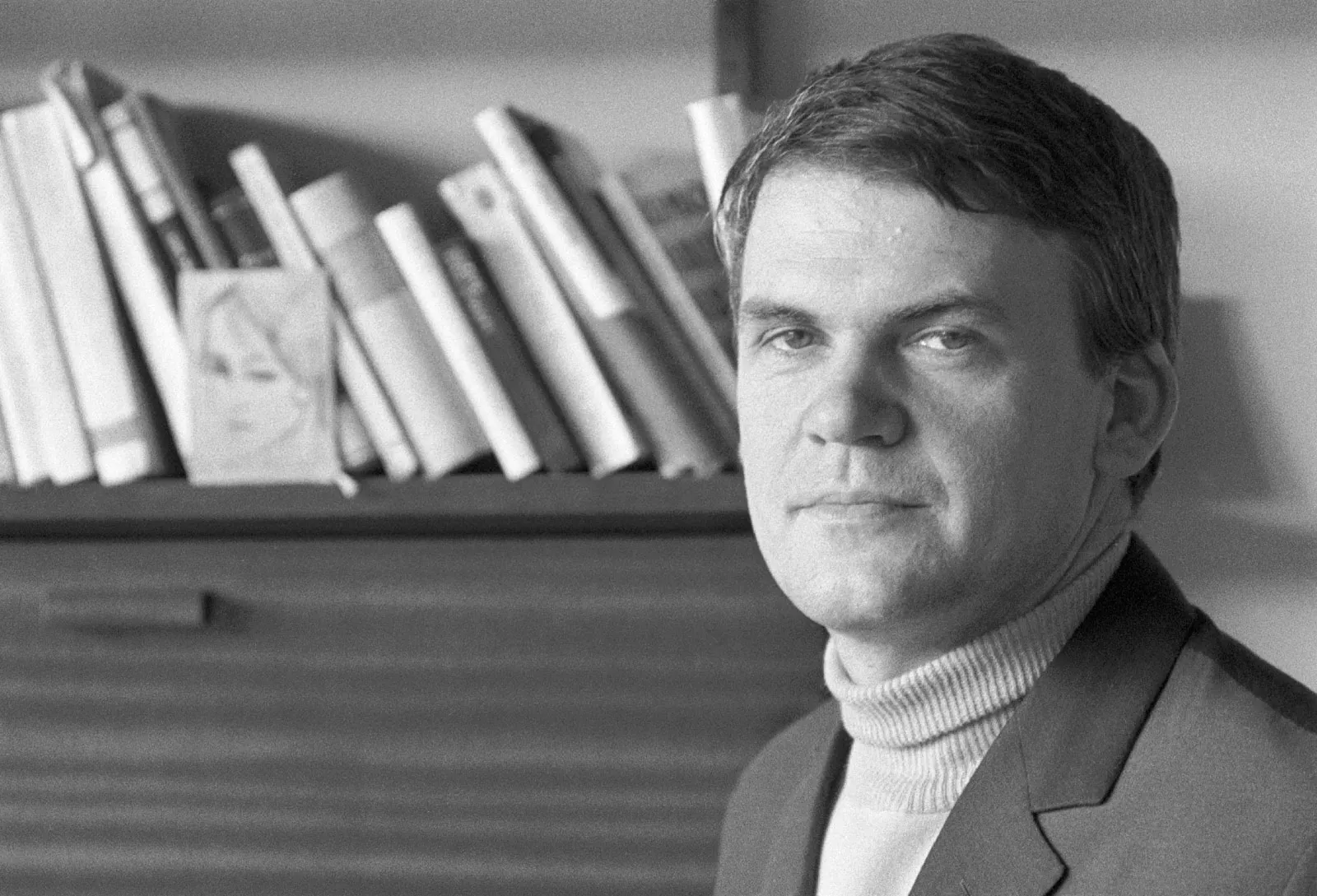
Milan Kundera, born on April 1, 1929, in Brno, Czechoslovakia (now the Czech Republic), was a prolific and influential writer whose works left an indelible mark on world literature. Known for his profound explorations of themes such as identity, memory, and the human condition, Kundera’s novels often blend philosophical discourse with intricate narratives, making him a central figure in the 20th-century literary canon. His journey from a young intellectual in Czechoslovakia to an internationally celebrated author in France is a testament to his intellectual resilience and literary genius.
Early Life and Cultural Influences
Milan Kundera was born into a family deeply rooted in the arts. His father, Ludvik Kundera, was a prominent pianist and musicologist, which ensured that Kundera grew up in a culturally rich environment. This early exposure to music profoundly influenced his later works, where he often drew parallels between musical composition and narrative structure.
In his youth, Kundera was not only passionate about literature but also dabbled in music, particularly jazz, which was gaining popularity in post-war Europe. His love for jazz reflects his broader interest in the arts and his desire to explore different forms of expression. Kundera’s educational pursuits were equally diverse; he studied literature and aesthetics at Charles University in Prague and later enrolled at the Film and TV School of the Academy of Performing Arts in Prague (FAMU), where he studied screenwriting and film direction.
Political Engagement and Early Literary Career
Kundera’s early adulthood was marked by political turbulence in Czechoslovakia, a country under the influence of Soviet communism. Initially, Kundera was a committed communist, joining the Communist Party of Czechoslovakia in 1948. However, his enthusiasm waned as he became increasingly disillusioned with the oppressive nature of the regime. This shift in perspective was evident in his early works, which often contained subtle criticisms of the state.
Kundera’s involvement in the Communist Party was short-lived; he was expelled twice, first in 1950 and then again in 1956, for his “anti-party activities” and for holding views that diverged from the official party line. These experiences of political disillusionment and censorship would become recurring themes in his later works.
In the 1950s, Kundera began his literary career with poetry and short stories. His first significant work, The Joke (Žert), published in 1967, was a biting satire of the absurdities of life under a totalitarian regime. The novel’s protagonist, Ludvik Jahn, is a man whose life is ruined by a single, politically charged joke, a narrative that resonated deeply with readers living under repressive governments. The Joke was a critical success and marked the beginning of Kundera’s international reputation as a novelist capable of blending political critique with deep humanism.
The Prague Spring and Exile in France
The Prague Spring of 1968, a brief period of political liberalization in Czechoslovakia, was a pivotal moment in Kundera’s life. Like many intellectuals of the time, Kundera was an active participant in the reform movement, which sought to create “socialism with a human face.” However, the movement was brutally crushed by the Soviet-led Warsaw Pact invasion in August 1968, leading to widespread repression.
Kundera’s involvement in the Prague Spring had severe consequences. He was blacklisted, his books were banned, and he lost his teaching position at the Film and TV School of the Academy of Performing Arts in Prague. In 1975, Kundera went into exile in France, where he would spend the rest of his life. This move marked a significant shift in his writing; while his earlier works were written in Czech, his later novels were predominantly written in French.
Literary Achievements and Major Works
Kundera’s relocation to France did not diminish his literary output; rather, it allowed him to reach a broader audience. His novels, characterized by their intricate structure and philosophical depth, continued to explore themes of identity, memory, and the individual’s place in society.
One of Kundera’s most famous works is The Unbearable Lightness of Being (Nesnesitelná lehkost bytí), published in 1984. This novel, set against the backdrop of the Prague Spring and its aftermath, delves into the lives of four characters whose fates are intertwined by love, politics, and existential musings. The novel’s exploration of the idea of “lightness” versus “weight” in human existence—whether life is a fleeting, inconsequential experience or a series of deeply meaningful events—resonated with readers worldwide. The book’s success was further amplified by its 1988 film adaptation, directed by Philip Kaufman, although Kundera himself was famously critical of the adaptation.
Another significant work is The Book of Laughter and Forgetting (Kniha smíchu a zapomnění), published in 1979. This novel is a series of interconnected stories that examine how personal and collective memories are shaped, manipulated, and erased by political power. Kundera’s narrative style in this book—combining elements of fiction, autobiography, and philosophical essay—exemplifies his approach to the novel as a space for intellectual exploration.
Immortality (Nesmrtelnost), published in 1990, marked Kundera’s further experimentation with narrative form. The novel intertwines the lives of several characters, both real and fictional, across different time periods, exploring the idea of legacy and the human desire for immortality. It is in this work that Kundera fully embraces the concept of the “novel-essay,” blending fiction with philosophical inquiry in a seamless narrative.
Philosophical and Aesthetic Contributions
Kundera’s novels are not only literary achievements but also philosophical treatises. His work often reflects on the nature of the novel itself, as well as broader existential questions. He was deeply influenced by the philosophy of Friedrich Nietzsche, particularly the concept of “eternal return,” which he explores in The Unbearable Lightness of Being. This philosophical underpinning adds a layer of complexity to his narratives, inviting readers to engage with his work on both an emotional and intellectual level.
Kundera’s exploration of memory, both personal and collective, is another recurring theme in his work. He was fascinated by the ways in which memories can be manipulated, erased, or reconstructed, particularly in societies where history is often rewritten by those in power. This theme is most evident in The Book of Laughter and Forgetting, where Kundera examines how individuals and societies deal with the burden of history and the inevitability of forgetting.
Aesthetically, Kundera’s writing is marked by its clear, precise language and its structural complexity. He was a master of the “novel-essay,” a form that allowed him to integrate philosophical discourse into his narratives without sacrificing the emotional depth of his characters. This hybrid form is a hallmark of Kundera’s style and has influenced countless writers who seek to blur the boundaries between fiction and non-fiction.
Later Life and Legacy
In the latter part of his career, Kundera continued to write in French, producing works such as Slowness (La Lenteur, 1995), Identity (L’Identité, 1997), and Ignorance (L’Ignorance, 2000). These novels, while shorter and more introspective than his earlier works, continued to explore themes of identity, memory, and the passage of time. They reflect Kundera’s ongoing engagement with the philosophical questions that had preoccupied him throughout his life.
Despite living in France for most of his adult life and adopting French as the language of his later works, Kundera remained deeply connected to his Czech roots. However, his relationship with his homeland was complicated. For many years, his works were banned in Czechoslovakia, and he was considered a persona non grata by the communist regime. It was only after the fall of communism that his books were reintroduced to Czech readers, and he was able to visit his homeland once more.
Kundera’s legacy is that of a writer who transcended national boundaries and language barriers to become a global literary figure. His novels are studied in universities around the world, and his influence can be seen in the works of contemporary writers who seek to explore the human condition through a philosophical lens.
In 2023, Kundera passed away at the age of 94 in Paris, leaving behind a body of work that continues to resonate with readers and scholars alike. His exploration of the complexities of human existence, the interplay of memory and forgetting, and the nature of political power ensures that his work remains relevant in an ever-changing world.
Conclusion
Milan Kundera’s life and work offer a profound meditation on the nature of existence, identity, and the power of art to challenge and transform society. From his early days as a young intellectual in Czechoslovakia to his status as one of the most important writers of the 20th century, Kundera’s journey is a testament to the enduring power of literature to capture the complexities of the human experience.
His novels, with their blend of narrative innovation, philosophical depth, and emotional resonance, continue to captivate readers across the globe. As we reflect on his legacy, it is clear that Milan Kundera’s work will remain a vital part of the literary canon for generations to come.


