
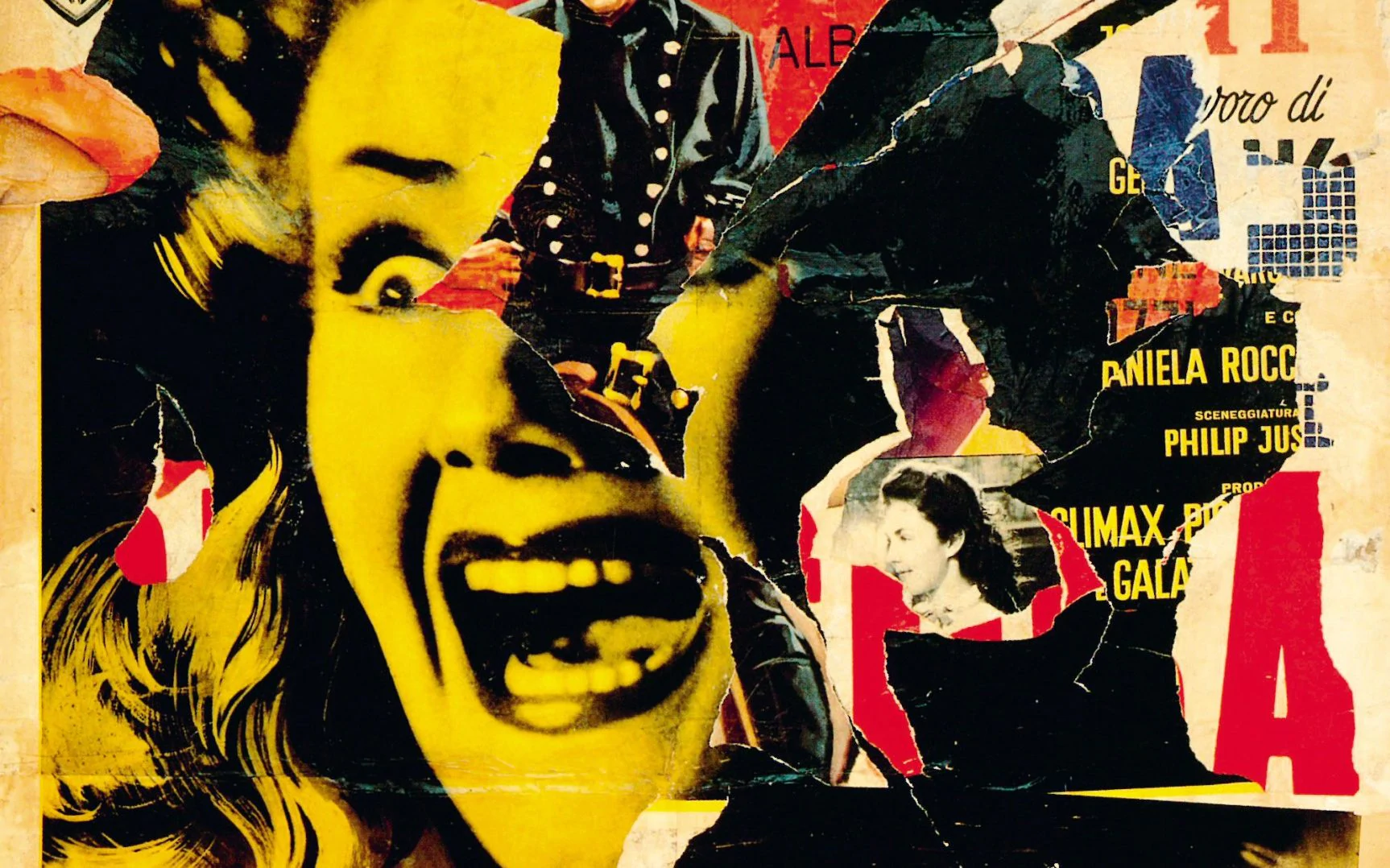
Mimmo Rotella, born Domenico Rotella on October 7, 1918, in Catanzaro, Italy, is celebrated as one of the most innovative and influential figures in 20th-century art. Known for his pioneering techniques and avant-garde approach, Rotella’s work has left an indelible mark on the world of contemporary art. His creative journey from the streets of post-war Rome to the galleries of Paris and New York encapsulates the dynamic and transformative spirit of modern art.
Early Life and Education
Rotella’s early years were spent in the southern Italian town of Catanzaro, a place far removed from the cultural hubs of Europe. Despite the geographical and cultural isolation, Rotella demonstrated a keen interest in art from a young age. His passion led him to enroll at the Accademia di Belle Arti in Naples, where he honed his artistic skills and developed a foundational understanding of traditional art forms.
In 1945, shortly after the end of World War II, Rotella moved to Rome. The city, which was rebuilding itself both physically and culturally after the war, provided fertile ground for Rotella’s burgeoning artistic career. Rome in the post-war period was a melting pot of ideas, where artists, writers, and intellectuals gathered to explore new forms of expression. It was in this vibrant environment that Rotella began to experiment with different artistic styles, moving away from traditional forms and towards more radical approaches.
The Evolution of an Artistic Vision
Rotella’s early work was characterized by experimentation. He explored various styles, including abstract and figurative painting, but it was his dissatisfaction with traditional painting methods that led him to seek new forms of expression. This period of exploration was crucial in shaping Rotella’s artistic identity, as he searched for a way to break free from the conventions of the art world.
In 1951, Rotella held his first solo exhibition at the Galleria Chiurazzi in Rome. The exhibition was well-received and marked the beginning of Rotella’s rise to prominence in the Italian art scene. That same year, he was awarded a scholarship by the Fulbright Foundation, which allowed him to travel to the United States and attend the prestigious University of Kansas City. This experience broadened Rotella’s artistic horizons and exposed him to new ideas and techniques.
While in the United States, Rotella created a mural for the Faculty of Physics at the university and recorded his first phonetic poems, which he called “epistaltic” poems. These early works demonstrated Rotella’s interest in combining different forms of media and his desire to push the boundaries of what could be considered art.
The Invention of Décollage
Upon his return to Italy in the early 1950s, Rotella experienced what he described as an “artistic crisis.” He felt that traditional painting had reached a dead end and began searching for new ways to express himself. It was during this period of reflection that Rotella invented the technique of décollage, a process that would become his signature style.
Décollage, in contrast to collage, involves the tearing away of layers from posters and advertisements found on the streets, rather than the assembly of different materials. Rotella’s décollage works were created by stripping posters off walls and then reassembling the torn pieces on canvas. This method allowed him to create dynamic compositions that captured the energy and chaos of urban life.
The technique was revolutionary and aligned with the broader trends of the post-war avant-garde movement, which sought to break down the barriers between high art and popular culture. Rotella’s décollage works, such as “Un poco in su” and “Collage” from 1954, were among the earliest examples of this approach and quickly gained attention in the art world.
Rotella’s work during this period reflected the influence of Dadaism and the ready-made concept pioneered by Marcel Duchamp. Like Duchamp, Rotella sought to challenge traditional notions of art by incorporating everyday objects and materials into his work. His use of torn posters, often featuring advertisements or film images, also drew parallels to the Pop Art movement, which was emerging in the United States around the same time.
Rise to International Fame
In the late 1950s, Rotella’s work began to attract international attention. He started to move away from purely abstract compositions and began incorporating recognizable images into his décollage works. This shift culminated in the “Cinecittà” series in 1962, where Rotella used images of movie stars and iconic figures from Hollywood. Works like “Eroi in galera” and “Tre minuti di tempo” from this series captured the glamour and allure of cinema while also critiquing the commercialization of culture.
Rotella’s association with the Nouveaux Réalistes, a group of artists who sought to incorporate elements of the real world into their work, further solidified his place in the international art scene. Invited by the influential critic Pierre Restany, Rotella joined the group in 1961. The Nouveaux Réalistes, including artists like Yves Klein and Arman, shared a commitment to exploring new materials and methods, often using found objects in their art.
In 1964, Rotella moved to Paris, where he continued to experiment with new techniques. One of his significant innovations during this period was the development of Mec Art, a process that involved using mechanical reproduction techniques on emulsion-coated canvases. This approach allowed Rotella to create works that blurred the lines between photography, painting, and printmaking. His first Mec Art pieces were exhibited at the Galerie J in Paris in 1965, further establishing his reputation as a leading figure in contemporary art.
Later Work and Continued Innovation
Throughout the 1970s and 1980s, Rotella continued to push the boundaries of his art. He began experimenting with a new technique called “Artypo,” which involved using printer’s proofs and other typographical materials to create unique compositions. These works were a continuation of Rotella’s interest in the intersection of art and commercial imagery, as well as his desire to challenge the traditional boundaries of artistic media.
Rotella’s work from this period also included the “Plastiforme” series, which he exhibited in Milan in 1975. These works involved covering advertising posters with plastic sheets, creating a layered effect that obscured the underlying images. The “Plastiforme” series was a commentary on the ways in which mass media and consumer culture manipulate and distort reality.
In the 1980s, Rotella returned to the theme of cinema with the “Cinecittà 2” series, revisiting the imagery of Hollywood and popular culture that had been a central focus of his earlier work. He also developed a new technique called “Sovrapitture,” which involved painting over décollage pieces on metal panels. These works represented a synthesis of Rotella’s previous experiments with décollage, Mec Art, and Artypo, showcasing his ability to continually reinvent his artistic practice.
Legacy and Influence
Mimmo Rotella’s contributions to contemporary art are immense. His invention of the décollage technique and his ongoing experimentation with media and materials have left a lasting impact on the art world. Rotella’s work is a testament to the power of innovation and the importance of challenging traditional boundaries in art.
Rotella participated in numerous prestigious exhibitions throughout his career, including “The Art of Assemblage” at the Museum of Modern Art in New York (1961), “Oltre l’Informale” at the IV Biennale Internazionale d’Arte di San Marino (1963), and “The Italian Metamorphosis 1943-1968” at the Solomon R. Guggenheim Museum in New York (1994). His work is held in major collections around the world, and he is regarded as one of the key figures in post-war European art.
Rotella’s influence extends beyond his immediate circle of contemporaries. His work has inspired subsequent generations of artists who have explored similar themes of consumer culture, media, and the fragmentation of images. The legacy of Mimmo Rotella is one of relentless innovation and a commitment to expanding the possibilities of what art can be.
Rotella passed away on January 9, 2006, in Milan, leaving behind a body of work that continues to inspire and challenge the art world. His career is a testament to the power of creative vision and the enduring impact of challenging the status quo. As the world of art continues to evolve, Mimmo Rotella’s influence remains a vital part of its ongoing narrative.


