
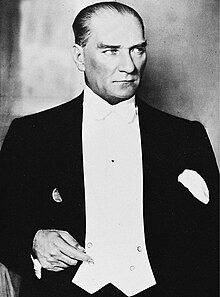
Mustafa Kemal Atatürk, a name synonymous with modern Turkey, stands as a towering figure in the annals of history. His indelible impact on the nation’s political, social, and cultural landscape continues to resonate even today. To understand the full spectrum of Atatürk’s influence, one must delve into his early life, military career, the revolutionary reforms he championed, and the lasting legacy he left behind.
Early Life and Education
Birth and Family Background
Mustafa Kemal Atatürk was born on May 19, 1881, in Salonika (now Thessaloniki, Greece), which was then part of the Ottoman Empire. His father, Ali Rıza Efendi, was a minor official and later a lumber trader, while his mother, Zübeyde Hanım, was a devout Muslim and homemaker. Atatürk’s upbringing was shaped by a blend of traditional values and progressive ideals, which were to influence his future vision for Turkey.
Education and Early Influences
Atatürk’s formal education began at the Şemsi Efendi School, a progressive institution that emphasized modern sciences alongside traditional subjects. This early exposure to modernity played a crucial role in shaping his worldview. After his father’s death, his mother moved the family to the countryside, but Atatürk soon returned to Salonika to continue his education. He attended the Salonika Military School, where he excelled in mathematics and earned the nickname “Kemal,” meaning perfection or maturity.
Military Career and Rise to Fame
Early Military Service
Atatürk’s military career began in earnest when he enrolled at the Ottoman Military Academy in Istanbul, graduating as a lieutenant in 1902. He furthered his education at the Ottoman War College, where he graduated as a staff captain in 1905. His early assignments took him to various parts of the Ottoman Empire, including Syria and Libya, where he honed his skills in leadership and strategy.
Role in World War I
Atatürk’s prominence grew significantly during World War I. He played a pivotal role in the Gallipoli Campaign (1915-1916), where his strategic acumen and leadership were instrumental in halting the Allied forces. His success at Gallipoli not only earned him national fame but also cemented his reputation as a formidable military leader. Following Gallipoli, he served in various capacities on different fronts, including the Eastern Front and in the defense of Anatolia.
The War of Independence and the Birth of a Nation
The Turkish War of Independence
Following the defeat of the Ottoman Empire in World War I, the nation faced partition under the Treaty of Sèvres. Atatürk emerged as the leader of the Turkish National Movement, rallying support for the resistance against occupying Allied forces. The ensuing Turkish War of Independence (1919-1923) saw Atatürk lead the nationalists to victory, culminating in the establishment of the Republic of Turkey.
Founding of the Republic
On October 29, 1923, the Republic of Turkey was officially proclaimed, with Atatürk unanimously elected as its first president. This marked the beginning of an era of profound transformation, as Atatürk embarked on an ambitious agenda to modernize Turkey. His vision was to create a secular, democratic, and industrialized nation-state, shedding the vestiges of the Ottoman past.
Reforms and Modernization
Political and Legal Reforms
Atatürk’s reformist zeal was most evident in his political and legal initiatives. He abolished the sultanate and the caliphate, severing the traditional ties between religion and state. The adoption of a new civil code, modeled after the Swiss Civil Code, replaced Islamic law, ensuring equality before the law for all citizens. These reforms laid the foundation for a secular state structure.
Social and Cultural Reforms
Atatürk recognized that true modernization required a transformation in social and cultural norms. He introduced sweeping changes aimed at elevating the status of women, including granting them the right to vote and run for office. The adoption of the Latin alphabet in place of the Arabic script was another monumental change, making education more accessible and fostering greater literacy.
Economic and Educational Reforms
Atatürk’s economic policies focused on industrialization and self-sufficiency. He established state-owned enterprises and promoted agricultural development to reduce Turkey’s dependency on foreign imports. In the realm of education, Atatürk championed universal primary education and founded numerous schools, universities, and vocational institutions to cultivate a skilled and educated populace.
Legacy and Continuing Influence
Atatürk’s Enduring Legacy
Atatürk passed away on November 10, 1938, but his legacy endures in numerous facets of Turkish life. His principles, known as “Kemalism,” continue to guide Turkey’s political and social ethos. These principles include republicanism, nationalism, secularism, statism, populism, and reformism. Atatürk’s mausoleum, Anıtkabir, in Ankara, remains a site of national reverence, symbolizing the enduring respect and admiration for his contributions.
Historical and Global Impact
Atatürk’s impact extends beyond Turkey’s borders. His successful implementation of secularism and modernization has been studied and admired by many leaders around the world. He demonstrated that a predominantly Muslim nation could embrace modernity while retaining its cultural identity. Atatürk’s vision and reforms have thus left an indelible mark on global history, influencing movements for modernization and secular governance worldwide.
Nuances and Historical Context
The Ottoman Decline and Nationalism
To fully appreciate Atatürk’s achievements, one must understand the context of the declining Ottoman Empire. The empire, once a formidable power, was in a state of disarray by the late 19th and early 20th centuries. Nationalist movements within and outside the empire sought independence, leading to significant territorial losses. Atatürk’s emergence as a leader was partly fueled by the desire to restore national pride and sovereignty.
Challenges and Controversies
Atatürk’s reforms were not without challenges and controversies. His secularization efforts, while progressive, faced opposition from conservative factions within Turkish society. The transition from a religiously oriented society to a secular one was fraught with tension. Additionally, some of Atatürk’s policies, such as the suppression of Kurdish uprisings, have been critiqued for their authoritarian nature. These complexities add depth to the understanding of Atatürk’s legacy, highlighting the intricate balance between progress and tradition.
Cultural Renaissance
Under Atatürk’s leadership, Turkey experienced a cultural renaissance. The promotion of the arts, literature, and architecture flourished as the country sought to forge a new identity. The establishment of institutions like the State Opera and Ballet and the Turkish Historical Society reflected Atatürk’s commitment to cultural enrichment. This period saw the birth of modern Turkish literature, with writers like Halide Edib Adıvar and Yakup Kadri Karaosmanoğlu exploring themes of nationalism, identity, and social change.
Conclusion
Mustafa Kemal Atatürk’s life is a testament to visionary leadership and unwavering commitment to national progress. From his early days as a military officer to his role as the founder of modern Turkey, Atatürk’s journey was marked by resilience, innovation, and a deep sense of patriotism. His reforms not only transformed Turkey into a modern republic but also set a precedent for nations grappling with the challenges of modernization and secularization. Atatürk’s legacy, characterized by his relentless pursuit of progress and justice, continues to inspire and resonate, affirming his place as one of the most influential leaders of the 20th century.


