
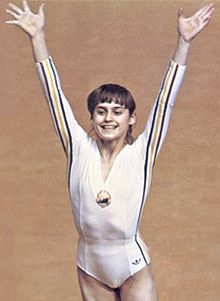
Nadia Comaneci, born on November 12, 1961, in Onesti, Romania, is one of the most iconic figures in the history of gymnastics and sports. Her name is forever etched in the annals of Olympic history due to her extraordinary achievements at the 1976 Montreal Olympics. But Nadia’s story is more than just a tale of athletic prowess; it’s a narrative rich with historical context, personal struggles, and ultimate triumph.
Early Life and Introduction to Gymnastics
Nadia Elena Comaneci was born to Gheorghe and Stefania-Alexandrina Comaneci, who named her after the Russian film “Nadezhda,” meaning “Hope.” This name would come to symbolize her journey, one marked by incredible talent, dedication, and resilience. Nadia’s introduction to gymnastics began at the tender age of three, a testament to the early onset of her discipline and focus. By 1967, she had joined “The Flame,” a newly established gymnastics society, where she was coached by Marta Karolyi and Valeriu Munteanu. These early years laid the foundation for what would become one of the most illustrious careers in sports history.
Rise to National and International Prominence
Nadia’s first significant taste of competition came in 1970 when she participated in a national event representing her hometown team. Despite facing challenges, including falling three times during the competition, her team emerged victorious, showcasing her determination and potential. Over the next two years, Nadia would dominate the junior championships, solidifying her reputation as a rising star in Romanian gymnastics.
In 1971, she won her first international competition in Ljubljana, Yugoslavia, marking the beginning of her global journey. By 1975, at just fourteen years old, Nadia had transitioned to the senior category, where she continued to make waves. At the European Championships in Skien, Norway, she defeated the favorites, including the Soviet Union’s rising star, Nelli Kim. This victory was a precursor to the monumental achievements that would follow.
The 1976 Montreal Olympics: A Historic Triumph
The 1976 Montreal Olympics were a turning point not only in Nadia’s life but also in the history of gymnastics. At just fifteen years old, Nadia captured the world’s attention with her flawless performances, earning the first perfect 10 in Olympic gymnastics history. Her routines were marked by grace, precision, and an almost ethereal quality, leaving both judges and spectators in awe. Nadia’s achievements at Montreal included three gold medals, solidifying her status as a global icon.
Her performance was not just about the medals; it was about the perfection she embodied. The sight of Nadia Comaneci receiving a perfect 10, something that had never been done before, became a symbol of excellence in sports. It was a moment that transcended gymnastics and became part of the broader cultural consciousness.
Continued Success and Challenges
Nadia’s success did not end with the Montreal Olympics. Four years later, at the 1980 Moscow Olympics, she added two more gold medals to her collection, continuing to captivate audiences worldwide. However, behind the scenes, Nadia’s life was far from the fairy tale it appeared to be.
The Romanian government, under the dictatorship of Nicolae Ceaușescu, exploited Nadia’s image for propaganda purposes. She was paraded at official events, showered with honors, and given material rewards such as a house in Bucharest and a luxury car. Yet, these privileges came at a cost. Nadia was effectively used as a tool to bolster the regime’s image, and her personal freedom was severely restricted.
Moreover, Nadia’s relationship with the regime’s inner circle was fraught with difficulties. She became involved with Nicu Ceaușescu, the dictator’s son, a relationship that brought her great pain and suffering. Nadia endured abuses that she would never fully disclose, a stark contrast to the public image of a celebrated athlete.
Escape and Life in the United States
As the Ceaușescu regime neared its end, Nadia made a daring escape from Romania in 1989, just one month before the regime’s collapse. She fled to the United States, seeking freedom and a new beginning. This decision marked a significant turning point in her life, as she left behind a country that had both made her a star and subjected her to immense personal hardships.
In the United States, Nadia found solace and a new purpose. She settled in Montreal, the city where she had first achieved global fame, and began a new chapter in her life. Nadia transitioned from being a celebrated athlete to a mentor and coach, dedicating herself to nurturing the next generation of gymnasts. She established a gymnastics school, where she imparted her knowledge and passion for the sport to young athletes.
Legacy and Impact
Nadia Comaneci’s legacy extends far beyond her Olympic achievements. She is not only remembered as the first gymnast to score a perfect 10 but also as a trailblazer who redefined the sport. Her influence on gymnastics is immeasurable, inspiring countless young athletes around the world to pursue excellence.
Her story also serves as a reminder of the complex interplay between sports and politics, particularly in authoritarian regimes. Nadia’s life under the Ceaușescu dictatorship highlights the challenges faced by athletes who are co-opted by their governments for political gain. Yet, despite these challenges, Nadia emerged as a symbol of resilience and strength, overcoming both personal and political adversities.
Nadia’s influence continues to be felt today, as she remains an active figure in the gymnastics community and a global ambassador for the sport. Her journey from a small town in Romania to the global stage is a testament to the power of determination, talent, and the human spirit.
Conclusion
Nadia Comaneci’s life is a story of incredible achievement, personal struggle, and ultimate triumph. From her early days as a young gymnast in Romania to her historic performances at the Olympics and her escape from a repressive regime, Nadia’s journey is one of the most compelling in the world of sports. Her legacy as a gymnast is secure, but her impact goes far beyond the gym. Nadia Comaneci is not just a sports icon; she is a symbol of hope, resilience, and the enduring power of the human spirit.


