
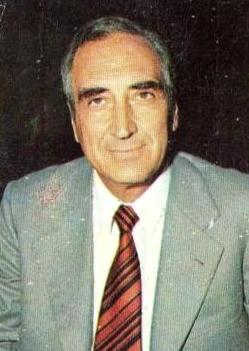
Nando Martellini, born Ferdinando Martellini on August 7, 1921, in Rome, Italy, is widely regarded as one of the most iconic sports commentators in the history of Italian broadcasting. His career, which spanned over four decades, was marked by his distinctive voice, expert commentary, and the unforgettable moments he narrated, most notably Italy’s triumph in the 1982 FIFA World Cup. Martellini’s legacy as a broadcaster continues to influence the world of sports journalism and remains a benchmark for excellence in sports commentary.
Early Life and Entry into Broadcasting
Born and raised in Rome, Nando Martellini pursued a degree in Political Science, showcasing his intellectual rigor and academic interests. However, it was his passion for communication and his command of five languages that would set the stage for his illustrious career in broadcasting.
Martellini began his career at the EIAR (Ente Italiano per le Audizioni Radiofoniche), the Italian state broadcasting corporation, in 1944. EIAR would later become RAI (Radiotelevisione Italiana), Italy’s national public broadcasting company. Initially, Martellini worked as a foreign affairs editor, leveraging his linguistic skills and deep understanding of international politics. However, it wasn’t long before his talent for communication saw him transition to more prominent roles within the organization.
His early work in radio involved covering a wide range of topics, but it was his expertise in sports commentary that would eventually define his career. By the mid-1940s, Martellini had begun to establish himself as a leading voice in sports broadcasting, a reputation that would only grow over the following decades.
Rise to Fame: The Voice of Italian Sports
Nando Martellini’s rise to fame was fueled by his unique ability to convey the drama and emotion of sporting events with clarity and passion. In 1946, he began his role as a sports commentator, a position that would bring him national recognition. His work in radio, particularly as the original voice of the iconic program “Tutto il calcio minuto per minuto” from 1960 to 1967, solidified his status as a household name in Italy. This program, which provided live updates from various football matches across Italy, was revolutionary in its format and reach, and Martellini’s calm yet engaging delivery was central to its success.
Martellini’s commentary was characterized by his deep understanding of the game, his ability to modulate his tone to match the ebb and flow of the action, and his respectful, measured approach. Unlike some commentators who relied on bombast or overt enthusiasm, Martellini’s style was one of quiet intensity, allowing the events on the field to take center stage while still providing insightful analysis.
His reputation as a sports commentator grew further with his coverage of major cycling events such as the Giro d’Italia and the Tour de France. Martellini’s versatility in covering different sports with the same level of expertise and enthusiasm made him a standout figure in Italian broadcasting.
The Transition to Television
The advent of television in the 1950s and 1960s marked a new chapter in Nando Martellini’s career. As television became the dominant medium for broadcasting, Martellini seamlessly transitioned from radio to television, where his visual presence and authoritative voice made him a natural fit for the new format.
One of his earliest major television assignments was covering the funeral of Luigi Einaudi, Italy’s second President, and later, the funeral of Pope John XXIII. These solemn occasions required a commentator with a deep sense of respect and gravitas, qualities that Martellini possessed in abundance. His ability to convey the significance of these events to a national audience further cemented his role as one of Italy’s most trusted broadcasters.
However, it was in sports television where Martellini truly made his mark. His first major breakthrough came in 1968 when he provided commentary for the European Football Championship, in which Italy emerged victorious. This victory, Italy’s first major football title, was a moment of immense national pride, and Martellini’s voice became synonymous with the celebrations that followed.
The Iconic 1982 FIFA World Cup
While Nando Martellini had already established himself as a leading sports commentator by the 1980s, it was the 1982 FIFA World Cup in Spain that would forever enshrine him in the annals of Italian sports history. Martellini was chosen as the lead commentator for the Italian national team’s matches, a role that brought him into the homes of millions of Italians during one of the most thrilling World Cup campaigns in history.
Italy’s journey to the final was filled with drama, including a stunning victory over Brazil in the quarterfinals and a hard-fought win against West Germany in the final. On July 11, 1982, when Italy defeated West Germany 3-1 to win their third World Cup title, it was Martellini’s voice that captured the jubilation of the moment. His emotional and unforgettable declaration—”Campioni del Mondo! Campioni del Mondo! Campioni del Mondo!” (“Champions of the World! Champions of the World! Champions of the World!”)—echoed across the nation and became one of the most iconic phrases in Italian sports broadcasting history.
This moment not only encapsulated the euphoria of Italy’s World Cup victory but also highlighted Martellini’s ability to convey the deep emotional resonance of sports. His commentary struck the perfect balance between professionalism and passion, making it a moment that transcended sports and became a part of Italy’s cultural memory.
Challenges and Continued Success
Despite the overwhelming success of the 1982 World Cup, Martellini’s career was not without its challenges. He was slated to cover the 1986 World Cup in Mexico, but health issues related to the high altitude forced him to withdraw from the assignment. This marked a significant moment in his career, as it signaled the beginning of his transition away from regular sports commentary.
Bruno Pizzul, a younger colleague, took over Martellini’s role, and Martellini gracefully stepped back, demonstrating his professionalism and humility. Although he officially retired from RAI in 1986, Martellini remained active in broadcasting, occasionally providing commentary for Fininvest (now Mediaset) on Champions League matches and serving as a respected voice on various radio networks.
Even in retirement, Martellini’s influence on sports journalism continued to be felt. His calm and measured style became the gold standard for sports commentary in Italy, influencing a new generation of broadcasters. His legacy is also evident in the continued reverence with which his work is regarded by both fans and professionals in the industry.
Personal Life and Legacy
Nando Martellini’s contributions to sports broadcasting were not limited to his work on the airwaves. His daughter, Simonetta Martellini, followed in his footsteps, becoming a respected sports commentator in her own right, particularly known for her coverage of volleyball for Radio Rai. This continuation of the Martellini legacy in sports broadcasting highlights the profound influence he had, not just on his audience, but also within his own family.
Martellini’s impact on Italian culture was further recognized after his death. He passed away on May 5, 2004, at the age of 82, leaving behind a legacy that continues to be celebrated. In honor of his contributions to Italian sports and broadcasting, the stadium at the Terme di Caracalla in Rome was named after him. This gesture ensured that his name would live on, not just in the memories of those who heard his voice, but also in the very fabric of Italian sports history.
The Enduring Influence of Nando Martellini
Nando Martellini’s career is a testament to the power of clear, concise, and emotionally resonant communication. His ability to convey the drama of sports, coupled with his respectful and measured tone, made him a trusted voice in Italy for over 40 years. Martellini’s influence extended beyond sports commentary; he set a standard for how broadcasters could connect with their audience, making complex emotions accessible and relatable.
His work during the 1982 World Cup remains a high point in sports broadcasting, not just in Italy, but globally. The emotion in his voice as he declared Italy the “Champions of the World” is still remembered and celebrated today, demonstrating the lasting impact of his work.
In the modern era, where sports commentary can often veer into sensationalism, Martellini’s style serves as a reminder of the importance of balance, respect, and professionalism in broadcasting. His legacy continues to inspire sports journalists and commentators who strive to achieve the same level of excellence that Martellini exemplified throughout his career.
Conclusion
Nando Martellini was more than just a sports commentator; he was a voice that brought Italy together during some of its most triumphant moments. His career, marked by dedication, skill, and a deep love for the sports he covered, left an indelible mark on Italian broadcasting. From his early days in radio to his iconic television commentary during the 1982 World Cup, Martellini’s contributions to sports journalism are unparalleled.
As we look back on his life and career, it’s clear that Nando Martellini was not just a commentator, but a cultural figure whose influence will continue to be felt for generations to come. His legacy is a benchmark for all who aspire to convey the beauty, drama, and emotion of sports through the spoken word.


