
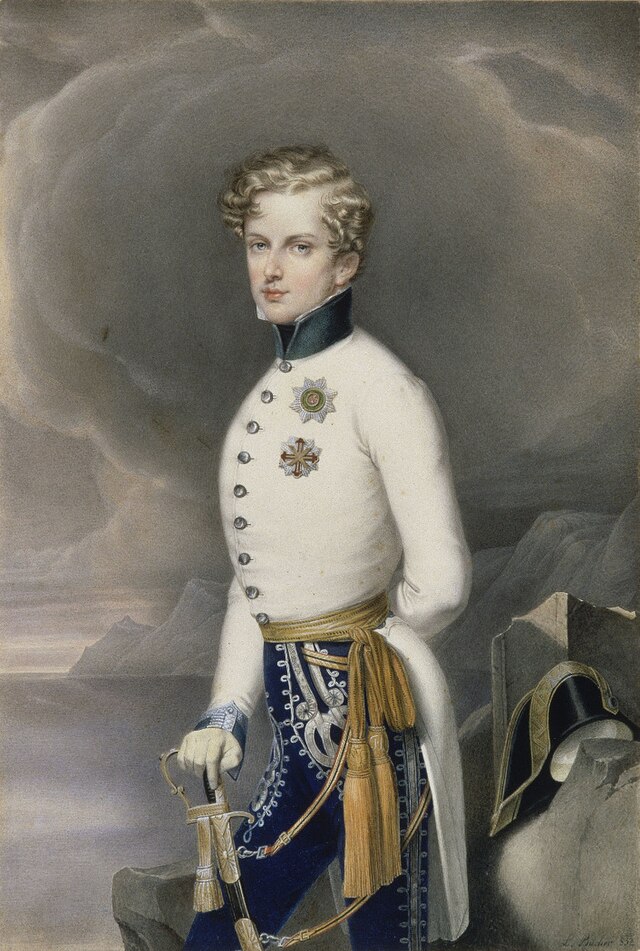
Napoleone II, born Napoléon François Charles Joseph Bonaparte on March 20, 1811, was the only legitimate son of the French Emperor Napoléon I and his second wife, Archduchess Marie Louise of Austria. Though his life was brief and largely overshadowed by the grandeur of his father’s legacy, Napoleone II’s story is one of profound historical significance. His existence represents a fleeting hope for the continuation of Napoleonic rule in France, and his life, filled with both promise and tragedy, is a compelling chapter in the larger narrative of European history.
Birth and Early Life
Napoleone II was born during a time of immense power and expansion for the Napoleonic Empire. His birth was a highly anticipated event, symbolizing the continuation of the Napoleonic dynasty. Even before his birth, he was proclaimed the “King of Rome” by his father, a title that reflected Napoléon I’s grand ambitions for his empire and the future of his lineage. The birth of the “King of Rome” was celebrated with great enthusiasm not only in France but also across Europe, where many saw him as the potential unifier of the continent under Napoleonic rule.
The first few years of Napoleone II’s life were spent in an atmosphere of imperial splendor. His father was at the height of his power, and the young prince was the center of attention in the French court. However, this idyllic beginning was not to last. The fortunes of the Napoleonic Empire began to change dramatically as the coalition of European powers, united against Napoléon I, gained strength. By 1814, the situation had deteriorated to the point where Paris itself was under threat of invasion.
The Fall of Napoléon I and the Exile of Napoleone II
In March 1814, as the coalition forces closed in on Paris, Napoléon I was forced to abdicate in favor of his son, Napoleone II. The abdication was a desperate attempt by Napoléon I to secure a future for his son and his dynasty. However, this hope was quickly dashed. On April 11, 1814, the Treaty of Fontainebleau was signed, which restored the Bourbon monarchy to the French throne under Louis XVIII, and Napoleone II’s brief reign as Emperor of the French came to an abrupt end.
After the fall of Napoléon I, the young Napoleone II was taken by his mother to the Austrian court in Vienna, where he lived under the protection of his grandfather, Emperor Francis II of Austria. In Vienna, he was given the title Duke of Reichstadt, a title that reflected his diminished status. Despite his illustrious birth, Napoleone II was now a political pawn, kept under close surveillance by the Austrian court, which sought to distance him from his father’s legacy.
Life in Vienna and the Shadow of Napoléon I
The years Napoleone II spent in Vienna were marked by isolation and melancholy. He was forbidden from using his own name and was largely kept away from the public eye. The Austrian court, aware of his potential as a symbol for Bonapartist sympathizers, took great care to ensure that he remained disconnected from his French heritage. Despite these efforts, Napoleone II remained deeply aware of his father’s legacy and harbored a strong sense of loyalty to his Napoleonic heritage.
The news of Napoléon I’s death in exile on Saint Helena in 1821 was a significant blow to the young Duke of Reichstadt. It deepened his sense of alienation and resentment towards his maternal family and the Austrian court. He became increasingly introspective, grappling with the weight of his father’s legacy and the expectations that came with it. His health, which had never been robust, began to decline during this period, exacerbated by the emotional toll of his circumstances.
The Hundred Days and the Brief Title of Emperor
In 1815, during the period known as the Hundred Days, Napoléon I briefly regained power after escaping from exile on Elba. This period culminated in the Battle of Waterloo, where Napoléon I was decisively defeated. During this brief resurgence, Napoléon I again abdicated in favor of his son on June 22, 1815. For a few fleeting days, Napoleone II was recognized as the Emperor of the French, albeit in title only. He never exercised any actual power, as he remained in Vienna, far from the political turmoil in France.
This period solidified Napoleone II’s symbolic importance as a figurehead for the Bonapartist cause. Although his reign was purely nominal, it kept alive the hopes of those who wished to see the restoration of the Napoleonic Empire. However, with the return of Louis XVIII to Paris on July 8, 1815, these hopes were definitively quashed. Napoleone II’s brief reign was over, and he returned to his life of seclusion in Austria.
The Final Years and Untimely Death
The last years of Napoleone II’s life were marked by illness and a growing sense of despair. His health, which had been fragile for much of his life, deteriorated rapidly. He suffered from tuberculosis, a disease that was common and often fatal in the 19th century. Despite his deteriorating condition, there were moments when Napoleone II showed signs of political ambition. In 1830, during the July Revolution in France, there were calls from Bonapartist supporters for Napoleone II to claim the throne. However, these efforts came to nothing, as his poor health prevented him from taking any decisive action.
Napoleone II died on July 22, 1832, at the age of 21, in the Schönbrunn Palace in Vienna. His death was a tragic end to a life that had been full of unrealized potential. Despite his brief and largely symbolic role in history, Napoleone II remained a figure of considerable interest and speculation. His death marked the end of the direct Napoleonic line, but his legacy would continue to influence European politics and culture.
Legacy and Cultural Impact
Although Napoleone II’s life was short and marked by tragedy, his legacy has endured, particularly in French cultural and historical memory. His story was immortalized by the French playwright Edmond Rostand in the play “L’Aiglon,” which premiered in 1900. The play, which dramatizes the life of Napoleone II, depicts him as a tragic hero, caught between his father’s towering legacy and his own unfulfilled potential. “L’Aiglon” was a critical and commercial success, further cementing Napoleone II’s place in the annals of history as a symbol of lost potential and the tragic consequences of power.
The figure of Napoleone II has also been the subject of numerous historical studies, which have explored his life in the context of the Napoleonic Wars and the broader political landscape of 19th-century Europe. His life, though largely lived in the shadows, serves as a poignant reminder of the human cost of political ambition and the complex interplay of power, legacy, and identity.
Conclusion
Napoleone II, the son of one of history’s most famous figures, lived a life that was defined by the legacy of his father and the tumultuous political landscape of his time. Though he was Emperor of the French in name only, his life and the brief hope he represented for the continuation of Napoleonic rule have left an indelible mark on history. His story is one of great potential that was never realized, of a young man who, despite his royal lineage, lived a life of isolation and unfulfilled promise. Yet, it is precisely this unfulfilled potential that makes Napoleone II a fascinating and enduring figure in the history of Europe.
Napoleone II’s life, though brief and marked by tragedy, continues to capture the imagination of historians, writers, and the public alike. His story serves as a powerful reminder of the complexities of history and the often-painful legacies that can be passed down through generations. As we reflect on his life, we are reminded of the fragility of power and the enduring impact of legacy on the course of history.


