
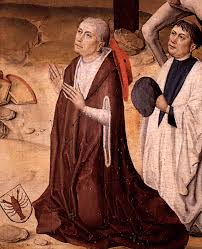
Nicola Cusano, known in his native German as Nikolaus Krebs von Kues, was born in 1401 in Cues, near Trier, Germany. He is a towering figure in the history of philosophy, mathematics, and theology, often regarded as one of the most important thinkers of the Renaissance. His work bridged the gap between medieval scholasticism and the emerging ideas of the modern era, making significant contributions to a wide range of disciplines.
Early Life and Education
Nicola Cusano was born into a modest family in the small town of Cues on the Moselle River. His early life was shaped by the rich intellectual and religious traditions of the region. Despite the limited means of his family, Cusano demonstrated exceptional intellectual abilities from a young age, which allowed him to pursue studies that would eventually lead him to some of the most prestigious universities of his time.
Cusano’s formal education began at the University of Heidelberg, where he studied law. However, his intellectual curiosity soon led him to the University of Padua, one of the leading centers of learning in Europe at the time. There, he earned a doctorate in canon law in 1423, and it was during his time in Padua that he was first exposed to the works of the ancient Greek philosophers, particularly Plato. This exposure would have a profound influence on his later work, especially his engagement with the Platonic tradition.
Academic and Ecclesiastical Career
After completing his studies, Cusano began a career that combined academic pursuits with ecclesiastical duties. He quickly gained a reputation as a brilliant scholar and was invited to participate in various important theological and philosophical debates of his time. In 1433, he made a significant contribution to the Council of Basel with his work “De concordantia catholica”, in which he argued for the unity of the Catholic Church and the need for concord among Christian believers. This work established him as a major intellectual figure in the Church and led to his appointment as a papal envoy.
In 1448, Cusano was elevated to the rank of cardinal by Pope Nicholas V, a recognition of his contributions to the Church and his growing influence in ecclesiastical matters. He was later appointed as the Bishop of Brixen (Bressanone), where he worked tirelessly to reform the local clergy and improve the spiritual life of the diocese.
Major Philosophical Contributions
Nicola Cusano’s most famous work is undoubtedly “De docta ignorantia” (On Learned Ignorance), written in 1440. This text represents a significant departure from the scholastic philosophy that dominated medieval thought. In “De docta ignorantia”, Cusano explores the limits of human knowledge and the paradoxical nature of knowing. He argues that true wisdom lies in recognizing the limits of what we can know, a concept he terms “learned ignorance.”
Cusano’s philosophy is deeply rooted in the Platonic tradition, but it also anticipates many of the ideas that would later emerge in the Renaissance and the Enlightenment. He believed that the universe was infinite and that the human mind, while capable of great knowledge, could never fully comprehend the divine or the absolute truth. This notion of the infinite and the unknowable would later influence thinkers such as Giordano Bruno and Galileo Galilei.
Another key idea in Cusano’s thought is the concept of “coincidentia oppositorum”, or the coincidence of opposites. In this view, Cusano posits that God is the ultimate unity that transcends all contradictions and oppositions. In the divine, all opposites—such as maximum and minimum, or the finite and the infinite—coincide. This idea challenges the rigid categories of Aristotelian logic and opens the door to a more dynamic and holistic understanding of the universe.
Cusano also made significant contributions to mathematics and cosmology. He challenged the traditional Aristotelian cosmology, which viewed the Earth as the center of the universe. Instead, Cusano proposed that the universe was infinite and had no fixed center, a revolutionary idea that prefigured the Copernican model of the solar system. His work “De ludo globi” (On the Game of Spheres) reflects his interest in the mathematical and symbolic representation of the cosmos, further illustrating his innovative approach to the understanding of nature and the divine.
Religious and Political Influence
Nicola Cusano’s influence extended beyond philosophy and theology into the realm of politics and ecclesiastical reform. As a cardinal and bishop, he was deeply involved in the religious and political affairs of his time. He played a key role in the negotiations that led to the reconciliation between the Eastern and Western Churches at the Council of Florence in 1439. Although the union was short-lived, Cusano’s efforts demonstrated his commitment to the idea of a united Christendom.
Cusano’s political philosophy is also evident in his writings on church governance. In “De concordantia catholica”, he advocates for a more conciliar approach to church governance, where decisions are made through councils representing the whole church, rather than being imposed by a central authority. This work can be seen as a precursor to later ideas about democracy and representative government.
The Legacy of Nicola Cusano
Nicola Cusano’s legacy is vast and multifaceted. He is often regarded as one of the most important figures of the Renaissance, a thinker who bridged the gap between the medieval and modern worlds. His ideas about the limits of human knowledge, the infinite nature of the universe, and the unity of opposites have had a lasting impact on Western thought.
Cusano’s influence can be seen in the works of later philosophers and scientists, including Giordano Bruno, Johannes Kepler, and Gottfried Wilhelm Leibniz. His emphasis on the importance of intellectual humility and the recognition of our limitations as human beings continues to resonate in contemporary discussions about the nature of knowledge and the role of science and philosophy in understanding the world.
In addition to his philosophical contributions, Cusano was a dedicated churchman and a tireless advocate for reform. His efforts to improve the spiritual and moral life of the Church, as well as his work to promote unity and dialogue among Christians, have earned him a place of honor in the history of the Catholic Church.
Conclusion
Nicola Cusano’s life and work represent a remarkable blend of intellectual rigor, spiritual depth, and practical engagement with the world. He was a true Renaissance man, whose ideas continue to inspire and challenge us today. Whether through his philosophical writings, his contributions to theology and cosmology, or his efforts to reform the Church, Cusano remains a figure of enduring significance in the history of Western thought.
His recognition of the limits of human knowledge and the importance of intellectual humility are lessons that are as relevant today as they were in the 15th century. In a world where the search for certainty and absolute truth often leads to conflict and division, Cusano’s philosophy of learned ignorance offers a powerful reminder of the value of doubt, dialogue, and the continuous pursuit of understanding.
As we reflect on Nicola Cusano’s contributions to philosophy, theology, and science, we are reminded of the importance of questioning our assumptions, embracing the complexity of the world, and recognizing the infinite possibilities that lie beyond the boundaries of our current knowledge.


