
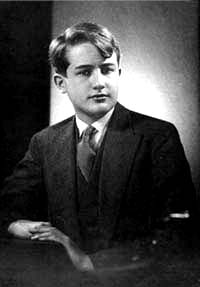
Nicolás Gómez Dávila, born on May 18, 1913, in Bogotá, Colombia, is a name that resonates with a specific, though selective, audience in the intellectual world. His life, much like his work, is characterized by a profound simplicity that belies the complexity of his thoughts. Often described as a reclusive thinker, Gómez Dávila spent the majority of his life in the solitude of his extensive personal library, cultivating a mind steeped in classical and humanistic studies. His life is a testament to the power of intellectual solitude and the pursuit of wisdom beyond the conventional paths of academia.
Early Life and Education
Gómez Dávila’s early years were marked by a significant geographical and cultural shift. At the tender age of six, he moved with his family from Bogotá to Paris, where he began his education. This move would prove to be pivotal, as it introduced him to the rich intellectual traditions of Europe at an early age. His education was predominantly humanistic, with a strong emphasis on classical languages, a field he studied rigorously at a Benedictine monastery. This early immersion in the classics laid the foundation for his later work, which would be characterized by a deep engagement with the literary and philosophical traditions of the West.
Despite his intensive studies, Gómez Dávila never pursued formal academic qualifications. He returned to Bogotá at the age of 23, choosing a life of relative seclusion over the conventional paths of academic or public life. His disdain for formal academic titles was consistent with his belief that true intellectual merit could not be measured by such external markers.
Literary Career and Style
Gómez Dávila’s literary output is best understood as a reflection of his personal philosophy: brief, incisive, and deeply skeptical of modernity. His first published work, a collection of aphorisms titled “Notas I,” was released in 1954, but only in a limited edition of 100 copies, intended for his close circle of friends and intellectual peers. This limited distribution was not a quirk but rather a deliberate choice, reflecting his belief that his work was intended for a select, discerning audience rather than the masses.
In 1959, he published “Textos I,” a collection of short essays that further exemplified his characteristic style. His writing is marked by brevity and precision, a style that challenges readers to engage deeply with each sentence. This approach has posed significant challenges for commentators and critics, who must unpack the dense layers of meaning in his succinct prose.
Gómez Dávila’s disdain for the modern world is a recurring theme in his work. He was deeply critical of the political and social realities of his time, rejecting the ideas of progress, democracy, and materialism. His critique of modernity was so profound that he declined an offer to serve as the first advisor to the Colombian president in 1958, a position that would have given him considerable influence in shaping the country’s future. For Gómez Dávila, the idea of participating in a system he fundamentally disagreed with was unthinkable.
Intellectual Influence and Philosophy
Nicolás Gómez Dávila’s intellectual influence extends far beyond the limited circulation of his works during his lifetime. His ideas resonate with a specific type of intellectual: those who are skeptical of modernity and the prevailing democratic ethos. Gómez Dávila believed in the concept of an intellectual aristocracy—not an aristocracy of birth, but one of merit and intellectual rigor. He argued that society should be guided by these intellectual elites, rather than by the masses, who he believed were often swayed by populist and materialistic impulses.
His philosophy has drawn comparisons to that of Friedrich Nietzsche, particularly in his critique of modernity and his emphasis on the role of the intellectual elite. However, unlike Nietzsche, Gómez Dávila’s thought was deeply rooted in his Catholic faith, albeit a faith that was critical of the institutional Church. His religious beliefs did not prevent him from being a harsh critic of the Roman Catholic Church, particularly its embrace of modernity in the wake of the Second Vatican Council.
Gómez Dávila’s skepticism extended to the very concept of progress, which he viewed as a dangerous myth that led society away from the timeless truths found in the classical and Christian traditions. His works are filled with references to historical figures and thinkers who shared his skepticism, including figures as diverse as Justus Möser, Maurice Barrès, and Donoso Cortés.
Legacy and Posthumous Recognition
Nicolás Gómez Dávila’s work remained relatively obscure during his lifetime, but it began to gain wider recognition in the years following his death. The translation of his “Escolios a un texto implícito” (Glosses on an Implicit Text), a collection of aphorisms and scholia, into German in the late 1980s marked the beginning of a broader interest in his thought. His works found an audience among conservative intellectuals in Europe, particularly in Germany and Austria, where his critique of modernity resonated deeply.
Despite this growing recognition, Gómez Dávila’s works have only recently begun to be translated into other languages. In Italy, for instance, his writings were not translated until 2001, a full seven years after his death. This delay in translation has contributed to his relative obscurity outside of Spanish-speaking intellectual circles.
However, for those who do engage with his work, Gómez Dávila offers a powerful and uncompromising critique of the modern world. His writing challenges readers to question the assumptions of modernity and to consider the possibility that true wisdom lies not in progress, but in the timeless truths of the classical and Christian traditions.
Conclusion: The Enduring Relevance of Nicolás Gómez Dávila
In an age where intellectual discourse is often dominated by the latest trends and the loudest voices, Nicolás Gómez Dávila stands as a figure of quiet but profound resistance. His life and work remind us that true intellectual engagement requires solitude, reflection, and a willingness to challenge the prevailing assumptions of the day.
Gómez Dávila’s critique of modernity, his belief in an intellectual aristocracy, and his deep engagement with the classical and Christian traditions offer a counterpoint to the dominant narratives of our time. For those willing to engage with his thought, Nicolás Gómez Dávila provides not only a critique of the modern world but also a vision of a different kind of intellectual life—one that is rooted in the pursuit of wisdom, rather than the pursuit of power or recognition.
His legacy, while still relatively obscure, continues to grow as more readers discover the depth and richness of his thought. As we navigate the complexities of the modern world, the insights of Nicolás Gómez Dávila offer a valuable perspective, reminding us of the enduring power of intellectual solitude and the pursuit of timeless truths.


