
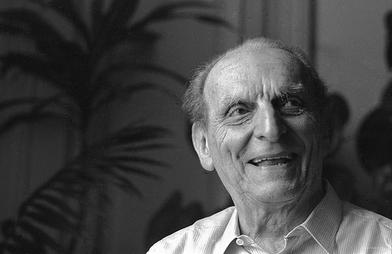
Norberto Bobbio, an influential Italian philosopher, jurist, and political theorist, is celebrated for his extensive contributions to legal and political philosophy. Born in Turin on October 18, 1909, to Luigi Bobbio, a prominent surgeon, Bobbio’s early years were steeped in a rich cultural and intellectual milieu. His formative years at the Liceo Massimo D’Azeglio, where he befriended notable figures such as Vittorio Foa, Leone Ginzburg, and Cesare Pavese, set the stage for his lifelong engagement with political and social issues.
Early Life and Education
Norberto Bobbio’s upbringing in Turin, a hub of cultural and political activity, profoundly influenced his intellectual development. His education at the Liceo Massimo D’Azeglio introduced him to a circle of future luminaries, fostering an environment that nurtured his critical thinking. Bobbio pursued higher education at the University of Turin, where he graduated in both law and philosophy. His academic journey was marked by significant interactions with prominent scholars, including Alessandro Galante Garrone.
Academic Career
Bobbio’s academic career began with his studies in Philosophy of Law under Solari. He went on to teach at various universities, including Camerino (1935-38), Siena (1938-40), and Padua (1940-48). During his tenure at these institutions, he became involved with several anti-fascist groups, meeting influential figures such as Aldo Capitini and Guido Calogero. His move to Padua brought him into contact with Antonio Giuriolo and further deepened his engagement with the resistance movement.
Teaching Philosophy and Contributions
In 1948, Bobbio began teaching Philosophy of Law at the University of Turin, where he would remain until 1972 before transitioning to teaching Political Philosophy until 1979. His academic contributions during this period were substantial, including his involvement with the Turin-based group Giustizia e Libertà and collaboration with notable intellectuals like Franco Antonicelli and Massimo Mila.
Political and Civil Engagement
Bobbio’s political engagement was marked by his affiliation with the Action Party in 1942 and his active participation in the resistance movement during World War II. He was arrested in 1943 for his activities. After the war, Bobbio continued to influence Italian intellectual and political life, becoming a key figure in debates about democracy, socialism, and human rights.
Notable Works and Theories
Bobbio’s scholarly work is characterized by his commitment to an evaluative approach to legal science, influenced by analytical philosophy and legal positivism. His major works include:
- Teoria della scienza giuridica (1950)
- Studi sulla teoria generale del diritto (1955)
- Teoria della norma giuridica (1958)
- Teoria dell’ordinamento giuridico (1960)
- Giusnaturalismo e positivismo giuridico (1965)
- Dalla struttura alla funzione (1978)
In these works, Bobbio argued for a conception of law as a system of logically irreducible norms and emphasized the principle of effectiveness, which holds that law consists of norms that are effectively enforced in society.
Honors and Recognitions
Norberto Bobbio’s contributions were widely recognized, earning him numerous honorary degrees from prestigious institutions, including the Universities of Paris, Buenos Aires, Madrid (Complutense), Bologna, and Chambéry. He served as the director of the “Rivista di filosofia” alongside Nicola Abbagnano and was a corresponding member of the British Academy since 1966.
Later Years and Legacy
In July 1984, Bobbio was appointed as a senator for life by the President of the Italian Republic, Sandro Pertini. His later years were marked by continued engagement in intellectual debates and a strong stance against political complacency. Bobbio passed away in Turin on January 9, 2004, at the age of 94.
Critical Influence and Thought
Bobbio’s intellectual legacy is profound, particularly his influence on the Italian left and his critique of political and academic philosophies. His works reflect a steadfast commitment to rationalism and a renewed Enlightenment, challenging spiritualistic and idealistic traditions in Italian thought. Bobbio’s “politics of rights” remains a cornerstone of his legacy, emphasizing the importance of human rights and democratic principles in political discourse.
Controversies and Public Debates
Bobbio was never one to shy away from controversy. In 1984, he publicly criticized the “democracy of applause” promoted by Bettino Craxi and Sandro Pertini at the Verona Congress. His outspoken stance on political issues often positioned him as a critical voice within the Italian intellectual community.
Selected Bibliography
Norberto Bobbio’s extensive body of work includes both theoretical treatises and critical essays on contemporary political issues. Some of his most influential publications are:
- 1944: La filosofia del decadentismo
- 1950: Scienza del diritto e analisi del linguaggio
- 1955: Politica e cultura
- 1964: Italia civile
- 1965: Da Hobbes a Marx
- 1969: Profilo ideologico del Novecento
- 1971: Una filosofia militante
- 1973: La cultura e il fascismo
- 1976: Quale socialismo?
- 1978: Il problema della guerra e le vie della pace
- 1994: Destra e sinistra
- 1999: Autobiografia
- 2001: Dialogo intorno alla repubblica
Bobbio’s writings continue to be studied and debated, reflecting his enduring influence on legal and political theory.
Final Thoughts
Norberto Bobbio’s life and work represent a remarkable intersection of academic rigor, political activism, and a profound commitment to democratic principles. His legacy as a critical conscience of the Italian left and his contributions to legal and political philosophy remain influential, offering valuable insights into the complexities of law, politics, and society.
As we reflect on Bobbio’s contributions, it becomes clear that his ideas and theories continue to resonate, providing a framework for understanding and addressing contemporary political and social challenges.


