
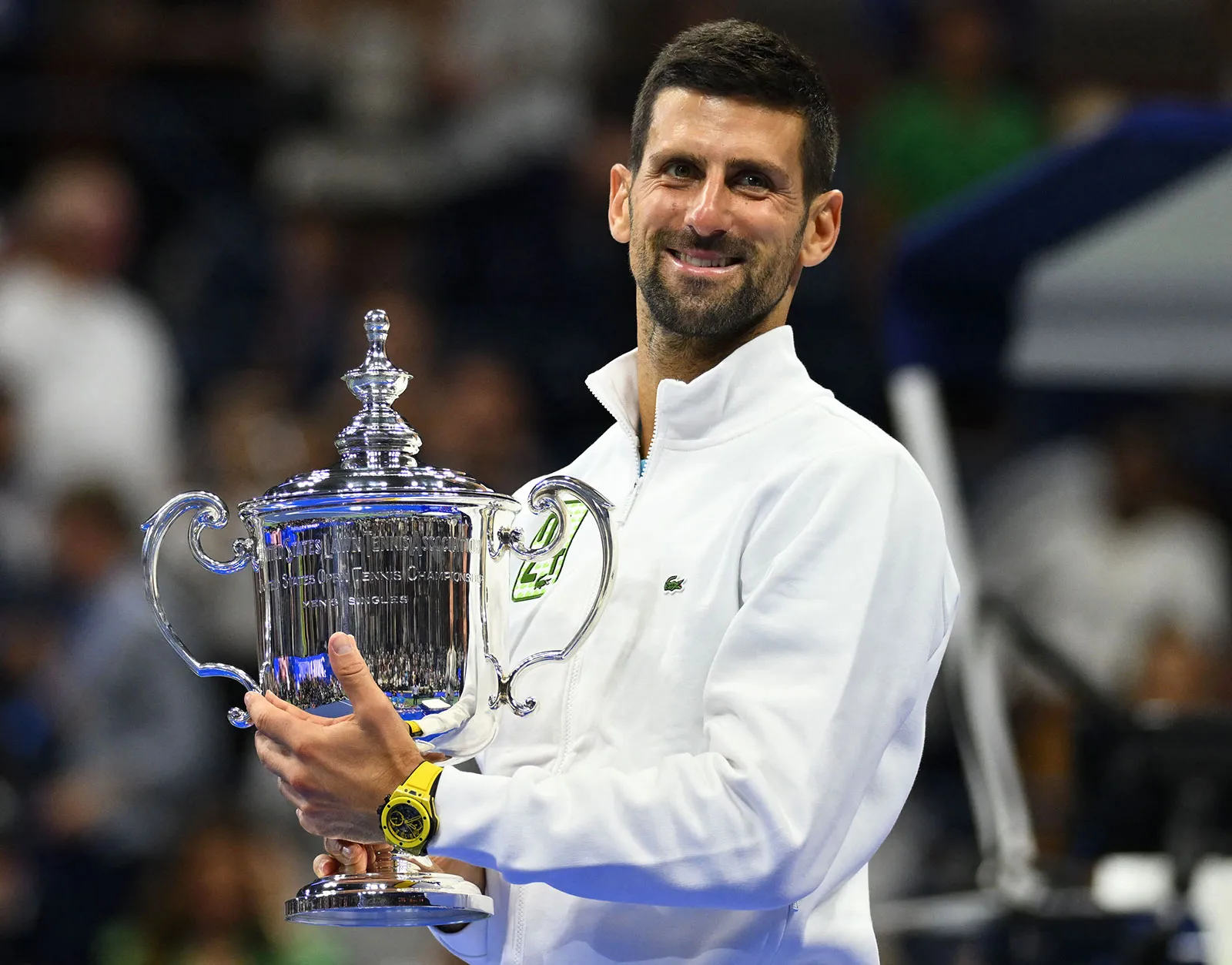
Novak Djokovic is not only a name that resonates in the tennis world but is also recognized globally as one of the greatest athletes of all time. Born on May 22, 1987, in Belgrade, Serbia, Djokovic’s journey from a young tennis enthusiast to the world’s number one tennis player is nothing short of extraordinary. This article provides a comprehensive look into his life, his rise to fame, and the key highlights that have shaped his illustrious career.
Early Life and Tennis Beginnings
Novak Djokovic, affectionately known as “Nole” within his family, was introduced to tennis at the tender age of four. His early training took place under the watchful eye of Jelena Gencic, a legendary figure in Yugoslavian tennis who had previously mentored Monica Seles. Gencic recognized Djokovic’s prodigious talent early on, famously declaring that he was the greatest talent she had encountered since Seles.
Djokovic was born into a family with a strong sporting background. His father, Srdjan Djokovic, was a professional skier and soccer player, while his uncles were also accomplished skiers. Despite his father’s initial hopes that Novak would follow in his footsteps in skiing or pursue soccer, it quickly became apparent that tennis was Novak’s true passion. By the age of 12, Djokovic was enrolled in the prestigious Nikola Pilić Academy in Munich, Germany, where he honed his skills and prepared for a career in professional tennis.
Junior Success and Early Professional Career
Djokovic’s junior career was marked by success from the outset. In 2001, at just 14 years old, he won the European Championship in singles, doubles, and team categories. His early victories in the junior circuit quickly transitioned into success at the professional level. By 2003, Djokovic was already making waves as one of the top junior players in the world, winning a Futures tournament in Serbia and reaching the final in Nuremberg.
In 2004, Djokovic made his professional debut and quickly climbed the rankings. He played in his first ATP Challenger tournament in Belgrade and secured his first Challenger title in Budapest, defeating Italy’s Daniele Bracciali. Later that year, he achieved his first ATP tour victory by defeating Arnaud Clément at the Bucharest tournament, breaking into the top 200 players in the ATP rankings by the end of 2004.
Breakthrough in the Mid-2000s
The mid-2000s marked a period of rapid ascent for Djokovic. In 2005, he participated in the Grand Slam tournaments, reaching the third round of the US Open and climbing into the top 80 in the world rankings. His consistent performance earned him recognition as a rising star in the tennis world.
In 2006, Djokovic won his first ATP title at the Dutch Open in Amersfoort, defeating Chile’s Nicolás Massú in the final. He followed this with a victory in Metz, claiming his second ATP title. His success continued in the Masters Series, particularly at the Miami Open, where he defeated Rafael Nadal in the quarterfinals, setting the stage for his emergence as a top contender in the global tennis arena.
Ascension to World Number One
Djokovic’s breakthrough year came in 2007 when he won the Miami Masters, defeating Guillermo Cañas in the final. This victory propelled him to the world number seven ranking, but his rise was far from over. In 2008, Djokovic won his first Grand Slam title at the Australian Open, defeating Jo-Wilfried Tsonga in the final. This victory made him the first Serbian player to win a Grand Slam singles title and solidified his status as one of the sport’s elite.
Throughout 2008 and 2009, Djokovic continued to amass titles, including victories at the ATP Masters Series events in Indian Wells and Rome. His consistency on the court earned him the number three ranking in the world by the end of 2008. At the 2008 Beijing Olympics, Djokovic further cemented his place in tennis history by winning a bronze medal in singles, representing Serbia.
Dominance in the 2010s
The 2010s were defined by Djokovic’s dominance in men’s tennis. In 2011, he ascended to the world number one ranking for the first time after winning Wimbledon, where he defeated Rafael Nadal in the final. This victory was part of a stellar year in which Djokovic won three Grand Slam titles—Australian Open, Wimbledon, and the US Open—along with five ATP Masters 1000 titles, setting a record for the most Masters titles won in a single year.
Djokovic’s success continued into 2012 and 2013, with victories at the Australian Open and maintaining his position at the top of the ATP rankings. By the end of 2013, Djokovic had held the number one ranking for over 100 weeks, a testament to his consistency and dominance on the court.
In 2014, Djokovic won his second Wimbledon title and reclaimed the number one ranking. The following year, 2015, was arguably his best season, as he won three Grand Slam titles (Australian Open, Wimbledon, and US Open) and reached the final of the French Open. His dominance extended across the ATP World Tour, where he won six Masters 1000 titles, further solidifying his legacy as one of the greatest tennis players of all time.
Challenges and Resurgence
Despite his success, Djokovic faced challenges in the latter part of the decade. In 2016, after winning the French Open to complete his career Grand Slam, Djokovic’s form dipped, and he struggled with injuries and inconsistent performances. His ranking slipped, and by 2017, he had fallen out of the top ten for the first time in over a decade.
However, Djokovic’s career resurgence began in 2018. After undergoing elbow surgery and making significant changes to his team, he returned to peak form. He won Wimbledon in 2018, defeating Kevin Anderson in the final, and followed it up with victories at the US Open and the Australian Open in 2019. His win at Wimbledon in 2019, in a five-hour epic against Roger Federer, is widely regarded as one of the greatest matches in tennis history.
Recent Achievements and Legacy
As the 2020s began, Djokovic showed no signs of slowing down. In 2021, he won his 20th Grand Slam title at Wimbledon, tying Roger Federer and Rafael Nadal for the most Grand Slam titles in men’s tennis history. His victories in Australia, Paris, and London during the 2021 season put him on the brink of achieving a calendar-year Grand Slam, a feat that had not been accomplished since Rod Laver in 1969. However, his quest was thwarted in the US Open final, where he lost to Daniil Medvedev.
Djokovic’s refusal to get vaccinated against COVID-19 became a major controversy in 2022. His decision led to his detention and deportation from Australia, preventing him from defending his Australian Open title. Despite these challenges, Djokovic continued to perform at the highest level, winning his 23rd Grand Slam title at the 2023 French Open, breaking the record for the most Grand Slam singles titles in men’s tennis.
In 2024, Djokovic ceded the number one ranking to Italy’s Jannik Sinner but remained a formidable force in the sport. He reached his 37th Grand Slam final at Wimbledon, where he was defeated by Spain’s Carlos Alcaraz. Later that year, Djokovic finally captured his first Olympic gold medal at the Paris 2024 Olympics, defeating Alcaraz in a grueling three-hour final.
The Historical Context and Djokovic’s Impact on Tennis
To fully appreciate Novak Djokovic’s place in tennis history, it’s essential to understand the broader context in which he has competed. Djokovic emerged during an era dominated by Roger Federer and Rafael Nadal, two of the greatest players the sport has ever seen. His ability to not only compete with but often surpass these legends is a testament to his extraordinary talent and mental fortitude.
Djokovic’s style of play is characterized by his exceptional flexibility, powerful baseline game, and unmatched return of serve. His physical conditioning and mental toughness have allowed him to win matches that seemed unwinnable, often outlasting his opponents in marathon encounters. This resilience has been a key factor in his success, particularly in Grand Slam tournaments where the best-of-five-set format tests a player’s endurance and resolve.
Djokovic’s impact on tennis extends beyond his on-court achievements. He has been a vocal advocate for players’ rights, helping to establish the Professional Tennis Players Association (PTPA) in 2020. His commitment to philanthropy is also noteworthy; through the Novak Djokovic Foundation, he has supported numerous educational initiatives for children in Serbia and around the world.
SEO Optimization and Digital Strategy
As a global sports icon, Novak Djokovic’s digital presence is a crucial aspect of his brand. SEO optimization ensures that his name remains at the forefront of online searches related to tennis and sports in general. Keywords such as “Novak Djokovic age,” “Novak Djokovic Grand Slam titles,” and “Novak Djokovic Olympic gold” are vital for maintaining high visibility on search engines.
Furthermore, Djokovic’s active engagement on social media platforms like Instagram, Twitter, and Facebook allows him to connect with millions of fans worldwide. His online content, including match highlights, training videos, and personal insights, helps to build a strong digital footprint that complements his on-court success.
Conclusion
Novak Djokovic’s journey from a young tennis prodigy in Serbia to one of the greatest players in the history of the sport is a story of talent, determination, and resilience. His numerous records, including the most Grand Slam singles titles, multiple ATP Masters 1000 titles, and Olympic gold, are a testament to his extraordinary career. Despite facing numerous challenges, both on and off the court, Djokovic has consistently demonstrated his ability to overcome adversity and achieve greatness.
As he continues to compete at the highest level, Djokovic’s legacy in tennis is secure. He remains a source of inspiration for aspiring athletes around the world, a player who has redefined the boundaries of what is possible in the sport of tennis. His influence will undoubtedly be felt for generations to come.


