
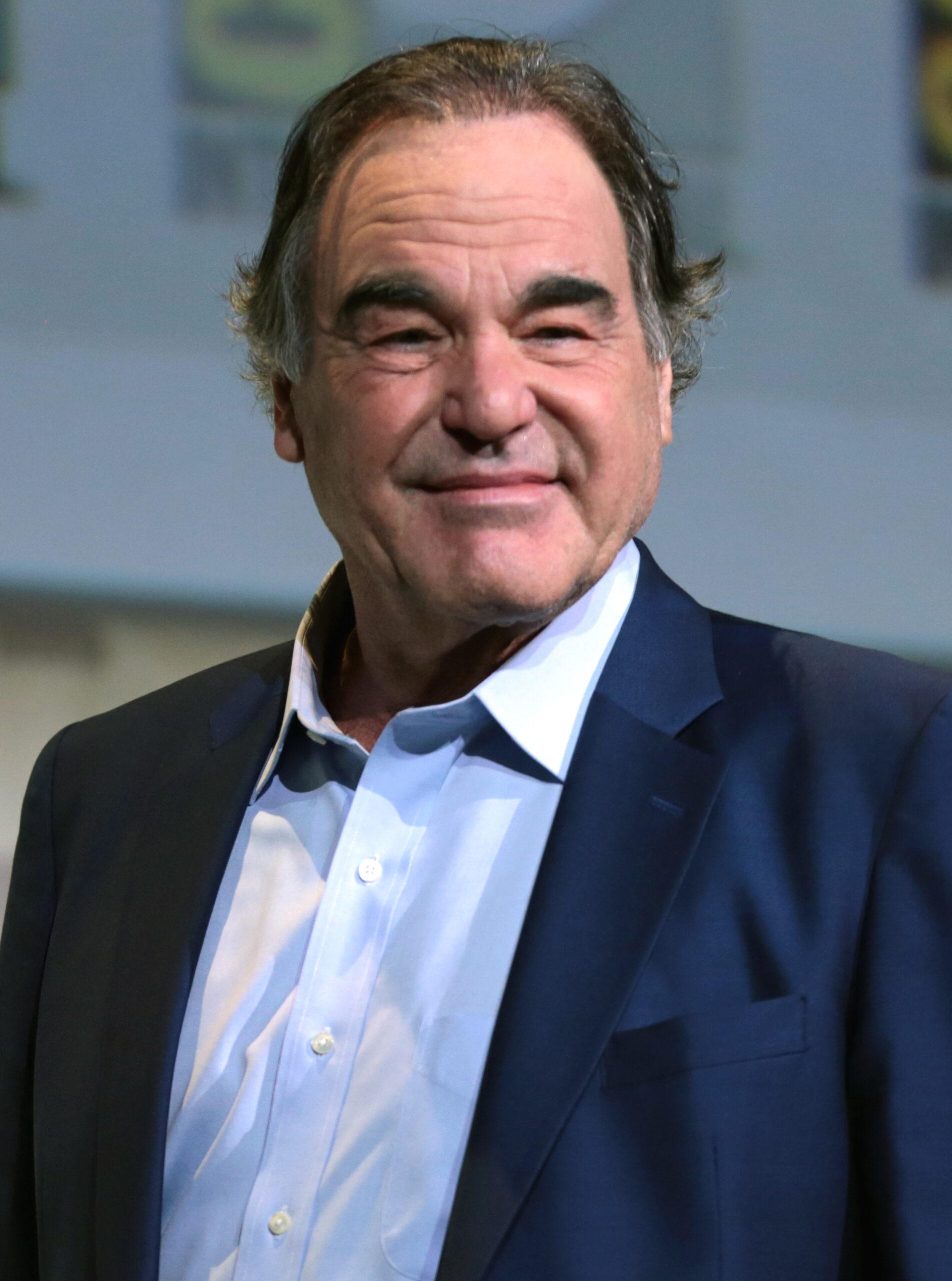
Oliver Stone is one of the most influential and controversial filmmakers of the late 20th and early 21st centuries. His films are known for their provocative themes, in-depth historical exploration, and fearless critique of American society. Born on September 15, 1946, in New York City, Stone’s journey from a young man with a complex background to a celebrated filmmaker is a story worth telling. His work has not only shaped the film industry but also sparked debates and discussions on significant social and political issues.
Early Life and Influences
Oliver Stone was born into a family that embodied a mix of cultures and ideologies. His father, Louis Stone, was an American stockbroker of Jewish descent, while his mother, Jacqueline Goddet, was a French Catholic. This diverse background exposed Stone to a variety of perspectives from an early age, which would later influence his approach to filmmaking. Growing up in Manhattan, Stone attended the prestigious Trinity School before moving on to The Hill School, a private boarding school in Pennsylvania. His early education instilled in him a sense of discipline, but it was also during these years that Stone began to rebel against the conservative environment in which he was raised.
In 1965, Stone enrolled at Yale University but dropped out after one year. His decision to leave Yale marked the beginning of a tumultuous period in his life. Stone moved to Vietnam in 1966, where he taught English and mathematics at the Free Pacific Institute in Saigon. However, his time in Vietnam was short-lived, and after a brief stint in a Mexican jail for possession of marijuana, he returned to the United States, disillusioned and seeking a new direction.
Vietnam War and Early Career
The Vietnam War played a pivotal role in shaping Oliver Stone’s worldview. In 1967, he enlisted in the U.S. Army and requested combat duty in Vietnam. Stone served as an infantryman in the 25th Infantry Division, where he was wounded twice and awarded the Bronze Star for Valor. His experiences in Vietnam profoundly affected him, leading to a lifelong commitment to addressing the war and its aftermath in his films.
Upon his return from Vietnam, Stone pursued a career in film, enrolling in the New York University (NYU) Film School. There, he studied under renowned director Martin Scorsese, who became a significant influence on his work. Stone’s time at NYU marked the beginning of his exploration into the power of cinema as a tool for political and social commentary.
Breakthrough as a Screenwriter
Oliver Stone’s early work in the film industry was as a screenwriter, where he quickly made a name for himself with his sharp, incisive scripts. His breakthrough came in 1977 when he wrote the screenplay for “Midnight Express,” directed by Alan Parker. The film, which tells the harrowing story of an American imprisoned in Turkey for drug smuggling, was both a critical and commercial success. Stone’s screenplay won the Academy Award for Best Adapted Screenplay, establishing him as a talented and provocative writer.
Following the success of “Midnight Express,” Stone continued to work as a screenwriter, contributing to several major films. In 1983, he wrote the screenplay for “Scarface,” directed by Brian De Palma. The film, which starred Al Pacino as the notorious Cuban drug lord Tony Montana, has since become a cult classic, known for its gritty portrayal of the American Dream turned nightmare. Stone’s script was instrumental in creating the film’s dark, iconic tone.
Directorial Debut and Early Films
While Stone’s success as a screenwriter was impressive, he was determined to make his mark as a director. His directorial debut came in 1981 with “The Hand,” a horror film starring Michael Caine. Although the film received mixed reviews, it showcased Stone’s potential as a director with a unique voice.
Stone’s first major success as a director came in 1986 with “Salvador,” a political thriller set against the backdrop of the Salvadoran Civil War. The film, which starred James Woods and James Belushi, was a critical success and earned Stone an Academy Award nomination for Best Original Screenplay. “Salvador” was also notable for its unflinching portrayal of American foreign policy in Latin America, a theme that would recur throughout Stone’s career.
Vietnam Trilogy and Critical Acclaim
Oliver Stone’s experiences in Vietnam deeply influenced his work, leading to the creation of what is often referred to as his “Vietnam Trilogy.” The first film in the trilogy, “Platoon” (1986), was a groundbreaking depiction of the Vietnam War from the perspective of the soldiers on the ground. The film was a commercial and critical success, winning four Academy Awards, including Best Picture and Best Director for Stone. “Platoon” was praised for its realistic portrayal of the horrors of war and its exploration of the moral ambiguities faced by soldiers in combat.
The second film in the trilogy, “Born on the Fourth of July” (1989), starred Tom Cruise as Ron Kovic, a paralyzed Vietnam veteran who becomes an anti-war activist. The film was based on Kovic’s autobiography and was another critical success for Stone, earning him his second Academy Award for Best Director. “Born on the Fourth of July” further solidified Stone’s reputation as a filmmaker unafraid to tackle controversial and politically charged subjects.
The final film in the trilogy, “Heaven & Earth” (1993), told the story of a Vietnamese woman who survives the war and later marries an American soldier. Although it did not achieve the same level of success as the previous two films, “Heaven & Earth” was praised for its unique perspective on the Vietnam War, highlighting the experiences of the Vietnamese people.
Political Films and Controversies
Oliver Stone’s career is marked by a series of films that explore American politics, often challenging the official narratives and provoking debate. In 1991, he released “JFK,” a film that delves into the conspiracy theories surrounding the assassination of President John F. Kennedy. Starring Kevin Costner as New Orleans District Attorney Jim Garrison, “JFK” was both a critical and commercial success, earning eight Academy Award nominations and winning two. The film’s portrayal of the assassination and the subsequent investigation sparked widespread controversy, with some praising Stone for his bold approach and others accusing him of distorting historical facts.
In 1994, Stone released “Natural Born Killers,” a satirical crime film that critiques the media’s obsession with violence and the glorification of criminals. The film, which starred Woody Harrelson and Juliette Lewis as a pair of psychopathic lovers on a killing spree, was highly controversial for its graphic violence and its portrayal of the media. Despite the controversy, “Natural Born Killers” was praised for its innovative style and its critique of American culture.
Stone continued to explore political themes in his later films, including “Nixon” (1995), a biopic of President Richard Nixon, and “W.” (2008), a biopic of President George W. Bush. Both films received mixed reviews, with some critics praising Stone’s nuanced portrayal of these complex figures and others criticizing his approach.
Documentary Work and Historical Exploration
In addition to his narrative films, Oliver Stone has also made significant contributions to the documentary genre. His documentaries often focus on historical events and figures, offering alternative perspectives to mainstream narratives. In 2003, Stone directed “Comandante,” a documentary about Cuban leader Fidel Castro. The film, which was based on a series of interviews between Stone and Castro, provided a rare glimpse into the life and thoughts of one of the most enigmatic figures of the 20th century.
Stone followed “Comandante” with “Looking for Fidel” (2004), another documentary about Castro, and “South of the Border” (2009), which explored the rise of leftist governments in Latin America. These documentaries reflect Stone’s interest in political figures who challenge the status quo and his willingness to explore controversial subjects.
One of Stone’s most ambitious documentary projects is “The Untold History of the United States” (2012), a 10-part series that offers a critical perspective on American history from World War II to the present. The series, which was also released as a book co-written by Stone, challenges conventional narratives and provides a comprehensive examination of the forces that have shaped modern America.
Personal Life and Legacy
Oliver Stone’s personal life has been as complex and varied as his career. He has been married three times and has three children. Stone has often spoken about the influence of his father, who instilled in him a love of history and a critical approach to American society. His experiences in Vietnam and his struggles with post-traumatic stress disorder (PTSD) have also profoundly shaped his worldview and his approach to filmmaking.
Throughout his career, Stone has been a polarizing figure, with some praising him as a visionary filmmaker and others criticizing him for his perceived biases and controversial subject matter. However, there is no denying the impact that Stone has had on the film industry and on American culture. His films have sparked important conversations about history, politics, and the role of the media, and his willingness to challenge official narratives has earned him both acclaim and criticism.
Conclusion
Oliver Stone’s career as a filmmaker is a testament to the power of cinema as a tool for political and social commentary. From his early days as a screenwriter to his success as a director of some of the most influential films of the last few decades, Stone has consistently pushed the boundaries of what film can achieve. His work is characterized by a deep commitment to exploring the complexities of American history and society, and his films continue to resonate with audiences around the world.
As Stone continues to work on new projects, his legacy as one of the most important and controversial filmmakers of his generation is secure. Whether loved or hated, Oliver Stone’s films have left an indelible mark on the world of cinema and have challenged viewers to think critically about the world around them.


