
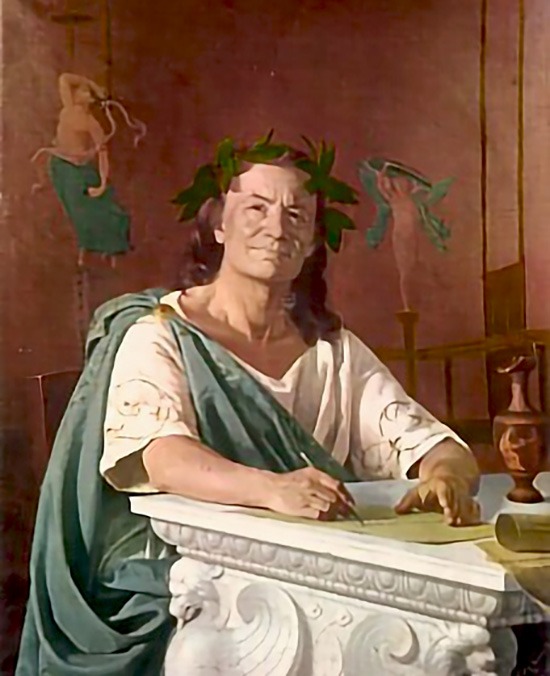
Quintus Horatius Flaccus, known more commonly as Orazio or Horace in English, is one of the most influential poets of ancient Rome. His works, which have endured through the centuries, are celebrated for their lyrical beauty, philosophical depth, and insight into the human condition. Born on December 8, 65 BCE, in Venusia, a Roman colony situated between Lucania and Apulia (now part of modern-day Basilicata, Italy), Orazio’s life and career were shaped by the political and cultural upheavals of the late Roman Republic and the early Roman Empire. This article delves into Orazio’s life, examining the events that defined his career and the legacy that continues to influence literature and philosophy today.
Early Life and Education
Orazio was born into a family of modest means; his father was a freedman, a former slave who had gained his freedom. Despite their humble origins, Orazio’s father was determined to provide his son with the best education possible. The family moved to Rome, where Orazio’s father worked as a coactor, a type of public auction collector, a position that, while not particularly prestigious, provided a comfortable income. This financial stability allowed Orazio to pursue a formal education under the tutelage of the renowned grammarian Orbilius.
Orazio’s education laid the foundation for his literary career. He studied the classics, which included the works of Homer and the teachings of Greek philosophers. His exposure to Greek culture and language was pivotal, as it influenced his later works and philosophical outlook. Around the age of 20, Orazio traveled to Athens, the intellectual center of the ancient world, to continue his studies. There, he delved deeper into philosophy, particularly the teachings of the Epicureans, which would leave a lasting impression on his worldview.
Military Service and Political Turmoil
Orazio’s life took a dramatic turn with the assassination of Julius Caesar in 44 BCE. The ensuing civil war between the forces of Caesar’s assassins, led by Brutus, and those loyal to Caesar’s heir, Octavian (later Augustus), divided Rome. Orazio, inspired by the ideals of republican freedom, joined the army of Brutus, serving as a tribune, a high-ranking officer. He participated in the Battle of Philippi in 42 BCE, where the forces of Brutus were ultimately defeated by those of Octavian and Mark Antony.
The defeat at Philippi marked a turning point in Orazio’s life. With Brutus’s army crushed, Orazio fled the battlefield and returned to Rome, only to find that his family’s estate had been confiscated. Stripped of his wealth and status, Orazio faced a difficult choice: to abandon his ideals or adapt to the new political reality. He chose the latter, accepting an amnesty that allowed him to return to Rome. To support himself, he took up a position as a scribe (scriba quaestorius), a role that, while far removed from his military aspirations, provided him with a stable income.
Literary Beginnings and the Patronage of Maecenas
It was during this period of personal hardship that Orazio began to focus on his poetry. His early works, particularly the “Satires” (Saturae or Sermones), reflect his experiences and observations of Roman society. These works were well-received and brought him to the attention of prominent figures in Roman literary circles, including Virgil and Varius Rufus. Through their introduction, Orazio met Gaius Maecenas, a wealthy and influential patron of the arts who played a crucial role in supporting the poets of his time.
In 38 BCE, Maecenas invited Orazio to join his literary circle, a prestigious group that included some of the most celebrated poets of the era. This association with Maecenas not only provided Orazio with financial security but also allowed him to focus entirely on his literary pursuits. Maecenas’s patronage was instrumental in the publication of Orazio’s early works, including the first book of “Satires” between 35 and 33 BCE. In these poems, Orazio explored the concept of the “golden mean” (aurea mediocritas), advocating for a balanced life free from excesses—a theme that would recur throughout his oeuvre.
Fame and Literary Achievements
With the support of Maecenas, Orazio continued to refine his craft, producing works that would secure his place in literary history. In 30 BCE, he published the “Epodes” (Epodon Libri), a collection of 17 short poems that blended satire with invective. These poems, while darker and more personal than his earlier works, were well-received and further established Orazio’s reputation as a leading poet of his time.
Orazio’s fame reached new heights with the publication of the “Odes” (Carmina) in 23 BCE. This collection of 88 poems, divided into three books, showcased his mastery of the Latin language and his ability to convey complex emotions and ideas through verse. The “Odes” are particularly notable for their exploration of themes such as love, friendship, politics, and the fleeting nature of life. It is from these poems that the famous phrase “carpe diem” (seize the day) originates—a concept that encapsulates Orazio’s Epicurean belief in enjoying the present moment while acknowledging the uncertainty of the future.
Relationship with Augustus and Propaganda
As Orazio’s fame grew, so too did his relationship with Rome’s first emperor, Augustus. Although Orazio had initially supported Brutus and the republican cause, he gradually aligned himself with the new regime. Augustus, recognizing the power of poetry as a tool for propaganda, enlisted Orazio to compose works that would bolster the image of his reign. Orazio responded with several odes that praised Augustus’s achievements and celebrated the stability and prosperity of the new Roman Empire.
One of Orazio’s most significant contributions to Augustan propaganda was the “Carmen Saeculare,” a hymn composed in 17 BCE to celebrate the Ludi Saeculares, a festival marking the beginning of a new saeculum (age). This work, commissioned by Augustus himself, was performed by a choir of boys and girls and was intended to reinforce the idea of a golden age of peace and prosperity under Augustus’s rule. The “Carmen Saeculare” exemplifies Orazio’s ability to blend personal reflection with public duty, creating poetry that resonated with both his contemporaries and future generations.
Later Works and “Ars Poetica”
In his later years, Orazio continued to write, producing some of his most mature and reflective works. Between 20 and 19 BCE, he published the two books of “Epistles” (Epistulae), a series of letters in verse that explored philosophical themes and offered advice to friends and fellow poets. These works, more introspective than his earlier poetry, reveal Orazio’s deepening commitment to the principles of Epicureanism and his belief in the importance of inner peace and self-sufficiency.
Among the “Epistles” is the “Ars Poetica,” a letter addressed to the Pisos that serves as a treatise on the art of poetry. In this work, Orazio outlines his views on the qualities that make for great poetry, emphasizing the importance of clarity, unity, and adherence to tradition. The “Ars Poetica” would go on to become one of the most influential works on literary theory in the Western canon, shaping the principles of poetic composition for centuries to come.
Final Years and Legacy
Orazio spent his final years enjoying the fruits of his literary success. In 33 BCE, Maecenas gifted him a small estate in the Sabine Hills, near Rome, where Orazio could retreat from the bustle of the city and live according to the Epicurean ideals of simplicity and contentment. This rural retreat provided the inspiration for many of his later poems, which reflect his love of nature and his desire for a life of peaceful contemplation.
Orazio died on November 27, 8 BCE, at the age of 57. He was buried on the Esquiline Hill in Rome, close to the tomb of his beloved patron Maecenas, who had passed away only a few weeks earlier. Orazio’s death marked the end of an era in Roman literature, but his influence would endure for centuries.
Orazio’s works have been celebrated not only for their literary merit but also for their philosophical insights and their portrayal of the human experience. His exploration of themes such as the transience of life, the pursuit of happiness, and the value of moderation continues to resonate with readers today. His poetry, characterized by its elegance, wit, and wisdom, has earned him a place among the greatest poets of the ancient world.
Conclusion
Quintus Horatius Flaccus, or Orazio, remains a towering figure in the history of Western literature. His life and works offer a window into the cultural and political landscape of ancient Rome, while his poetry continues to inspire and instruct readers across the ages. Orazio’s legacy is one of enduring relevance, as his reflections on life, love, and the pursuit of virtue speak to the universal aspects of the human condition. As we continue to explore and appreciate his works, Orazio’s voice remains as vital and compelling as ever, a testament to the timeless power of great literature.


