
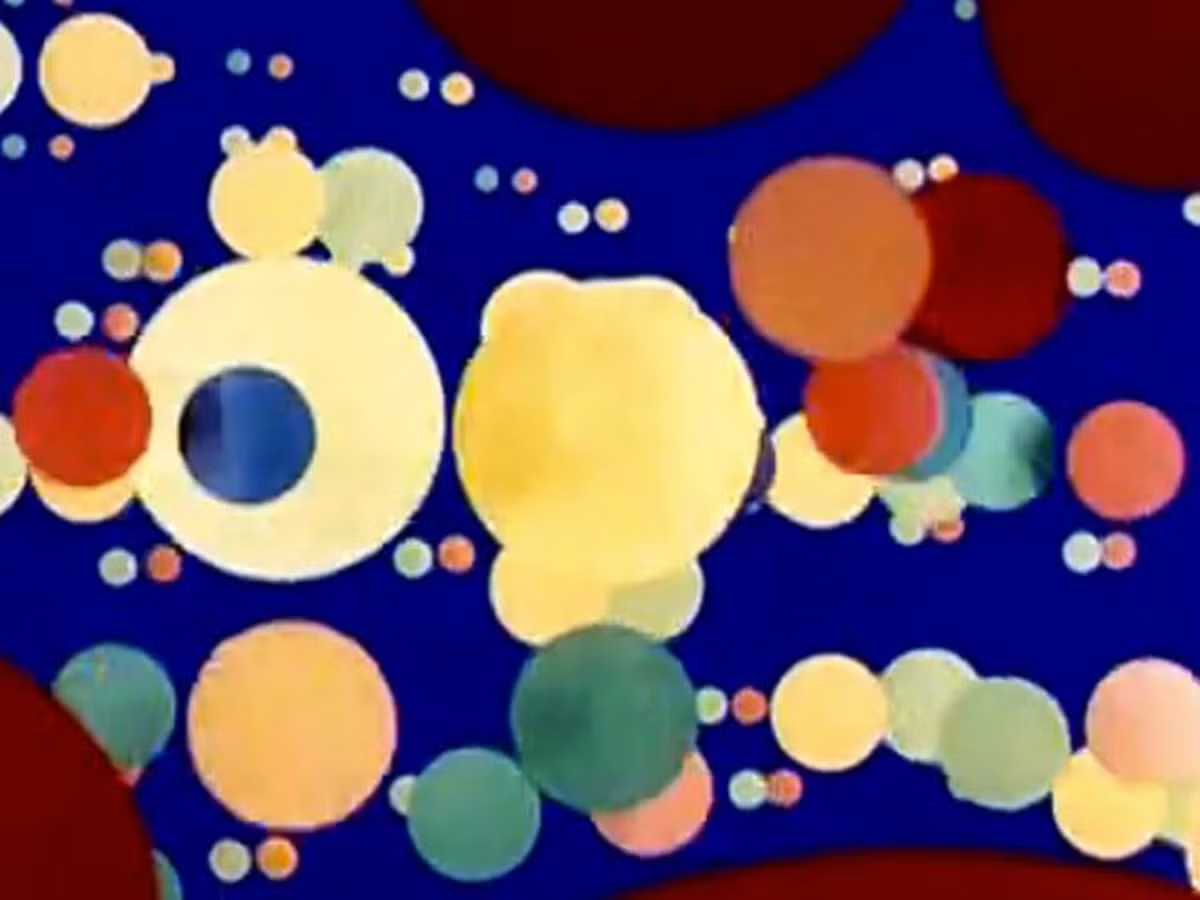
Oskar Fischinger, an artist, animator, and painter, remains a towering figure in the world of abstract cinema. Born on June 22, 1900, in Gelnhausen, Germany, Fischinger’s legacy includes over 50 short films and approximately 900 canvases, solidifying his status as one of the most innovative and influential filmmakers of the 20th century. His work, particularly in abstract animation, continues to inspire and influence modern visual art and cinema.
Early Life and Passion for Art
Oskar Wilhelm Fischinger was the fourth of six children in his family. His father owned a grocery store, while his mother managed a multifaceted establishment that served as a tavern, brewery, and bowling alley. From a young age, Fischinger exhibited a strong passion for painting, a talent that was nurtured by local artists who visited Gelnhausen to paint the surrounding landscapes. Alongside his love for painting, Fischinger also developed an interest in music, taking violin lessons during his youth.
Fischinger’s early professional life began with an apprenticeship at an organ-building company. However, the outbreak of World War I interrupted this trajectory, as the company’s owners were called to military service. Following this, Fischinger took up a position as a draftsman in an architect’s studio, only to be rejected for military service due to health issues. His family later relocated to the west of Frankfurt, where Fischinger completed his studies at a commercial school and earned a diploma in engineering.
Transition to Filmmaking
Fischinger’s journey into the world of filmmaking began in the 1920s in Frankfurt, where he met Dr. Bernhard Diebold, a prominent figure in the literary club scene. Diebold, impressed by Fischinger’s abstract sketches, encouraged him to pursue abstract filmmaking. Fischinger’s determination to explore this new medium was further solidified by the public’s reaction to the abstract films of Walter Ruttmann, a pioneering filmmaker, in 1921.
Driven by his newfound passion, Fischinger left his engineering job and moved to Munich, where he aspired to become a full-time filmmaker. However, financial difficulties forced him to relocate to Berlin in 1927. Despite the challenges, Fischinger’s determination paid off. In 1928, he began working on special effects for Fritz Lang’s film “Woman in the Moon” (“Frau im Mond”), marking his entry into the cinematic world.
A significant turning point in Fischinger’s career came in 1929 when he suffered a broken ankle and was hospitalized. During this time, he decided to fully dedicate himself to the production of abstract films. Over the following years, Fischinger created a series of meticulously synchronized black-and-white studies set to music. These films garnered international acclaim, being screened in Europe, Japan, and America.
Innovation and Fame in Abstract Cinema
Oskar Fischinger’s contributions to the field of abstract cinema cannot be overstated. His experiments with “synthesized and drawn” sound, as well as his collaboration with Béla Gaspar on a three-color film process called GasparColor, led to the creation of his first color film, “Kreise,” in 1933. This film marked the beginning of a new chapter in Fischinger’s career, characterized by a series of groundbreaking color films, including “Muratti Marches On” and “Composition in Blue.”
These films received widespread acclaim, capturing the attention of Hollywood. In February 1936, Fischinger accepted a contract with Paramount Pictures and relocated to Hollywood, marking the beginning of his American exile. He would never return to Germany.
In Hollywood, Fischinger continued to push the boundaries of visual art and cinema. His work was characterized by a deep exploration of the relationship between music and visual art, often using simple geometric shapes to create intricate, rhythmic visual compositions that seemed to dance to the music. This approach was not merely decorative; it was a profound investigation into how sound and vision could be united in a harmonious, almost mystical, experience.
Mysticism and Artistic Philosophy
Behind Fischinger’s groundbreaking work lay a deep sense of mysticism. He believed that music and visual art were interconnected, governed by underlying laws that he sought to uncover through his films. Fischinger often followed astrological principles in his work, timing his creative activities according to lunar cycles. He was also known to practice yoga, spending hours in contemplation to align his body with the earth’s magnetic fields.
This spiritual approach to art is perhaps most evident in his most famous work, “Motion Painting No. 1” (1947). This film, set to Johann Sebastian Bach’s “Brandenburg Concerto No. 3, BWV 1048,” was created by painstakingly applying oil paint to acrylic glass, filming each brushstroke over a period of nine months. The result is a mesmerizing visual journey that has been recognized as culturally, historically, and aesthetically significant, earning a place in the National Film Registry by the American Library of Congress in 1997.
The Legacy of Oskar Fischinger
Fischinger’s work was not without its challenges. In Nazi Germany, his art was labeled as “degenerate” (Entartete Kunst), a term used by the regime to describe art that did not align with Nazi ideals. As a result, Fischinger was forced into exile in the United States, where he continued to create, despite the difficulties of working in a foreign land.
Fischinger’s influence extends far beyond his own time. His exploration of the relationship between sound and image paved the way for future generations of animators and filmmakers. His work anticipated the development of music videos, computer graphics, and even aspects of video game design. Fischinger’s films, with their emphasis on rhythm, color, and abstract form, continue to inspire contemporary artists and filmmakers.
Final Years and Death
Oskar Fischinger spent the last years of his life in Los Angeles, where he continued to work on various artistic projects until his death on January 31, 1967, at the age of 66. Despite facing numerous challenges throughout his life, Fischinger remained committed to his artistic vision, leaving behind a legacy that continues to resonate with audiences and artists alike.
Conclusion
Oskar Fischinger’s life and work represent a unique blend of art, music, and mysticism. His pioneering efforts in abstract cinema have left an indelible mark on the history of visual art and film. From his early days in Germany to his exile in the United States, Fischinger remained dedicated to exploring the depths of human creativity through his films. His legacy serves as a testament to the power of art to transcend boundaries and connect with the deepest aspects of the human experience.
Fischinger’s work continues to be studied and celebrated for its innovative approach to visual art and its profound understanding of the relationship between sound and image. As one of the most important figures in the history of abstract cinema, Oskar Fischinger’s life and career offer valuable insights into the evolution of visual art in the 20th century.


