
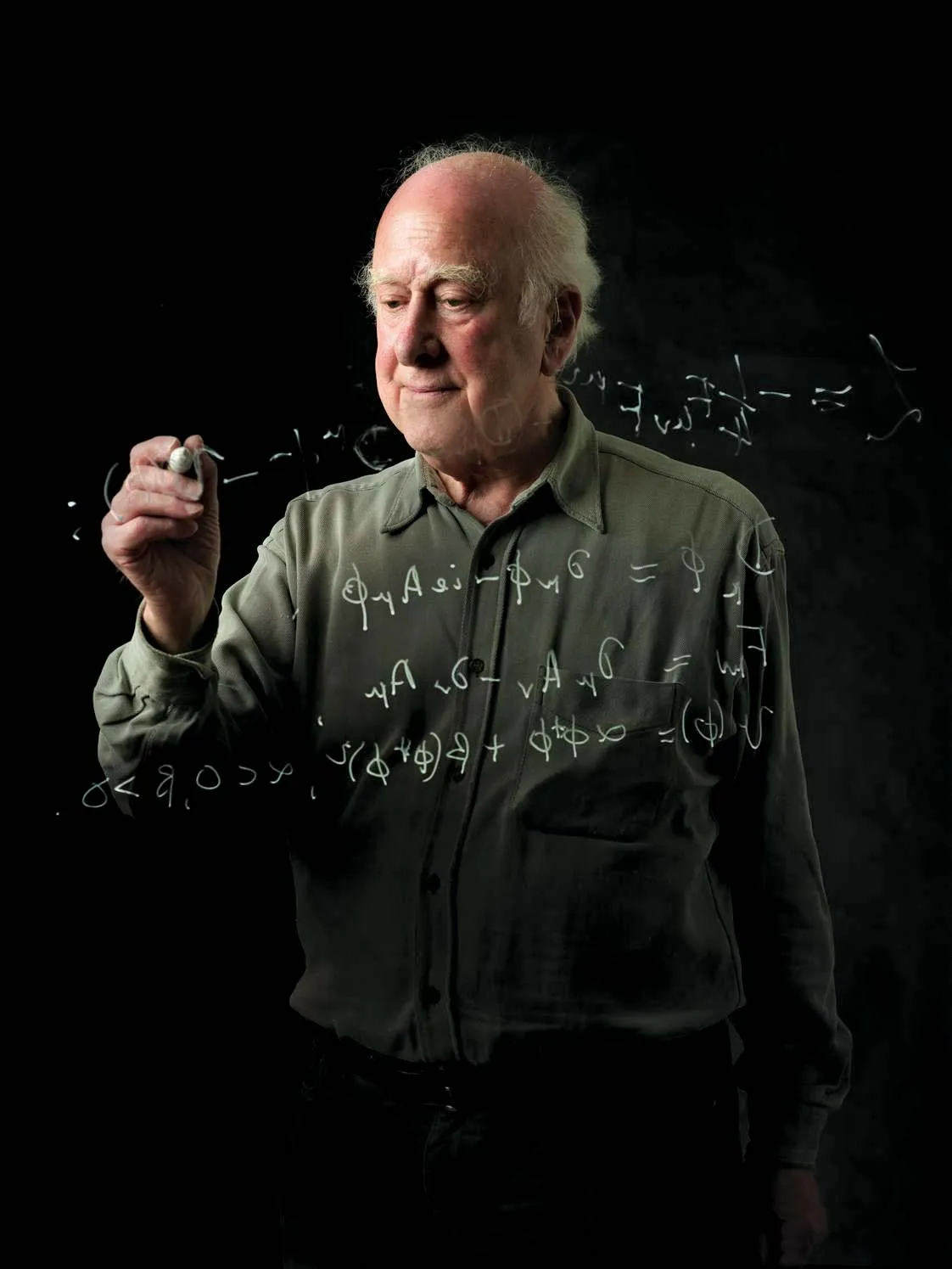
Peter Higgs is a name that resonates powerfully within the scientific community, particularly among physicists. Best known for the theoretical prediction of the Higgs boson—a particle often referred to as the “God particle”—Higgs has left an indelible mark on the world of science. His work has been pivotal in shaping our understanding of the universe’s fundamental forces. This article delves into the life of Peter Higgs, exploring his age, the fame he garnered through his groundbreaking discoveries, and the key highlights that define his illustrious career.
Early Life and Education: The Foundations of a Scientific Mind
Peter Ware Higgs was born on May 29, 1929, in Newcastle upon Tyne, England. His early life was marked by a series of relocations due to his father’s job as a sound engineer. These moves exposed Higgs to various educational environments, which played a crucial role in shaping his intellectual development.
Higgs’s academic journey began at the City of London School, where he demonstrated an early aptitude for mathematics and physics. His interest in these subjects was further fueled by his admiration for Paul Dirac, a pioneering physicist whose work in quantum mechanics would later influence Higgs’s own research. In 1947, Higgs enrolled at King’s College London, where he pursued a degree in physics. It was here that he first encountered the concepts that would later lead to his groundbreaking work on the Higgs mechanism.
The Post-War Era: A New Dawn for Science
The post-war era was a time of rapid advancement in science and technology, with physics at the forefront of many new discoveries. Higgs entered the academic world during this dynamic period, and his early research was heavily influenced by the developments in quantum field theory, a branch of physics that seeks to explain how particles interact at the quantum level.
After completing his undergraduate studies, Higgs pursued a Ph.D. at King’s College, where his research focused on the theory of quantum electrodynamics (QED). QED is the quantum theory of the electromagnetic force, one of the four fundamental forces in nature. During this time, Higgs became increasingly interested in the concept of symmetry breaking—a phenomenon in which a system that is symmetric under certain conditions becomes asymmetric under others. This concept would later become central to his work on the Higgs mechanism.
The Higgs Mechanism: A Revolutionary Idea
Peter Higgs’s most significant contribution to physics is undoubtedly the Higgs mechanism, a theoretical framework that explains how particles acquire mass. In the early 1960s, physicists were grappling with a fundamental problem: according to the then-prevailing theories, particles should be massless, but in reality, they have mass. This discrepancy posed a significant challenge to the standard model of particle physics, which seeks to explain the fundamental particles and forces in the universe.
In 1964, Higgs proposed a solution to this problem by introducing the concept of a scalar field, now known as the Higgs field. This field permeates the entire universe, and particles interact with it as they move through space. According to Higgs’s theory, the mass of a particle is determined by the strength of its interaction with the Higgs field—the stronger the interaction, the greater the mass.
The Higgs Boson: The “God Particle”
A critical component of Higgs’s theory was the prediction of a new particle, the Higgs boson. This particle is the quantum manifestation of the Higgs field, and its discovery was essential for validating Higgs’s theory. However, detecting the Higgs boson proved to be a formidable challenge due to its highly unstable nature and the extreme conditions required to produce it.
For decades, the existence of the Higgs boson remained hypothetical, and the search for it became one of the most significant quests in modern physics. The construction of the Large Hadron Collider (LHC) at CERN in Switzerland was, in part, driven by the desire to detect the elusive particle. Finally, on July 4, 2012, scientists at CERN announced the discovery of a particle consistent with the Higgs boson, a momentous occasion that confirmed the validity of Higgs’s theory.
The Nobel Prize: Recognition of a Lifetime’s Work
The discovery of the Higgs boson was hailed as one of the most important scientific achievements of the 21st century. It provided the missing piece of the puzzle in the standard model of particle physics and earned Peter Higgs and François Englert, who independently proposed a similar theory, the 2013 Nobel Prize in Physics.
For Higgs, the Nobel Prize was the culmination of a lifetime of dedication to the pursuit of knowledge. However, it is worth noting that Higgs has always been a modest and somewhat reclusive figure, shunning the limelight that came with his newfound fame. In interviews, he has often downplayed his achievements, emphasizing the collaborative nature of scientific research and the contributions of his colleagues.
Beyond the Nobel Prize: Continued Influence and Legacy
Even after receiving the Nobel Prize, Peter Higgs continued to be an influential figure in the field of theoretical physics. His work has inspired countless other researchers and has had a profound impact on our understanding of the universe. The Higgs mechanism and the discovery of the Higgs boson have opened up new avenues of research in particle physics, cosmology, and beyond.
In recognition of his contributions to science, Higgs has received numerous other honors and awards, including the Copley Medal from the Royal Society and the Edinburgh Medal. He has also been the subject of several biographies and documentaries, which have sought to bring his remarkable story to a broader audience.
Age and Personal Life: The Man Behind the Science
As of 2024, Peter Higgs is 95 years old. Despite his advanced age, he remains intellectually active and engaged with the scientific community. However, Higgs has always been a private individual, preferring to keep his personal life out of the public eye. He has rarely given interviews, and when he does, he often speaks with humility and reticence about his achievements.
Higgs has been described by those who know him as a kind and gentle person, with a deep love for classical music and literature. He has lived a relatively quiet life, spending much of his time in Edinburgh, where he has held various academic positions at the University of Edinburgh since the 1960s. Higgs never married and has no children, which has perhaps contributed to his ability to focus so single-mindedly on his research.
The Importance of Solitude in Scientific Discovery
One of the most intriguing aspects of Peter Higgs’s life is his belief in the importance of solitude for scientific discovery. Higgs has often spoken about how he values time alone to think deeply about complex problems, free from the distractions of modern life. This preference for solitude is reflected in his working style—Higgs did much of his most significant work independently, without the aid of large research teams or advanced computing technology.
In today’s fast-paced world, where collaboration and instant communication are often emphasized, Higgs’s approach serves as a reminder of the value of quiet reflection and individual thought in the pursuit of scientific breakthroughs. His life and career are a testament to the idea that some of the most profound discoveries come not from large teams or sophisticated equipment but from a single mind, quietly contemplating the mysteries of the universe.
Historical Context: The Evolution of Particle Physics
To fully appreciate Peter Higgs’s contributions to science, it is essential to understand the historical context in which he worked. The mid-20th century was a period of rapid development in particle physics, with many new particles being discovered and the standard model of particle physics taking shape.
In the 1950s and 1960s, physicists were struggling to reconcile the growing number of discovered particles with existing theories. The concept of symmetry breaking, which Higgs would later use in his work, was beginning to gain traction as a way to explain why certain particles have mass while others do not. However, the mathematical framework to fully understand this phenomenon was still being developed.
Higgs’s work on the Higgs mechanism and the prediction of the Higgs boson came at a time when the field of particle physics was on the cusp of significant breakthroughs. His ideas provided a critical piece of the puzzle, helping to explain how particles acquire mass and offering a way to unify the fundamental forces of nature. The subsequent discovery of the Higgs boson in 2012 was a triumph for the standard model and confirmed the correctness of Higgs’s theoretical predictions made nearly five decades earlier.
The Impact of the Higgs Discovery on Modern Physics
The discovery of the Higgs boson has had far-reaching implications for modern physics. It has not only confirmed the validity of the standard model but has also opened up new areas of research in particle physics and cosmology. Scientists are now exploring the implications of the Higgs field for the early universe, particularly its role in cosmic inflation—a period of rapid expansion that occurred just after the Big Bang.
Moreover, the Higgs discovery has raised new questions about the nature of the universe. For example, the mass of the Higgs boson is lower than many physicists expected, which has led to speculation about the stability of the universe. Some theories suggest that the universe could be in a “false vacuum” state, meaning that it could one day undergo a catastrophic phase transition, leading to its eventual collapse.
While these ideas remain speculative, they highlight the ongoing importance of the Higgs boson in contemporary physics. Higgs’s work continues to inspire new research and challenges our understanding of the universe’s fundamental nature.
Conclusion: Peter Higgs’s Enduring Legacy
Peter Higgs’s life and work have had a profound impact on the field of physics and our understanding of the universe. From his early years as a student in post-war England to his groundbreaking work on the Higgs mechanism and the discovery of the Higgs boson, Higgs has made contributions that will be remembered for generations to come.
At 95 years old, Higgs remains a towering figure in the world of science, respected not only for his intellectual achievements but also for his humility and dedication to the pursuit of knowledge. His story serves as an inspiration to future generations of scientists, reminding us that even the most challenging problems can be solved through persistence, creativity, and a deep commitment to understanding the world around us.
As we continue to explore the mysteries of the universe, Peter Higgs’s legacy will undoubtedly endure, guiding us as we seek to uncover the fundamental truths of nature.


