
Introduction
Philippe Petit, born on August 13, 1949, in Nemours, France, is a name that resonates with audacity, artistry, and an indomitable spirit. Known for his high-wire walks across some of the world’s most iconic landmarks, Petit is a legendary figure who has pushed the boundaries of what is possible. His most famous feat, the unauthorized walk between the Twin Towers of the World Trade Center in 1974, remains one of the most daring and celebrated acts in the history of performance art. This article delves into the life of Philippe Petit, exploring his age, career highlights, and the impact of his extraordinary achievements on both the art world and popular culture.
Early Life and Introduction to the High Wire
Philippe Petit was born into a creative family. His father, Edmond Petit, was an author and a former army pilot, which perhaps planted the seeds of adventure in young Philippe. From a very early age, Petit showed a fascination with performing arts. He started with juggling and magic, both of which laid the foundation for his future as a high-wire artist.
By the age of 16, Petit was already making his first steps—quite literally—on a tightrope. Self-taught and driven by an insatiable curiosity, he quickly mastered the art of walking on a wire. In just a year, he was performing intricate tricks, including riding a bicycle and executing flips on the wire. Despite his growing expertise, Petit was an unruly student and was expelled from five different schools, preferring the open skies to the confines of a classroom.
The Birth of a Dream: The Twin Towers Walk
The idea that would define Philippe Petit’s life came to him in 1968 while sitting in a dentist’s office. Flipping through a magazine, he stumbled upon an article about the construction of the Twin Towers in New York City. The vision of walking between the two tallest buildings in the world ignited a spark in Petit that would burn for six years.
Petit began obsessively collecting articles and images of the Twin Towers. He meticulously studied every aspect of their construction, determined to make his dream a reality. This obsession would lead him to one of the most daring and illegal acts of performance art ever conceived.
Preliminary Feats: Building Up to the Twin Towers
Before attempting the Twin Towers walk, Philippe Petit honed his craft by performing on some of the world’s most famous landmarks. In 1971, he walked a tightrope between the towers of Notre Dame Cathedral in Paris. This daring performance was followed by another in 1973, where he walked between two pylons of the Sydney Harbour Bridge in Australia.
These feats were not just about pushing the limits of physical endurance but also about refining the art of planning and execution. Each performance was a complex operation involving months of preparation, reconnaissance, and practice. These early successes built Petit’s confidence and honed his skills for the ultimate challenge—the Twin Towers.
Planning the Twin Towers Walk: An Exercise in Precision
The preparation for the Twin Towers walk was nothing short of a military operation. Petit and his team, which included friends and collaborators, made several trips to New York City to study the Towers. They spent months observing the security routines, the construction schedules, and even the weather patterns that could affect the walk.
Petit understood that every detail mattered. He rented a helicopter to take aerial photographs of the Towers and built a scale model to practice his walk. He also forged IDs for himself and his team, posing as contractors to gain access to the Towers. To blend in, they even studied the clothing and behavior of the workers in the buildings.
The planning was intense and meticulous. Petit and his team smuggled heavy equipment, including a 200-foot cable, into the Towers under the cover of night. They spent hours securing the cable between the buildings, battling strong winds and the immense height. The night before the walk, they hid in the Towers, waiting for dawn.
The Walk: A Moment of Transcendence
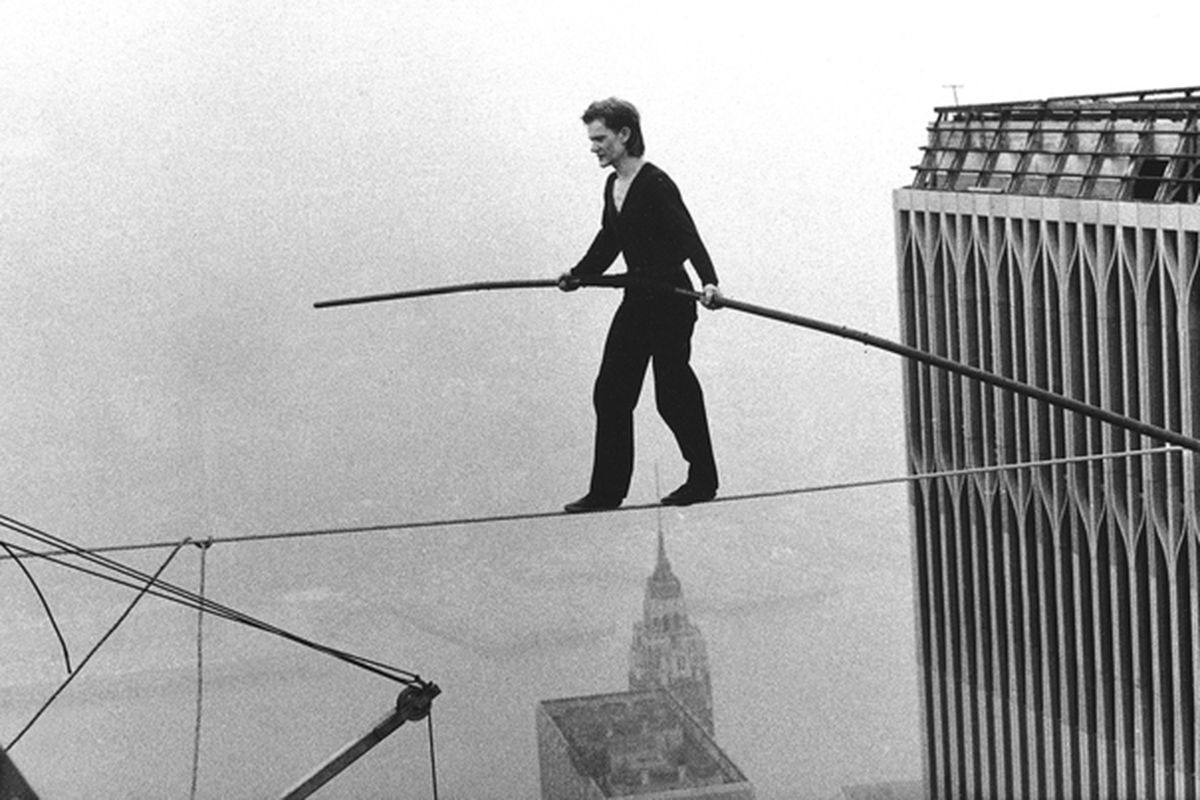
On the morning of August 7, 1974, Philippe Petit stepped onto the wire stretched between the Twin Towers. He was 1,350 feet above the ground, with no safety net or harness. For 45 minutes, Petit performed a ballet in the sky, walking, dancing, kneeling, and even lying down on the wire. The streets of New York City came to a standstill as people watched in awe.
The police and Port Authority officials, who had rushed to the scene, were powerless to stop him. They threatened to pluck him from the wire with a helicopter, but Petit continued his performance, unfazed. When he finally stepped off the wire, he was arrested immediately, but he had already become a legend.
The walk between the Twin Towers was not just a physical feat; it was a profound statement of human potential and the power of dreams. Petit had turned the impossible into the possible, defying the laws of gravity and the boundaries of art.
After the Twin Towers: A Life of Continued Daring
Following his Twin Towers walk, Philippe Petit became an international sensation. The media coverage was extensive, and Petit was celebrated as a hero. The Port Authority of New York and New Jersey even awarded him a lifetime pass to the Observation Deck of the Twin Towers.
Petit’s career did not end with the Twin Towers. He continued to perform daring high-wire walks at iconic locations around the world, including the Niagara Falls and the Superdome in New Orleans. Each performance was a testament to his skill, courage, and artistic vision.
Petit also turned his attention to writing, sharing his philosophy and experiences through books. His works include “To Reach the Clouds” (2002), which provides an intimate look at his life and the Twin Towers walk, and “Creativity: The Perfect Crime” (2015), where he explores the nature of creativity and the rebellious spirit that drives it.
The Legacy of Philippe Petit: A Cultural Icon
Philippe Petit’s influence extends beyond the realm of performance art. His Twin Towers walk has been immortalized in books, documentaries, and films. The 2008 documentary “Man on Wire,” directed by James Marsh, won the Academy Award for Best Documentary Feature. The film captures the tension, drama, and sheer audacity of Petit’s Twin Towers walk, earning critical acclaim and introducing Petit’s story to a new generation.
In 2015, director Robert Zemeckis brought Petit’s story to the big screen with “The Walk,” starring Joseph Gordon-Levitt as Petit. The film used cutting-edge visual effects to recreate the Twin Towers and Petit’s walk, giving audiences a visceral sense of the experience. While the film took some creative liberties, it captured the essence of Petit’s achievement and the spirit of adventure that defines his life.
The Philosophy of Philippe Petit: Pushing Boundaries
Philippe Petit is more than just a high-wire artist; he is a philosopher of life and creativity. His walks are not merely stunts but expressions of a deeper belief in the power of imagination and the human spirit. Petit sees the wire as a metaphor for life—a journey that requires balance, focus, and the willingness to embrace risk.
Petit’s approach to his art is one of meticulous preparation and fearless execution. He believes that creativity thrives on constraints and that true art comes from the tension between discipline and freedom. His life’s work is a testament to the idea that boundaries exist only to be transcended.
Historical Context: The Impact of the Twin Towers Walk
Philippe Petit’s walk between the Twin Towers holds a special place in history, not just as an incredible physical achievement but also as a cultural moment. The Twin Towers, which stood as symbols of modernity and human ambition, became the stage for an act that transcended their architectural significance. Petit’s walk transformed them into symbols of human courage and creativity.
The Twin Towers walk took place during a time of social and political upheaval in the 1970s. In a world grappling with the aftermath of the Vietnam War, the Watergate scandal, and economic instability, Petit’s act of defiance and artistry provided a moment of pure, unadulterated joy. It reminded people of the power of dreams and the possibility of achieving the impossible.
The destruction of the Twin Towers on September 11, 2001, added another layer of poignancy to Petit’s walk. In the wake of the tragedy, Petit’s achievement became a symbol of resilience and hope, a reminder of the enduring human spirit in the face of adversity.
The Future: Philippe Petit’s Continuing Influence
As of 2024, Philippe Petit remains an active and influential figure in the world of art and creativity. He continues to write, lecture, and inspire people with his philosophy of life and art. His foundation, The Philippe Petit Foundation, supports young artists and performers, encouraging them to pursue their dreams with the same passion and determination that has defined his own life.
Petit’s legacy is not just his high-wire walks but the way he has lived his life—fearlessly, passionately, and with an unwavering commitment to his art. He challenges us all to find our own wires, to walk them with confidence, and to embrace the beauty and uncertainty of the journey.
Conclusion
Philippe Petit’s life is a story of defiance, creativity, and the relentless pursuit of dreams. From his early days in France to his historic walk between the Twin Towers, Petit has shown the world what it means to live without limits. His achievements have left an indelible mark on the world of art and performance, inspiring countless others to push the boundaries of what is possible. As he continues to share his wisdom and experience, Philippe Petit’s influence will undoubtedly continue to grow, reminding us all to reach for the clouds.


