
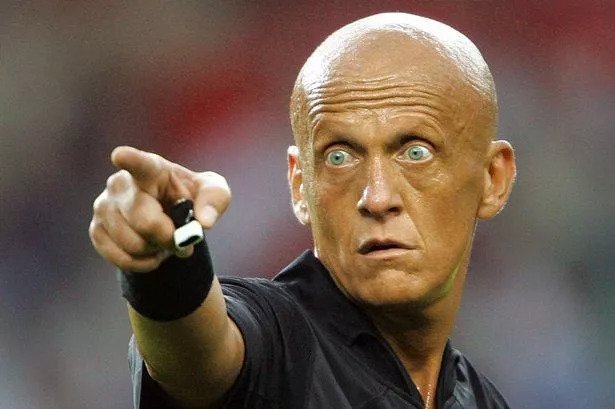
Pierluigi Collina is a name synonymous with football refereeing, revered for his unparalleled command on the field, distinctive appearance, and commitment to the sport. Born on February 13, 1960, in Bologna, Italy, Collina has become a legendary figure in the world of football, earning respect and admiration from players, coaches, and fans alike. His life story is one of discipline, dedication, and an unyielding pursuit of excellence, making him one of the most recognized and celebrated referees in football history.
Early Life and Education
Pierluigi Collina was born as the only child to Elia Collina, a state employee, and Luciana Collina, an elementary school teacher. Growing up in Bologna, a city rich in culture and history, Collina developed an early interest in sports. Despite his love for basketball and being a fervent supporter of Fortitudo Bologna, it was football that eventually captured his professional interest. Collina attended the University of Bologna, where he pursued a degree in Economics and Commerce, graduating in 1984 with honors. His academic achievements were a testament to his disciplined approach to life, a trait that would later define his career as a referee.
The Road to Refereeing
Collina’s journey into refereeing began somewhat serendipitously. As a young man, he was involved in playing football but often found himself on the bench rather than on the field. An injury sidelined him from playing, but it was during this recovery period that he first picked up the referee’s whistle. His talent for officiating was quickly recognized by those around him, and he soon became a regular referee for training matches. Encouraged by a friend from high school, Fausto Capuano, Collina enrolled in a refereeing course organized by the Bologna Referees’ Section in 1977. Interestingly, Capuano, who introduced him to refereeing, was not able to continue due to vision problems, highlighting the twists of fate that sometimes shape careers.
Rapid Ascent in Italian Football
Collina’s refereeing career took off quickly. Within three years, he had ascended to the highest regional level, the Promozione, where he officiated for three seasons. During this time, he also completed his military service and experienced his only pitch invasion, an event that solidified his resolve to maintain order and control during matches. By the 1983-84 season, Collina had moved to the national level, beginning his travels across Italy to officiate in matches, some in remote and challenging locations.
A significant moment in Collina’s life came when he developed severe alopecia, which resulted in the loss of all his hair. This condition, far from being a setback, became a defining characteristic of his public image, giving him a distinctive, recognizable look that would become synonymous with his strict and authoritative style on the field.
Breaking into the Big Leagues: Serie A and Beyond
The 1988-89 season marked Collina’s entry into Serie C, a crucial stepping stone towards the top tiers of Italian football. His performances were consistently impressive, and by the 1991-92 season, he had made his debut in Serie B, quickly followed by his first Serie A match. Collina’s rapid rise through the ranks was no accident; his precise decision-making, calm demeanor under pressure, and authoritative presence made him a standout referee. His debut season in Serie A saw him officiating eight matches, a remarkable achievement that set the stage for his future successes.
International Recognition and Major Tournaments
In 1995, after 43 Serie A matches, Collina was promoted to the international stage. This promotion was a turning point in his career, allowing him to officiate in some of the most prestigious football tournaments around the world. His international debut was soon followed by a series of high-profile assignments, including the 1996 Atlanta Olympics, where he officiated the final between Nigeria and Argentina. This match, watched by millions, showcased Collina’s exceptional refereeing skills on the world stage.
Perhaps the most famous match of Collina’s career was the 1999 UEFA Champions League final between Manchester United and Bayern Munich. The match is remembered not only for its dramatic conclusion but also for Collina’s calm and decisive officiating, which ensured that the game was played fairly and within the rules, despite the intense pressure. His handling of the 1998 FIFA World Cup and UEFA Euro 2000 further cemented his reputation as one of the best referees in the world.
The pinnacle of Collina’s career came in 2002 when he was chosen to officiate the FIFA World Cup final between Brazil and Germany. This match, the most watched sporting event globally, was a crowning achievement for Collina, affirming his status as the world’s top referee.
Life Beyond the Whistle
Collina’s illustrious refereeing career officially ended in 2005 when he reached the mandatory retirement age of 45. However, his influence on the game did not wane. In recognition of his unparalleled contribution to football, the Italian Football Federation (FIGC) changed its rules to allow Collina to continue refereeing for one more year. Despite this extension, Collina decided to retire, marking the end of an era in football refereeing.
After retiring, Collina remained involved in football, taking on the role of a referee designator for Serie A and B in 2007. His expertise and insights into the game have continued to influence the next generation of referees, ensuring that his legacy endures.
Collina’s Legacy and Impact on Football
Pierluigi Collina’s impact on football goes beyond the matches he officiated. He brought a level of professionalism and respect to the role of a referee that had rarely been seen before. His ability to manage games, communicate with players, and make difficult decisions under immense pressure set a new standard for referees around the world. Collina’s bald head, piercing gaze, and calm demeanor became symbolic of fairness and authority, earning him the respect of players, coaches, and fans alike.
Collina’s approach to refereeing was grounded in his belief that the referee’s role was not just to enforce the rules but to ensure that the game was played in the spirit of fair competition. His emphasis on respect for the rules and his unwavering commitment to maintaining the integrity of the game made him a role model for aspiring referees.
Awards and Recognitions
Throughout his career, Collina received numerous awards and accolades, reflecting his standing in the football community. He was named the best referee in the world by the International Federation of Football History & Statistics (IFFHS) for six consecutive years, from 1998 to 2003. His peers and players also recognized his excellence, with the Italian Footballers’ Association awarding him the title of best referee in Serie A multiple times.
In addition to these honors, Collina’s contributions to football were acknowledged by the Italian Referees’ Association (AIA), which awarded him several prestigious prizes, including the Bernardi Prize for the best Serie A debutant in the 1991-92 season and the Mauro Prize for the best referee in Serie A in 1998-99.
Pierluigi Collina’s Personal Life
Beyond the football pitch, Pierluigi Collina leads a relatively private life. He is married to Gianna and has two daughters, Francesca Romana and Carolina. The family resides in Viareggio, where Collina works as a financial consultant. Despite his fame, Collina has remained grounded, often reflecting on the values of discipline, respect, and fairness that have guided him throughout his life.
In 2003, Collina published his autobiography, “Le mie regole del gioco” (“My Rules of the Game”), in which he shares insights into his life and career, offering readers a glimpse into the mindset of one of the most respected figures in football. The book has been well-received, further cementing Collina’s status as a football icon.
Conclusion
Pierluigi Collina’s life and career are a testament to the power of discipline, dedication, and integrity. From his early days in Bologna to becoming the most recognized referee in the world, Collina’s journey has been marked by a relentless pursuit of excellence. His contributions to football have left an indelible mark on the sport, setting a standard for referees and earning him a place in the pantheon of football legends.
Collina’s story is not just about refereeing; it is about the importance of upholding values and principles, even in the face of immense pressure. His legacy will continue to inspire future generations of referees and football enthusiasts, ensuring that the spirit of fair play and respect for the game endures.


