
Piero della Francesca, born Piero di Benedetto de’ Franceschi, was a pioneering Italian painter of the early Renaissance, whose work is celebrated for its serene humanism, geometrical precision, and use of perspective. Born between 1412 and 1418 in Borgo Sansepolcro, a town situated at the border between Tuscany and Emilia-Romagna, Piero’s life and career reflect the intellectual vigor of the Renaissance, blending art, mathematics, and a deep interest in the scientific principles of perspective. This article explores the life, achievements, and enduring legacy of Piero della Francesca, whose contributions to both art and mathematics continue to resonate today.
Early Life and Artistic Beginnings
Piero della Francesca was born into a modest family in Borgo Sansepolcro. His father, Benedetto de’ Franceschi, was a tradesman, and his mother, Romana di Perino da Monterchi, came from a noble family. Although the exact date of Piero’s birth remains uncertain, it is generally believed to have occurred between 1412 and 1418. The early Renaissance was a time of great artistic and intellectual flourishing in Italy, and young Piero was immersed in this environment from an early age.
Piero’s initial training likely took place in his hometown, where he collaborated with local artists such as Antonio d’Anghileri on commissions for the church of San Francesco. These early experiences helped shape Piero’s understanding of art, particularly his interest in the interplay of light and form, which would become central to his later work.
In the 1430s, Piero moved to Florence, the cradle of the Renaissance, where he began to study under the renowned painter Domenico Veneziano. Working alongside Veneziano on projects such as the “Storie della Vergine” (Stories of the Virgin) in the church of Sant’Egidio, Piero absorbed the Florentine master’s techniques, particularly his use of color and light. Although these frescoes have since been lost, they played a critical role in Piero’s artistic development, fostering his deep commitment to naturalism and precise geometry.
The Evolution of Piero’s Artistic Style
Piero della Francesca’s early works reflect his collaboration with Veneziano, particularly in their luminous quality and balanced compositions. Among his earliest surviving works are the “Madonna col Bambino” (Madonna with Child) and the “Battesimo di Cristo” (Baptism of Christ), the latter of which is housed in the National Gallery in London. These paintings, created around 1439, demonstrate Piero’s mastery of light and his emerging interest in the principles of perspective, which would soon define his style.
In the early 1440s, Piero returned to Borgo Sansepolcro, where he was elected as a popular councilor and commissioned by the Confraternita della Misericordia to create a polyptych of 15 panels. Among these panels are the “Madonna della Misericordia” (Madonna of Mercy) and the “Crocifissione” (Crucifixion), both of which highlight Piero’s evolving approach to composition and spatial harmony. Despite the initial commission stipulating that the work be completed within three years, Piero took nearly 15 years to finish the project, underscoring his meticulous attention to detail.
Influence of Flemish Art and Early Masterpieces
During the 1440s, Piero della Francesca traveled extensively across Italy, working in the courts of various noble families and coming into contact with other artists and intellectuals. His time in Ferrara, Bologna, and Urbino was particularly formative, as he encountered the work of Flemish artists such as Rogier van der Weyden. The influence of Flemish art is evident in Piero’s detailed approach to texture and his nuanced treatment of light, as seen in works like “San Girolamo penitente” (Saint Jerome in Penitence) and “San Girolamo e il donatore Girolamo Amadi” (Saint Jerome and the Donor Girolamo Amadi).
By 1450, Piero had established himself as one of the leading artists of his time. His work during this period is characterized by a sophisticated use of perspective, a technique that Piero had mastered and which he employed to create a sense of depth and realism in his compositions. This is particularly evident in the frescoes he painted in the Tempio Malatestiano in Rimini, where he depicted Sigismondo Malatesta, the ruler of the city, in a manner that exudes both authority and piety.
The Frescoes of Arezzo and Later Works
One of Piero della Francesca’s most significant contributions to Renaissance art is his cycle of frescoes in the Basilica of San Francesco in Arezzo, known as the “Storie della Vera Croce” (Stories of the True Cross). Commissioned by the Bacci family, these frescoes were intended to complete the work begun by Bicci di Lorenzo, who had died before finishing the project. Piero’s frescoes, completed between 1452 and 1466, are considered masterpieces of Renaissance art, showcasing his expertise in perspective, his delicate handling of light, and his ability to convey complex narratives with clarity and elegance.
The “Storie della Vera Croce” includes several scenes, such as the “Dream of Constantine,” the “Battle between Heraclius and Chosroes,” and the “Exaltation of the Cross.” These works are noted for their precise use of perspective and their vivid portrayal of both divine and human figures. The “Dream of Constantine,” in particular, is lauded for its innovative depiction of a night scene, where Piero skillfully manipulates light to create a hauntingly realistic atmosphere.
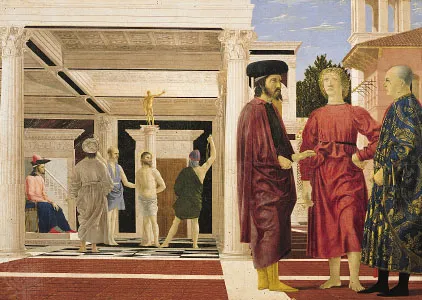
In addition to his work in Arezzo, Piero continued to paint for other patrons, including the d’Este family in Ferrara and the Montefeltro family in Urbino. His painting “La Flagellazione” (The Flagellation of Christ), completed around 1455-1460, is another of his most famous works. It demonstrates his complex understanding of space and architecture, as well as his ability to convey deep emotion through restrained yet powerful compositions.
Contributions to Mathematics and Perspective
Beyond his achievements as a painter, Piero della Francesca was also a respected mathematician and theorist. His interest in the principles of geometry and perspective is evident not only in his paintings but also in his written works. Piero authored several treatises on mathematics, which were highly regarded in his time and contributed to the spread of mathematical knowledge during the Renaissance.
One of Piero’s most important works is “De Prospectiva Pingendi” (On Perspective in Painting), a treatise that outlines the mathematical principles underlying the art of perspective. This work was groundbreaking in its systematic approach to the subject, offering practical guidelines for artists seeking to create the illusion of depth on a flat surface. Piero’s understanding of perspective was far ahead of his time, and his treatise became a foundational text for later Renaissance artists.
In addition to “De Prospectiva Pingendi,” Piero wrote “Trattato d’abaco” (Abacus Treatise) and “De Corporibus Regularibus” (On Regular Bodies), the latter of which focuses on the geometry of regular solids. These works reflect Piero’s deep commitment to the study of mathematics and his belief that art and science are interconnected disciplines.
Decline in Health and Final Years
As Piero della Francesca aged, his health began to deteriorate, particularly his eyesight. By the late 1470s, Piero was suffering from a condition that progressively led to blindness, forcing him to give up painting. Despite this setback, he continued to work on his mathematical treatises, dedicating his final years to the pursuit of knowledge.
Piero’s decline in health coincided with a shift in artistic tastes, as younger artists like Sandro Botticelli and Leonardo da Vinci began to rise to prominence. Nevertheless, Piero’s influence remained strong, particularly in the court of Urbino, where his teachings on perspective and geometry were highly valued.
Piero della Francesca passed away on October 12, 1492, in his hometown of Borgo Sansepolcro. His death marked the end of an era, but his legacy as a master of both art and mathematics lived on, inspiring generations of artists and scholars.
The Legacy of Piero della Francesca
Piero della Francesca’s contributions to Renaissance art and mathematics are immeasurable. His innovative use of perspective transformed the way artists approached the depiction of space, laying the groundwork for future developments in Western art. Piero’s ability to blend scientific rigor with artistic expression set him apart from his contemporaries and earned him a place among the great masters of the Renaissance.
Piero’s influence extended beyond Italy, as his works were studied and admired by artists across Europe. His treatises on perspective became essential reading for artists seeking to master the complexities of space and form. Piero’s emphasis on geometry and proportion resonated with the ideals of the Renaissance, which sought to harmonize art and science in the pursuit of beauty and truth.
Today, Piero della Francesca is celebrated not only for his artistic achievements but also for his contributions to the intellectual life of the Renaissance. His works continue to be studied and admired for their clarity, precision, and timeless beauty. The frescoes of Arezzo, the “Flagellation of Christ,” and the “Resurrection” stand as enduring testaments to his genius, while his mathematical writings remind us of the deep connections between art and science.
Piero della Francesca in Historical Context
To fully appreciate Piero della Francesca’s legacy, it is important to consider the broader historical context in which he lived. The early Renaissance was a period of intense intellectual and artistic activity, characterized by a renewed interest in the classical ideals of ancient Greece and Rome. In this environment, artists like Piero sought to combine the beauty of the classical world with the scientific advancements of their own time.
Piero’s work reflects the humanist ideals of the Renaissance, which emphasized the importance of education, individual achievement, and the pursuit of knowledge. His paintings, with their serene figures and harmonious compositions, embody the Renaissance ideal of the “universal man,” a person who excels in both the arts and sciences.
Piero’s exploration of perspective also aligns with the broader scientific advancements of the period. The Renaissance was a time of great innovation in fields such as mathematics, astronomy, and anatomy, and Piero’s work reflects this spirit of discovery. His paintings are not only beautiful works of art but also sophisticated studies of space, light, and form.
Conclusion
Piero della Francesca was a true Renaissance man, whose work as a painter and mathematician left an indelible mark on the history of art and science. His innovative use of perspective, his commitment to the study of geometry, and his ability to create compositions of serene beauty have earned him a place among the great masters of the Renaissance. Piero’s legacy continues to inspire and inform the work of artists, scholars, and mathematicians, reminding us of the enduring power of art and knowledge.
As we look back on the life and achievements of Piero della Francesca, we are reminded of the profound connections between art and science, and the ways in which these disciplines can work together to create something truly extraordinary. Piero’s work stands as a testament to the potential of human creativity and the enduring value of the Renaissance ideals that continue to shape our world today.


