
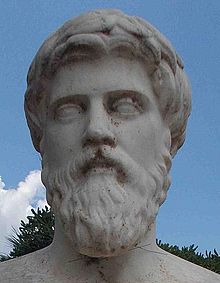
Plutarch, an ancient Greek historian, biographer, and essayist, is one of the most influential figures from antiquity, whose works have shaped Western literature and philosophy. Born between 46 and 48 AD in Chaeronea, a small town in the region of Boeotia, Greece, Plutarch’s contributions to history and literature are profound, particularly through his seminal works “Parallel Lives” and “Moralia.” His writings provide a window into the ethical and moral frameworks of his time, reflecting on the lives of notable Greek and Roman figures. Plutarch’s life and work continue to resonate in modern times, highlighting his lasting impact on culture and intellectual thought.
Early Life and Background
Plutarch was born into a family that was likely affluent, which afforded him the opportunity to pursue education and cultural interests from an early age. Although the identity of his parents remains uncertain, some sources suggest that his father could have been named Autobulus or Nicarcus, both of whom are mentioned in his writings. However, these are speculative identifications, as there is no concrete evidence to confirm their exact relationship to Plutarch.
Plutarch had at least one brother, Lamprias, and he was a descendant of Nicarcus, which suggests a family lineage of some prominence. His early education took place in his hometown of Chaeronea, where he would have received a foundational education in grammar, rhetoric, and philosophy. This early exposure to learning would set the stage for his later achievements as a scholar and philosopher.
Education and Philosophical Influences
In 60 AD, Plutarch moved to Athens, the intellectual hub of the ancient world, where he studied under Ammonius, a renowned Platonist philosopher. It was here that he immersed himself in the study of Platonic philosophy, which greatly influenced his thinking and writings. Under Ammonius’s mentorship, Plutarch not only mastered Platonic philosophy but also broadened his intellectual pursuits to include mathematics and rhetoric.
His time in Athens also allowed him to engage with various philosophical circles and gain exposure to different schools of thought, including Stoicism and Epicureanism. This diverse intellectual environment enriched his understanding and provided him with a well-rounded perspective that would later be evident in his writings.
Rise to Prominence in Rome
Plutarch’s fame began to spread beyond Greece, leading him to travel extensively throughout the Roman Empire. Around 66 AD, he traveled to Rome, where he was well-received by the intellectual and political elite. During his time in Rome, he became acquainted with Emperor Nero, who was relatively benevolent toward Greek scholars and philosophers, particularly because of his decision to exempt Greece from paying tributes to Rome.
Although Plutarch’s command of the Latin language was not perfect, his reputation as a scholar and philosopher garnered him a significant following in Rome. He gave numerous lectures and formed connections with several prominent Romans, including Mestrius Florus, a consul who later played a crucial role in helping Plutarch obtain Roman citizenship. Plutarch adopted the nomen “Mestrius” in honor of his friend, further solidifying his integration into Roman society.
Political and Social Contributions
Throughout his life, Plutarch was actively involved in both political and social affairs in Greece and Rome. After gaining Roman citizenship, he returned to his native Chaeronea, where he took on various civic responsibilities. He was appointed to several significant positions, including the supervisor of public buildings and the archon eponymous, a chief magistrate role in his hometown. His involvement in civic duties extended to religious activities as well, as he was appointed a priest at the Temple of Apollo in Delphi around 90 AD.
Plutarch’s appointment as a priest at Delphi was a prestigious role that underscored his influence and status within Greek society. His duties included overseeing religious rituals and maintaining the sacred site, which was considered the center of the world in ancient Greek mythology. His involvement in Delphi’s religious life reflected his deep commitment to his cultural and spiritual heritage.
Literary Works and Philosophical Contributions
Plutarch’s literary output is vast and varied, covering topics from history and biography to philosophy and ethics. His works are traditionally divided into two categories: “Parallel Lives” and “Moralia.”
“Parallel Lives”
“Parallel Lives” is perhaps Plutarch’s most famous work, consisting of 23 pairs of biographies of Greek and Roman figures, with each pair typically consisting of one Greek and one Roman. These biographies were designed to draw moral and ethical comparisons between the subjects, highlighting their virtues and vices. Notable pairs include “Alexander the Great and Julius Caesar,” “Demosthenes and Cicero,” and “Lycurgus and Numa.”
“Parallel Lives” is not just a historical account but also a study in character and morality. Plutarch was less concerned with the factual details of his subjects’ lives and more focused on the ethical lessons that could be drawn from their actions. His work provides valuable insights into the values and moral beliefs of ancient societies and has been a source of inspiration for countless writers, including Shakespeare, who drew upon Plutarch’s biographies for his Roman plays.
“Moralia”
“Moralia” is a collection of essays, dialogues, and treatises covering a wide range of topics, including ethics, religion, politics, and natural sciences. Unlike “Parallel Lives,” which focuses on historical figures, “Moralia” delves into philosophical discussions on a variety of subjects, from the nature of virtue to the role of superstition in society.
The essays in “Moralia” reflect Plutarch’s eclectic interests and his ability to engage with different philosophical traditions. His writings demonstrate a deep understanding of Platonic philosophy, but he also engages with Stoic and Epicurean ideas, often critiquing or synthesizing these different perspectives. “Moralia” provides a comprehensive view of Plutarch’s thought and serves as an important source of information on ancient philosophy and religion.
Personal Life and Family
Plutarch married Timoxena, a woman of noble birth from his hometown of Chaeronea. Together, they had five children, though not all survived to adulthood. Their children included Cheron, Soclarus, Plutarch, Autobulus, and a daughter named Timoxena, who tragically died at the age of two. Plutarch’s family life was marked by both joy and sorrow, and he often reflected on these personal experiences in his writings, particularly in his essay “Consolation to His Wife,” which he wrote after the death of their daughter.
Timoxena was a supportive partner who shared Plutarch’s intellectual and religious pursuits. She accompanied him in various religious ceremonies at Delphi, where he served as a priest. Her own contributions to intellectual life are noted by Plutarch, who mentions a treatise she wrote on luxury, indicating her active engagement in philosophical discussions.
Later Years and Death
After his return to Chaeronea from Rome, Plutarch continued his intellectual and civic engagements until his death. In 90 AD, he was appointed to a second term as the archon eponymous and continued to serve as a priest at Delphi, a role he held until his death. His later years were marked by a continued dedication to writing and teaching, as well as an involvement in the local community and its governance.
Plutarch died between 119 and 125 AD, with the exact date of his death being uncertain. His passing marked the end of an era for Greek scholarship, but his works lived on, influencing countless generations of thinkers, writers, and philosophers.
Legacy and Impact
Plutarch’s works have had a lasting impact on Western literature and thought. During the Middle Ages, his writings were largely forgotten in the West but continued to be read in the Byzantine Empire. It was not until the Renaissance that Plutarch’s works were rediscovered and translated into Latin and vernacular languages, sparking renewed interest in his writings and ideas.
The “Parallel Lives” and “Moralia” have influenced numerous writers, philosophers, and historians, including Montaigne, Rousseau, and Shakespeare. His approach to biography and history, focusing on moral lessons and character studies, has shaped the genre and continues to be a model for historical writing today.
Conclusion
Plutarch remains a towering figure in the annals of history and philosophy, his works bridging the worlds of Greek and Roman antiquity. His writings offer a unique blend of historical narrative and moral philosophy, providing insights into the ethical considerations of his time. Through “Parallel Lives” and “Moralia,” Plutarch has left an indelible mark on Western culture, influencing countless generations of thinkers and writers.
His life, marked by intellectual curiosity, civic responsibility, and a commitment to moral and ethical reflection, serves as a timeless example of the philosopher-scholar. Even today, Plutarch’s works are studied for their literary merit and philosophical insights, ensuring that his legacy continues to inspire and educate future generations.


