
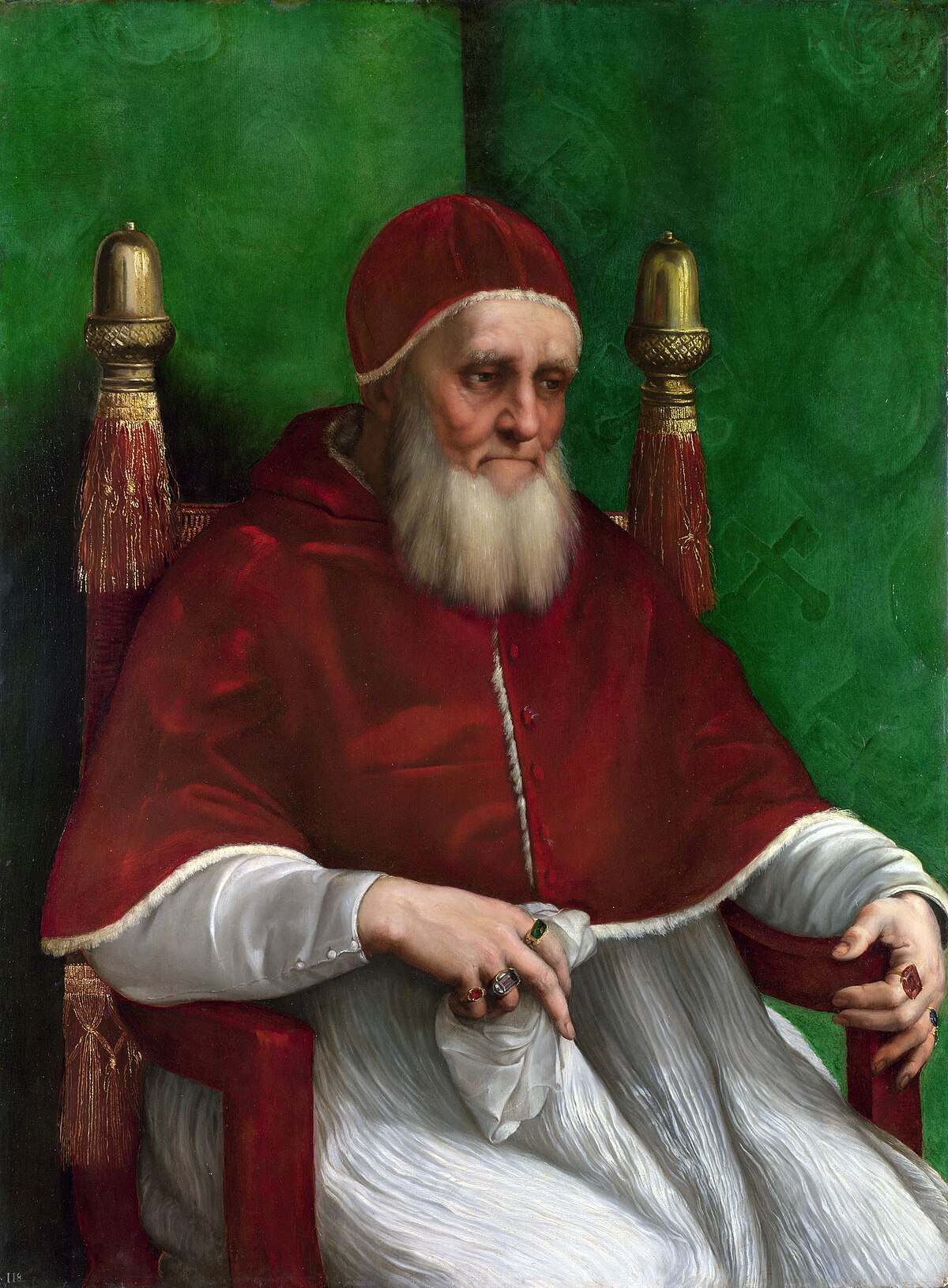
Pope Julius II, born Giuliano della Rovere on December 5, 1443, in Albisola, Italy, is one of the most influential and formidable figures in the history of the Catholic Church. His papacy, which began in 1503, is marked by significant political, military, and cultural accomplishments. Often referred to as the “Warrior Pope” due to his military campaigns to consolidate the power of the Papal States, Julius II’s life and legacy are a testament to his ambition, strategic brilliance, and dedication to the church’s temporal and spiritual authority.
Early Life and Rise to Power
Giuliano della Rovere was born into a modest family but was quickly drawn into the ecclesiastical world under the protection of his uncle, Francesco della Rovere, who later became Pope Sixtus IV. Giuliano was educated by the Franciscans and demonstrated an early aptitude for the political and religious complexities of his time. His uncle’s elevation to the papacy in 1471 was a turning point in Giuliano’s life, providing him with opportunities to rise within the church hierarchy.
At the age of 28, Giuliano was appointed as the Bishop of Carpentras in France, marking the beginning of his ecclesiastical career. His rise was rapid; by 1471, he had become a cardinal, taking the title Cardinal of San Pietro in Vincoli. This position allowed him to wield significant influence within the church, particularly in France, where he served as a papal legate for several years.
Rivalry with Rodrigo Borgia
The death of Pope Innocent VIII in 1492 led to one of the most contentious papal elections in history. Giuliano della Rovere was a strong contender for the papacy but was outmaneuvered by Rodrigo Borgia, who became Pope Alexander VI. The rivalry between Giuliano and Alexander VI was intense and often dangerous. Giuliano fled to Ostia and later to France, where he sought the support of King Charles VIII in his quest to challenge Alexander VI’s authority. His efforts to unseat Alexander VI were unsuccessful, but they cemented Giuliano’s reputation as a determined and ambitious leader.
The Papacy of Julius II
Following the brief papacy of Pius III, Giuliano della Rovere was elected pope in 1503, taking the name Julius II. His choice of name was symbolic, invoking the legacy of Julius Caesar and signaling his intent to restore the power and glory of the Papal States.
Julius II’s papacy was characterized by his aggressive efforts to expand and consolidate the territories of the Papal States. He launched several military campaigns, most notably against the Borgia family and the Republic of Venice, to reclaim lands that had been lost to the church. His formation of the League of Cambrai in 1508, an alliance with France, the Holy Roman Empire, and Spain, was a strategic move to combat Venetian expansion and restore papal control over key territories.
Despite his military focus, Julius II was also a great patron of the arts. He commissioned numerous works that would leave a lasting impact on the cultural heritage of the Vatican and the broader world. Among his most famous commissions was the rebuilding of St. Peter’s Basilica, a project that would span several papacies and become one of the most iconic structures in Christendom. Julius II also played a crucial role in the decoration of the Vatican, commissioning Michelangelo to paint the ceiling of the Sistine Chapel, one of the most celebrated masterpieces of the Renaissance.
Relationship with Michelangelo
The relationship between Pope Julius II and Michelangelo Buonarroti is one of the most fascinating aspects of his papacy. In 1505, Julius II summoned Michelangelo to Rome with the grand vision of creating a monumental tomb that would serve as his final resting place. This project, however, became a source of tension between the pope and the artist. Michelangelo spent months in Carrara selecting the finest marble, only to return to Rome and find that Julius II had changed his mind. The pope had grown superstitious, believing that commissioning his tomb while still alive was an ill omen.
The tomb project was eventually set aside, leading to a temporary estrangement between Julius II and Michelangelo. However, their relationship was later mended, and in 1508, Julius II commissioned Michelangelo to paint the ceiling of the Sistine Chapel, a task that would become one of the most challenging and rewarding of the artist’s career. The completion of the Sistine Chapel ceiling in 1512 remains one of the crowning achievements of Julius II’s papacy and a testament to his commitment to the arts.
Political and Military Legacy
Pope Julius II’s political and military actions were driven by his desire to restore the power and independence of the Papal States. His military campaigns, though often brutal, were aimed at consolidating papal authority and preventing the encroachment of foreign powers on Italian soil. The League of Cambrai was initially successful in its objectives, leading to significant victories against Venice. However, the shifting alliances and the volatile nature of European politics soon turned against Julius II.
In 1510, the French king, Louis XII, convened a synod at Tours, where French bishops withdrew their obedience to the pope, accusing him of various transgressions, including corruption and simony. This led to the convening of the Council of Pisa in 1511, where Julius II was accused of moral and spiritual failings. In response, Julius II formed the Holy League, a new alliance that included Spain, Venice, and later England, to combat French influence in Italy. The ensuing conflicts eventually forced the French to retreat, securing Julius II’s position and the independence of the Papal States, at least temporarily.
Death and Legacy
Pope Julius II’s health began to decline in the early 1510s, but he continued to wield significant influence until his death on February 21, 1513, at the age of 70. His death marked the end of an era of aggressive papal expansion and the beginning of a more cautious approach by his successors.
Julius II’s legacy is multifaceted. He is remembered as a warrior pope who was unafraid to use military force to achieve his objectives, but also as a patron of the arts whose contributions to the cultural heritage of the Vatican are immeasurable. His vision for the papacy was one of strength and independence, and his efforts to realize that vision shaped the course of European history during a critical period.
The papacy of Julius II was a time of both great conflict and great achievement. His actions, whether on the battlefield or in the halls of the Vatican, were driven by a deep sense of duty to the church and a desire to restore its temporal and spiritual power. While his methods were often controversial, the impact of his papacy is undeniable. Julius II remains one of the most significant and complex figures in the history of the Catholic Church, a pope whose life and legacy continue to be studied and debated by historians and scholars to this day.


