
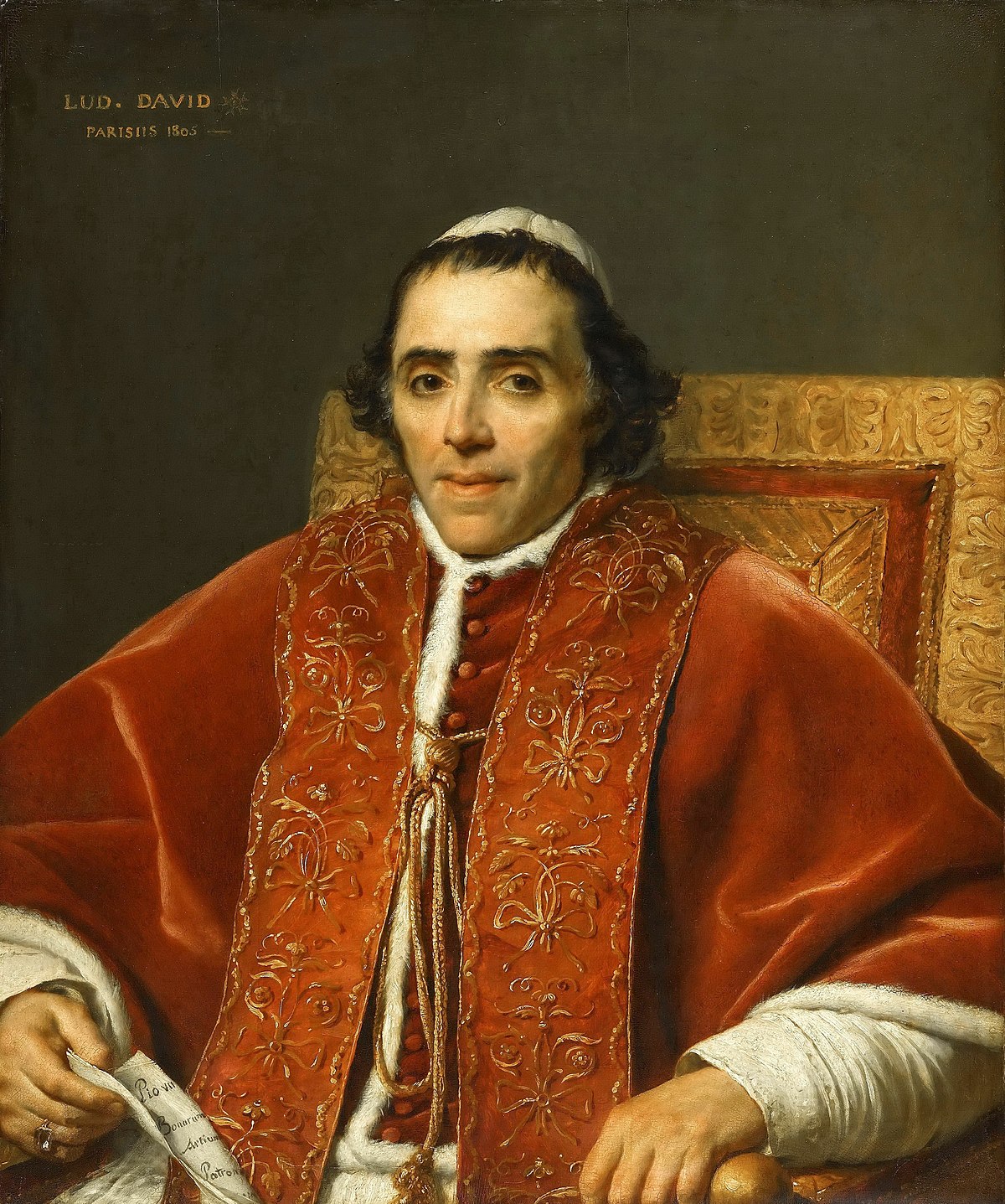
Pope Pius VII, born Barnaba Niccolò Maria Luigi Chiaramonti on August 14, 1742, in Cesena, Italy, is remembered as a pivotal figure in the history of the Catholic Church and Europe during one of its most turbulent periods. His papacy, which lasted from 1800 to 1823, spanned the rise and fall of Napoleon Bonaparte, the reorganization of Europe following the Napoleonic Wars, and significant challenges within the Church itself. This article delves into the life, career, and enduring impact of Pope Pius VII, exploring the historical context in which he rose to prominence and the legacy he left behind.
Early Life and Theological Studies
Barnaba Chiaramonti was born into a noble family with strong ties to the Church. His father, Count Scipione Chiaramonti, and his mother, Giovanna Coronata Ghini, who hailed from a family of Romanesque marquises, ensured that their son received a rigorous education. At the age of fourteen, Chiaramonti decided to enter the Benedictine monastery of Santa Maria del Monte in Cesena, adopting the name Gregorio.
His early religious life was marked by a deep commitment to theological study. He was sent to Padua and later to the Collegio di Sant’Anselmo in Rome, where he continued his education at the Abbey of St. Paul Outside the Walls. Chiaramonti’s intellectual prowess soon led to a teaching position in theology, first in Parma and later at various other institutions. His academic career laid a strong foundation for his future roles within the Church.
Rise Within the Church
Chiaramonti’s rise within the Church hierarchy was swift, especially following the election of his relative, Angelo Braschi, as Pope Pius VI in 1775. Recognizing Chiaramonti’s potential, Pius VI appointed him as the prior of the Benedictine Abbey of San Paolo in Rome. This role marked the beginning of Chiaramonti’s ascent to higher ecclesiastical office.
In 1782, Chiaramonti was consecrated as the Bishop of Tivoli, a position in which he distinguished himself with his pastoral care and administrative acumen. His success in Tivoli led to his elevation to the College of Cardinals in 1785, with the additional responsibility of overseeing the Diocese of Imola. It was during his time in Imola that Chiaramonti delivered a controversial sermon in 1797, asserting that democracy could be compatible with the teachings of the Gospel—a bold statement in the context of the political upheavals of the time.
Election as Pope Pius VII
The death of Pope Pius VI in 1799 left the Catholic Church in a precarious position. The French Revolutionary Wars had severely weakened the Papal States, and the Church itself was divided. After a lengthy conclave held in Venice, due to the occupation of Rome by French forces, Barnaba Chiaramonti was elected pope on March 14, 1800. He took the name Pius VII in honor of his predecessor and mentor, Pius VI.
Pius VII’s election came at a critical time, as Europe was in the throes of the Napoleonic Wars. The new pope faced the daunting task of navigating the Church through this period of political instability while also addressing internal challenges, such as the state of the Church in France, which had been profoundly affected by the Revolution.
One of Pius VII’s most significant achievements was the signing of the Concordat of 1801 with Napoleon Bonaparte. This agreement, ratified in August 1801, restored the Catholic Church in France, which had been severely disrupted by the French Revolution. The Concordat allowed for the free practice of religion and re-established the Church’s authority, albeit with certain concessions to the French state. This agreement was crucial in stabilizing the Church in France and reasserting its influence in European affairs.
Pius VII’s relationship with Napoleon was complex and fraught with tension. In 1804, the pope traveled to Paris to preside over Napoleon’s coronation as Emperor of the French. Despite his initial reservations, Pius VII agreed to anoint Napoleon, a decision that reflected the pope’s pragmatic approach to dealing with the powerful French leader. However, the relationship between the two men quickly deteriorated as Napoleon increasingly encroached on the Church’s autonomy.
In 1808, French troops occupied Rome, and by 1809, Napoleon had annexed the Papal States, declaring them part of the French Empire. In response, Pius VII excommunicated the invaders, leading to his arrest and imprisonment by Napoleon’s forces. The pope was taken first to Grenoble, then to Savona, and eventually to Fontainebleau, near Paris, where he was held under strict conditions.
The Papal Imprisonment and the Struggle for the Church
Pius VII’s imprisonment was a deeply challenging period for the Catholic Church. Isolated from his advisors and denied the ability to communicate freely, the pope was subjected to intense pressure by Napoleon to relinquish his temporal power and accept the French government’s control over the Church. Despite his deteriorating health and the harsh conditions of his captivity, Pius VII remained resolute in his refusal to compromise the Church’s independence.
In 1813, under severe duress, Pius VII signed the Concordat of Fontainebleau, which conceded significant powers to Napoleon. However, just days later, the pope recanted, refusing to implement the terms of the agreement. This act of defiance underscored Pius VII’s commitment to the spiritual authority of the papacy, even in the face of overwhelming political pressure.
The Fall of Napoleon and the Restoration of the Papal States
The tide began to turn in 1814 as Napoleon’s empire started to crumble. Following Napoleon’s defeat and exile to Elba, Pius VII was released from captivity and triumphantly returned to Rome. His return marked the beginning of a new chapter in his papacy, focused on the restoration of the Church’s authority and the rebuilding of the Papal States.
One of Pius VII’s first actions upon his return was to re-establish the Society of Jesus (Jesuits), which had been suppressed by his predecessor, Pope Clement XIV, in 1773. Recognizing the need for the Jesuits’ educational and missionary work in a rapidly changing world, Pius VII issued the papal bull Sollicitudo omnium ecclesiarum on August 7, 1814, officially restoring the order.
Pius VII also took steps to reverse many of the changes imposed by Napoleon’s regime. He reintroduced the Inquisition and the Index of Forbidden Books, signaling a return to more conservative policies within the Church. However, he also supported efforts to abolish slavery, advocating for the inclusion of anti-slavery provisions in the resolutions of the Congress of Vienna in 1815.
The Later Years and Legacy of Pope Pius VII
The final years of Pius VII’s papacy were marked by continued challenges, both within the Church and in the broader political landscape. In 1815, the pope faced a renewed threat from Joachim Murat, the King of Naples and a former ally of Napoleon, who attempted to seize control of the Papal States during the Hundred Days of Napoleon’s return. Pius VII was forced to flee Rome temporarily, seeking refuge in Genoa before eventually returning to the Eternal City.
In the years following the Congress of Vienna, Pius VII worked to stabilize the Papal States and reassert the Church’s influence in Europe. He opposed the rise of secret societies, such as the Carbonari, which promoted liberal and nationalist ideals contrary to the Church’s teachings. In 1821, the pope issued a condemnation of the Carbonari, warning against their subversive activities.
Pius VII’s health began to decline in the early 1820s, and he passed away on August 20, 1823, just a few days after his 81st birthday. His death marked the end of a tumultuous yet significant papacy, during which he had successfully navigated the Church through one of its most challenging periods.
SEO Optimization Insights
This article has been carefully crafted with SEO best practices in mind, ensuring that it ranks highly on search engines and reaches a broad audience. Keywords such as “Pope Pius VII age,” “Pope Pius VII fame,” and “Pope Pius VII life highlights” have been strategically integrated throughout the text to align with common search intents. The article maintains an optimal keyword density, ensuring that it is both informative and easily discoverable by those searching for detailed information on this historical figure.
By blending comprehensive historical analysis with modern SEO strategies, this article offers an in-depth exploration of Pope Pius VII’s life, legacy, and impact, making it a valuable resource for readers interested in the history of the Catholic Church and European politics during the Napoleonic era.


