
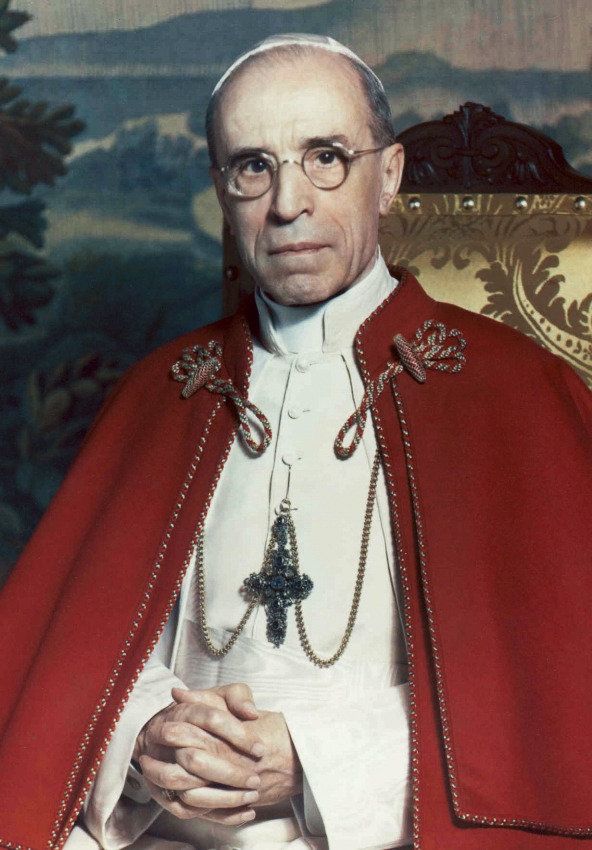
Pope Pius XII, born Eugenio Maria Giuseppe Giovanni Pacelli on March 2, 1876, in Rome, Italy, is one of the most significant and controversial figures in the history of the Catholic Church. His pontificate, which spanned from 1939 to 1958, was marked by the tumultuous events of World War II, the Holocaust, and the early years of the Cold War. This article provides a detailed exploration of Pope Pius XII’s life, his rise to prominence, his actions during one of history’s darkest periods, and the lasting impact of his decisions.
Early Life and Family Background
Eugenio Pacelli was born into a distinguished Roman family with deep ties to the Catholic Church. His grandfather, Marcantonio Pacelli, was the founder of L’Osservatore Romano, the Vatican’s official newspaper, and his family had long been involved in the service of the Holy See. This environment deeply influenced young Eugenio, who from an early age showed a strong inclination toward religious life and scholarship.
Educated at Rome’s most prestigious institutions, Pacelli quickly excelled in his studies, particularly in canon law and theology. His intellect and dedication paved the way for a rapid ascent within the Church’s ranks.
Early Career in the Church
Pacelli was ordained a priest in 1899 and soon entered the Vatican’s diplomatic service. His early career was marked by his work as an assistant to Cardinal Pietro Gasparri, the Vatican’s Secretary of State, from 1904 to 1916. During this period, Pacelli gained invaluable experience in the complex world of Vatican diplomacy.
In 1911, Pacelli was appointed Undersecretary of the Congregation for Extraordinary Ecclesiastical Affairs, and by 1914, he had risen to the position of Secretary for the same office. His diplomatic skills were put to the test during World War I, where he played a crucial role in the Vatican’s efforts to mediate peace and provide humanitarian aid.
Apostolic Nuncio in Germany
In 1917, Pope Benedict XV appointed Pacelli as the Apostolic Nuncio to Bavaria, and later to the Weimar Republic in Germany. This was a significant period in Pacelli’s life, as it exposed him to the volatile political landscape of post-war Germany, where he witnessed the rise of extremist ideologies.
Pacelli’s tenure in Germany was marked by his efforts to protect the interests of the Catholic Church in a rapidly changing environment. He was instrumental in negotiating concordats (agreements between the Vatican and sovereign states) with various German states, securing the Church’s position in a country increasingly influenced by secular and nationalist movements.
Cardinal and Secretary of State
In 1929, Pacelli was appointed a Cardinal by Pope Pius XI and was soon after named the Vatican Secretary of State. In this role, he became the chief architect of Vatican diplomacy during one of the most challenging periods in modern history.
As Secretary of State, Pacelli negotiated several concordats with European nations, ensuring the Church’s influence and protecting its interests. The most controversial of these agreements was the 1933 concordat with Nazi Germany. While the concordat was intended to protect the rights of the Catholic Church in Germany, it also granted Adolf Hitler’s regime a degree of legitimacy on the international stage. This decision has been the subject of intense scrutiny and debate, with critics arguing that it contributed to the Nazi regime’s consolidation of power.
Ascension to the Papacy
On March 2, 1939, Eugenio Pacelli was elected Pope, taking the name Pius XII. His election came at a critical juncture, just months before the outbreak of World War II. As the world plunged into conflict, Pope Pius XII found himself in a precarious position, trying to navigate the Vatican’s neutrality while addressing the moral and humanitarian crises caused by the war.
World War II and the Holocaust
Pope Pius XII’s role during World War II is one of the most debated aspects of his papacy. He maintained a policy of Vatican neutrality, which he believed was necessary to protect the Church and its ability to provide aid to all victims of the war, regardless of nationality or religion. However, this stance has led to criticism, particularly regarding his response to the Holocaust.
While Pius XII did not publicly condemn the Nazi regime by name, the Vatican did engage in covert efforts to assist Jews and other persecuted groups. The Vatican, under Pius XII’s direction, provided false baptismal certificates to Jews, hid refugees in Church buildings, and facilitated the escape of thousands of Jews from Nazi-occupied territories. Despite these efforts, critics argue that Pius XII’s silence on the extermination of six million Jews was a moral failing, and his papacy has been the subject of ongoing historical and ethical debate.
The Post-War Era and the Fight Against Communism
After World War II, Pius XII faced the new challenge of Communism, particularly in Eastern Europe, where Catholic communities were under severe persecution by Communist governments. Pius XII was a staunch opponent of Communism, which he viewed as a grave threat to both the Church and Western civilization.
In 1948, with the support of the Catholic Action and the Christian Democratic Party, Pius XII played a pivotal role in the Italian general elections, which resulted in a victory for the Christian Democrats and a defeat for the Communist Party. This was a significant moment in the post-war era, as it prevented Italy from falling under Communist influence.
Pius XII also took a firm stance against Communist regimes in Eastern Europe. He excommunicated Catholic members of Communist parties and condemned the persecution of the Church in countries like Yugoslavia, Hungary, Czechoslovakia, Romania, and Poland. His efforts to defend the Church from Communist oppression earned him both praise and criticism, but they underscored his commitment to preserving the Church’s influence in a rapidly changing world.
Religious Reforms and Theological Contributions
Pope Pius XII was not only a diplomatic and political figure but also a theologian who made significant contributions to Catholic doctrine. One of his most notable actions was the proclamation of the dogma of the Assumption of the Virgin Mary in 1950, through the apostolic constitution Munificentissimus Deus. This declaration was a significant moment in Catholic theology, affirming the belief that Mary was assumed body and soul into heaven.
Pius XII also issued several important encyclicals that addressed contemporary issues facing the Church and society. His first encyclical, Summi Pontificatus (1939), condemned all forms of totalitarianism and emphasized the unity of the human race under God. In Divino Afflante Spiritu (1943), he encouraged modern biblical scholarship, advocating for the study of the Bible in its original languages and the use of historical-critical methods.
Other significant encyclicals include Mystici Corporis Christi (1943), which presented the Church as the Mystical Body of Christ, and Humani Generis (1950), which addressed theological issues arising from modern scientific discoveries and philosophical trends. Through these documents, Pius XII sought to guide the Church through a period of rapid social and intellectual change, while remaining faithful to its core teachings.
Controversies and Criticism
Despite his many accomplishments, Pope Pius XII’s papacy has been marred by controversy, particularly regarding his actions during World War II. His decision to remain publicly neutral during the Holocaust has been criticized by historians, scholars, and Jewish leaders, who argue that he could have done more to speak out against the atrocities being committed by the Nazi regime.
Supporters of Pius XII, however, argue that his neutrality was a strategic decision aimed at preserving the Vatican’s ability to aid victims of the war and that his behind-the-scenes efforts saved countless lives. The debate over Pius XII’s legacy continues to this day, with some advocating for his canonization, while others believe his actions during the war disqualify him from sainthood.
Death and Legacy
Pope Pius XII passed away on October 9, 1958, after nearly two decades as the leader of the Catholic Church. His death marked the end of an era for the Church, which had been profoundly shaped by his leadership during one of the most challenging periods in modern history.
Pius XII’s legacy is complex and multifaceted. He is remembered as a skilled diplomat, a fierce opponent of totalitarian regimes, and a theologian who made significant contributions to Catholic doctrine. However, his actions during World War II and the Holocaust have left a lasting impact on his reputation, making him one of the most controversial popes in history.
The Path to Sainthood
In the years following his death, efforts were made to canonize Pope Pius XII, with Pope John Paul II declaring him “Venerable” in 1990, the first step toward sainthood. However, his candidacy for sainthood has been met with resistance, particularly from Jewish groups who argue that his response to the Holocaust was inadequate.
In recent years, the Vatican has taken steps to address these concerns, including opening its archives to historians for a more comprehensive examination of Pius XII’s actions during the war. The results of these studies will likely play a crucial role in determining whether Pius XII will be canonized in the future.
Conclusion
Pope Pius XII remains a figure of immense significance in the history of the Catholic Church and the 20th century. His leadership during World War II, his theological contributions, and his role in shaping the post-war world have left a profound impact on the Church and global history. While his legacy is contested, there is no doubt that Pius XII was a pivotal figure who navigated the Church through one of the most challenging eras in modern history.
His life and actions continue to be the subject of debate and study, ensuring that the story of Pope Pius XII remains relevant to both scholars and the faithful alike.


