
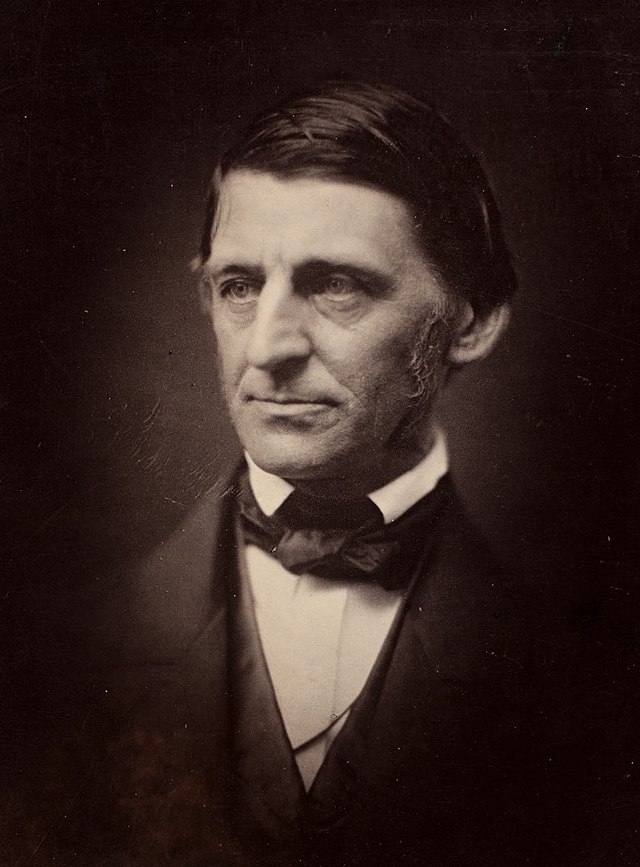
Ralph Waldo Emerson, born on May 25, 1803, in Boston, Massachusetts, is one of the most influential figures in American literature, philosophy, and cultural history. Emerson’s contributions to the American transcendentalist movement, his essays, and his oratory skills have left a profound impact on generations of thinkers, writers, and activists. This article explores the life, career, and philosophical contributions of Ralph Waldo Emerson, providing a deep dive into the nuances of his work and the historical context that shaped his thoughts.
Early Life and Education
Emerson was born into a deeply religious family. His father, Reverend William Emerson, was a prominent Unitarian minister, a fact that significantly influenced young Emerson’s early life. However, tragedy struck early when his father died in 1810, leaving his mother to raise him and his siblings. This loss at the tender age of eight profoundly affected Emerson, shaping his later views on spirituality and the human experience.
Despite the family’s financial struggles, Emerson’s mother ensured that he received a solid education. At 14, he enrolled at Harvard College, where he excelled academically despite having to work as a tutor and server in the college dining hall to support himself. Emerson graduated in 1821, and soon after, he took up a teaching position at a school for girls that his brother ran. This period was formative, as it exposed him to various intellectual currents and solidified his resolve to pursue a life of thought and reflection.
Theological Career and Crisis of Faith
Following in his father’s footsteps, Emerson entered Harvard Divinity School in 1825 to become a minister. By 1829, he was ordained as a Unitarian minister and became the junior pastor of Boston’s Second Church. However, Emerson’s tenure as a minister was short-lived. His wife, Ellen Louisa Tucker, whom he had married in 1829, died of tuberculosis just two years later, a loss that devastated him.
This personal tragedy, combined with growing theological doubts, led Emerson to question the very foundation of his faith. He became increasingly uncomfortable with the rituals of the church, particularly the administration of the Lord’s Supper, which he felt was rooted more in tradition than in genuine spiritual experience. In 1832, Emerson resigned from the ministry, a decision that marked the beginning of his journey toward developing his own philosophical ideas.
European Influence and the Birth of Transcendentalism
After leaving the ministry, Emerson traveled to Europe, where he met several leading intellectuals of the time, including William Wordsworth, Samuel Taylor Coleridge, John Stuart Mill, and Thomas Carlyle. His interactions with these thinkers had a profound impact on him, particularly Carlyle, with whom Emerson maintained a lifelong correspondence. These meetings and the ideas exchanged during his European travels played a crucial role in shaping Emerson’s philosophical outlook.
Upon returning to the United States in 1833, Emerson settled in Concord, Massachusetts, where he began to articulate the ideas that would eventually form the core of the transcendentalist movement. In 1836, he published his first significant work, Nature, a groundbreaking essay that laid the foundation for transcendentalism. The essay emphasized the spiritual and symbolic importance of nature and advocated for an intuitive, personal understanding of the divine, rather than a reliance on organized religion or dogma.
Transcendentalism: Principles and Impact
Transcendentalism, as articulated by Emerson, was a philosophical and literary movement that emerged as a reaction against the materialism and rigidity of contemporary society. It emphasized the inherent goodness of people and nature, the primacy of individual intuition as a guide to truth, and the belief in the interconnectedness of all life.
Emerson’s ideas were revolutionary for their time, challenging the established religious and social norms. He believed that every individual possessed an inner light, a divine spark that could lead them to truth and self-realization. This emphasis on self-reliance and the individual’s capacity for spiritual growth became a central theme in his work.
In 1836, Emerson, along with like-minded individuals, founded the Transcendental Club, which became the intellectual hub of the movement. The club included prominent figures such as Henry David Thoreau, Margaret Fuller, and Bronson Alcott. Through their discussions and writings, they sought to promote a new way of thinking that valued spiritual experience over empirical evidence and societal conventions.
Essays and Public Speaking: Spreading the Message
Emerson’s ideas gained widespread attention through his essays and public lectures. His essays, particularly “Self-Reliance,” “The American Scholar,” and “The Over-Soul,” became touchstones of American thought. In “Self-Reliance,” Emerson argues for the importance of individuality and personal integrity, urging readers to trust their inner voice rather than conforming to societal expectations. This essay, in particular, resonated deeply with the American public and remains one of Emerson’s most famous works.
In 1837, Emerson delivered “The American Scholar” at Harvard, a speech that Oliver Wendell Holmes later called “America’s Intellectual Declaration of Independence.” In this address, Emerson called for American intellectuals to break free from European influences and develop their own ideas and identity. This speech was a rallying cry for a new American cultural identity, emphasizing the importance of creativity, independence, and self-reliance.
Emerson was also a powerful public speaker, known for his ability to engage and inspire audiences. His lectures drew large crowds, and he became one of the most sought-after speakers in the United States. Through his speeches, Emerson was able to disseminate his ideas to a broad audience, influencing not just intellectuals, but also ordinary citizens who were inspired by his message of self-reliance and spiritual independence.
Controversy and Criticism
Despite his popularity, Emerson’s ideas were not without controversy. His 1838 address to the Harvard Divinity School graduates, known as the “Divinity School Address,” sparked outrage among the religious establishment. In this speech, Emerson challenged the traditional Christian doctrine, arguing that Jesus was a great man but not divine. He criticized the church for its dogmatism and called for a more personal, direct experience of the divine.
This address was met with fierce criticism, and Emerson was accused of heresy and atheism. He was effectively ostracized from the religious community, and it would be over 40 years before he was invited back to speak at Harvard. Despite this, Emerson remained steadfast in his beliefs, and his ideas gradually gained acceptance, particularly within the Unitarian Church, which eventually adopted many of the principles he had espoused.
Personal Tragedy and Philosophical Maturity
The early 1840s were marked by both personal and professional challenges for Emerson. In 1842, he suffered the devastating loss of his son, Waldo, who died of scarlet fever at the age of five. This tragedy profoundly affected Emerson and led to some of his most poignant reflections on life, death, and the nature of human experience. His grief found expression in the poem “Threnody” and the essay “Experience,” both of which explore the depth of his sorrow and his search for meaning in the face of loss.
Despite these challenges, Emerson continued to write and lecture, producing some of his most mature and reflective work during this period. His later essays, such as “The Conduct of Life” (1860), reflect a more nuanced understanding of human existence, acknowledging the complexities and contradictions of life while still advocating for the importance of individual integrity and self-reliance.
Legacy and Influence
Ralph Waldo Emerson died on April 27, 1882, in Concord, Massachusetts, where he had spent much of his life. He was buried in Sleepy Hollow Cemetery, a resting place for many other notable transcendentalists, including Thoreau and Hawthorne. His death marked the end of an era, but his ideas continued to influence generations of thinkers, writers, and activists.
Emerson’s legacy is vast and enduring. His promotion of individualism, self-reliance, and a personal, direct connection to the divine has had a lasting impact on American culture and thought. He is often credited with laying the intellectual groundwork for later movements, such as pragmatism and existentialism, and his influence can be seen in the works of writers like Walt Whitman, Emily Dickinson, and even modern figures such as Ralph Ellison and Robert Frost.
Moreover, Emerson’s emphasis on the importance of nature and the spiritual significance of the natural world has resonated with environmental movements, particularly in the United States. His work has inspired countless individuals to seek a deeper connection with nature and to consider the ethical implications of humanity’s relationship with the environment.
Conclusion: The Enduring Appeal of Emerson
Ralph Waldo Emerson remains a towering figure in American intellectual history. His writings, steeped in the ideals of transcendentalism, continue to inspire readers with their call for self-reliance, individual integrity, and a deeper spiritual connection with the world. Emerson’s legacy is not just in the words he wrote, but in the way he challenged his contemporaries to think differently, to question established norms, and to seek truth within themselves.
As we reflect on Emerson’s life and work, it is clear that his ideas have a timeless quality. In an age where conformity often seems to be the norm, Emerson’s call for individuality and personal integrity is as relevant today as it was in the 19th century. His belief in the power of the individual to transcend the limitations of society and to connect with something greater remains a powerful message, inspiring us to look within for the answers we seek.


