
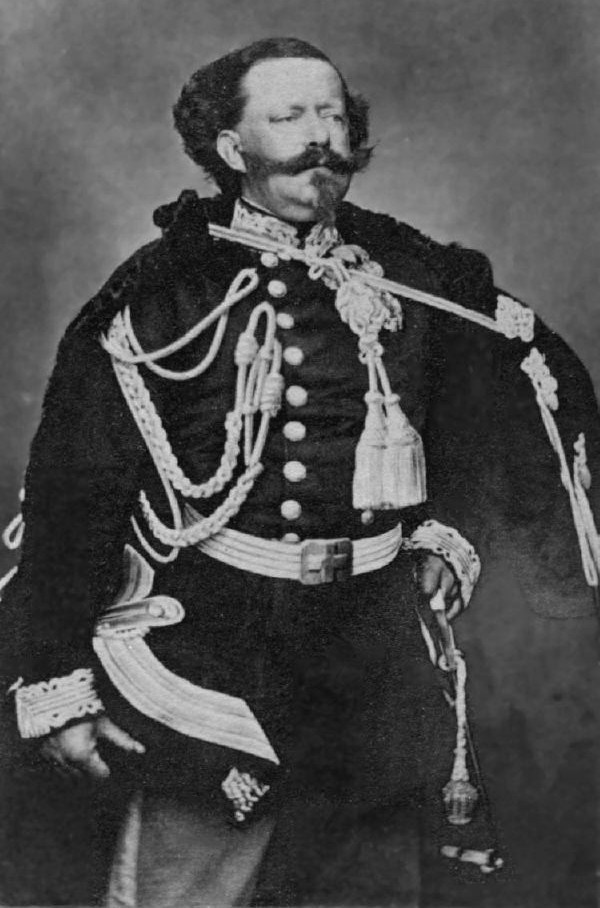
Re Vittorio Emanuele II, often referred to as the “Father of the Fatherland,” holds a significant place in the history of Italy as the country’s first king. His life, reign, and contributions to the unification of Italy are pivotal in understanding the nation’s modern history. Born on March 14, 1820, in Turin, Vittorio Emanuele was the firstborn son of Carlo Alberto, King of Sardinia, and Maria Teresa of Austria. His life was marked by military discipline, political maneuvering, and a relentless pursuit of Italian unity.
Early Life and Military Training
Vittorio Emanuele’s upbringing was steeped in the rigors of military life, a reflection of the expectations placed on him as the heir to the throne. At the tender age of eleven, he was appointed captain of the riflemen, and by 1831, he had risen to the rank of general. His rapid advancement in the military was not just a matter of privilege but also a testament to the intense training he underwent, preparing him for the responsibilities that lay ahead.
In 1842, Vittorio Emanuele married Maria Adelaide of Austria, the daughter of the Viceroy of Lombardy-Venetia, Archduke Rainer of Austria. This union produced several children, including Umberto I, Clotilde, Maria Pia, Oddone, and Amedeo. His marriage to Maria Adelaide also solidified his ties with the Austrian imperial family, a connection that would influence his political decisions in the years to come.
The First War of Independence
Vittorio Emanuele’s first significant military engagement was during the First Italian War of Independence (1848-1849). As the commander of the reserve division at the Battle of Goito, he distinguished himself and was awarded the Gold Medal of Military Valor. This conflict was a crucial moment in his life, not only because of his military achievements but also because it marked the beginning of his active role in the Italian unification movement.
However, Vittorio Emanuele’s political stance was initially at odds with the liberal reforms advocated by his father, Carlo Alberto. When Carlo Alberto abdicated in 1849, Vittorio Emanuele ascended to the throne. Although he had previously opposed many of his father’s liberal policies, he quickly adapted to the changing political landscape. He respected many of the concessions made by his father, including the Statuto Albertino, a constitution that granted civil liberties and laid the groundwork for a unified Italy.
The Moncalieri Proclamation and Political Maneuvering
One of the most audacious moves in Vittorio Emanuele’s early reign was the Moncalieri Proclamation of November 20, 1849. Dissolving the parliament that opposed peace negotiations with Austria, Vittorio Emanuele, with advice from his prime minister Massimo d’Azeglio, issued the proclamation to urge voters to support moderate candidates. This move was a clear indication of his willingness to use bold political strategies to maintain control and steer the nation toward his vision of unity.
Vittorio Emanuele II also focused on modernizing the state, reforming the army, and promoting public education. His efforts to strengthen trade relations, particularly with Great Britain, earned him widespread popular support. These domestic policies were essential in consolidating his power and setting the stage for the unification process.
Alliance with Cavour and the Path to Unification
The turning point in Vittorio Emanuele’s reign came in 1852 when Count Camillo Benso di Cavour became his prime minister. Cavour was a brilliant statesman whose vision for a unified Italy aligned with Vittorio Emanuele’s ambitions. Together, they laid the groundwork for what would become the Italian unification movement. However, their relationship was not without its tensions. While they shared a common goal, their methods and strategies often clashed, leading to moments of friction. Despite these challenges, their collaboration was instrumental in the success of the unification process.
The Crimean War (1853-1856) and the subsequent Congress of Paris in 1856 marked Italy’s emergence as a significant player on the European stage. Vittorio Emanuele II’s alliance with France, formalized in the secret agreements of Plombières in 1858, was a masterstroke that set the stage for the Second Italian War of Independence. This war resulted in the acquisition of Lombardy, a significant step toward the unification of northern Italy.
The Unification of Italy
The marriage of Vittorio Emanuele’s daughter Clotilde to Jérôme Bonaparte, a nephew of Napoleon III, further strengthened the alliance with France. This diplomatic marriage was part of a broader strategy to secure French support for Italian unification. The subsequent popular uprisings and plebiscites in Tuscany and Emilia brought these regions into the fold of the Kingdom of Sardinia, albeit at the cost of ceding Nice and Savoy to France.
One of the most contentious episodes in Vittorio Emanuele’s reign was the Expedition of the Thousand, led by Giuseppe Garibaldi in 1860. While Cavour was initially opposed to Garibaldi’s campaign, Vittorio Emanuele saw the potential for further unification. The success of Garibaldi’s campaign led to the annexation of the Kingdom of the Two Sicilies, significantly expanding the territory of the nascent Italian state.
In September 1860, Vittorio Emanuele ordered the occupation of the Papal States’ regions of Marche and Umbria, further consolidating his control over central Italy. By March 17, 1861, the unification of Italy was formally proclaimed, and Vittorio Emanuele II assumed the title of King of Italy. This achievement earned him the title “Father of the Fatherland,” a recognition of his pivotal role in bringing about Italy’s unification.
The Later Years and Legacy
The years following the unification were marked by efforts to consolidate the newly formed Kingdom of Italy. In 1865, Vittorio Emanuele moved the capital from Turin to Florence, a symbolic gesture of Italy’s newfound unity. During this period, significant legal and social reforms were enacted, including the promulgation of the civil code and the abolition of the death penalty.
Vittorio Emanuele continued to pursue the unification of Italy with the Third Italian War of Independence in 1866. Allying with Prussia, he succeeded in annexing the Veneto region, further expanding the Italian kingdom. The final piece of the unification puzzle fell into place on September 20, 1870, when Italian troops, led by General Raffaele Cadorna, breached the walls of Rome at Porta Pia. This event marked the end of the Papal States and the inclusion of Rome as the capital of Italy, completing the unification process.
However, as Italy became a unified state, Vittorio Emanuele’s influence over Italian politics gradually waned. In 1876, with the appointment of Agostino Depretis as prime minister, Italy entered a new political era, with the first left-wing government in its history. This shift marked the beginning of a new phase in Italian politics, one that would be less dominated by the monarchy.
Vittorio Emanuele II passed away in Rome on January 9, 1878, at the age of 58. His death marked the end of an era, but his legacy as the unifier of Italy endures. Today, he is remembered not only as the first King of Italy but also as a symbol of the country’s struggle for independence and unity.
Historical Context and Nuances
To fully appreciate Vittorio Emanuele II’s role in Italian history, it is essential to understand the broader context of 19th-century Europe. The period was marked by the rise of nationalism and the decline of old empires. The unification of Italy was part of a broader wave of national unification movements that swept across Europe, including the unification of Germany under Otto von Bismarck.
Vittorio Emanuele’s efforts were not just about expanding his kingdom but also about responding to the growing demand for national unity among Italians. The Risorgimento, as the unification movement was known, was driven by a complex interplay of political, social, and cultural factors. Vittorio Emanuele’s ability to navigate these forces, often in collaboration with key figures like Cavour and Garibaldi, was crucial to the movement’s success.
Moreover, Vittorio Emanuele’s reign highlighted the tensions between monarchical power and emerging democratic ideals. While he was a monarch, his reign was characterized by significant concessions to liberal and nationalist forces. This balancing act between maintaining royal authority and accommodating the demands of the people was a defining feature of his rule.
SEO and Keyword Strategy
In crafting this detailed exploration of Vittorio Emanuele II’s life and legacy, several key SEO strategies have been employed. The use of relevant keywords such as “Re Vittorio Emanuele II,” “Italian unification,” “Risorgimento,” “King of Italy,” and “Father of the Fatherland” ensures that the content aligns with search intent. These keywords have been strategically placed throughout the article to maximize visibility on search engines while maintaining a natural flow of information.
Additionally, the historical context and nuanced exploration of Vittorio Emanuele’s reign provide valuable content that meets the informational needs of users searching for in-depth knowledge about Italian history. The article’s length and comprehensive coverage also contribute to its SEO performance, offering a rich resource that is likely to be indexed favorably by Google.
In conclusion, Vittorio Emanuele II’s life was marked by his commitment to the unification of Italy, his strategic alliances, and his ability to adapt to the changing political landscape. His legacy as the first King of Italy and the “Father of the Fatherland” remains a cornerstone of Italian national identity, a testament to his enduring impact on the nation’s history.


