
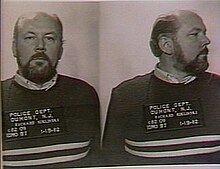
Richard Leonard Kuklinski, often referred to as “The Iceman,” was born on April 11, 1935, in Jersey City, New Jersey. He is notorious for being one of the most prolific and brutal contract killers in American history, with alleged ties to the Italian-American mafia. Kuklinski’s life is a chilling tale of violence, deception, and the dark underworld of organized crime. This article provides a comprehensive exploration of Richard Kuklinski’s life, tracing his rise to infamy, his methods, and the eventual downfall that led to his arrest and conviction.
Early Life and Troubled Upbringing
Richard Kuklinski’s early life was marked by extreme violence and abuse. Born to a Polish immigrant father, Stanley Kuklinski, and an Irish-born mother, Anna McNally, Richard grew up in a household characterized by brutality and dysfunction. His father, an alcoholic, was notoriously violent, often beating Richard and his siblings mercilessly. Richard’s mother was equally abusive, using corporal punishment as a means of discipline.
The abuse Kuklinski endured at home had a profound impact on his psychological development. He later recounted that his father had killed his older brother, Florian, by beating him to death. The family, however, covered up the crime by claiming that Florian had died in an accidental fall down the stairs. This early exposure to violence and death desensitized Kuklinski and planted the seeds for his future as a cold-blooded killer.
By the time he was a teenager, Kuklinski was already exhibiting disturbing behavior. He began torturing animals for pleasure and fantasized about killing his father. At the age of 14, Kuklinski committed his first known murder. He killed a local bully, Charley Lane, who had been harassing him and others in the neighborhood. Kuklinski beat Lane to death with a wooden pole and disposed of the body, marking the beginning of his long and deadly career.
Descent into Crime: From Small-Time Criminal to Mafia Hitman
In the years following his first murder, Richard Kuklinski became increasingly involved in criminal activities. During his late teens and early twenties, he joined a local gang involved in petty crimes such as burglaries, robberies, and the theft of liquor from delivery trucks. Kuklinski’s reputation as a tough and ruthless enforcer grew, and he soon became known for his violent temper and willingness to inflict harm on others without remorse.
Kuklinski’s criminal activities escalated when he began working with the Italian-American mafia. His introduction to the underworld came through his association with Carmine Genovese, a prominent member of the DeCavalcante crime family. This connection provided Kuklinski with the opportunity to prove himself as a reliable and effective hitman. Over time, his reputation spread throughout the organized crime world, and he became a sought-after contract killer for various mafia families.
The Iceman: Methods and Murders
Richard Kuklinski earned the nickname “The Iceman” due to his practice of freezing his victims’ bodies to obscure the time of death, making it more difficult for law enforcement to trace the crime back to him. This chilling method was just one of the many techniques he employed to carry out his killings. Kuklinski claimed to have killed over 200 people during his criminal career, although only a fraction of these murders were ever confirmed.
Kuklinski’s methods of murder were as varied as they were brutal. He used guns, knives, explosives, and even his bare hands to kill his victims. One of his most infamous techniques involved the use of cyanide, a deadly poison that he often administered by spraying it into his victim’s face or lacing their food or drink. Cyanide poisoning, which could mimic the symptoms of a heart attack, was one of his preferred methods because it allowed him to kill quickly and discreetly.
In addition to his proficiency with various weapons, Kuklinski was known for his sadistic streak. For an additional fee, he would make his victims suffer before they died, sometimes recording their final moments on video to show his clients. One particularly gruesome method involved binding a victim and placing them in a cave where they were left to be eaten alive by rats, while a camera recorded the horrific scene. These videos were then delivered to the individuals who had ordered the hit as proof of the job’s completion.
Kuklinski’s ability to carry out his murders without leaving evidence behind made him a valuable asset to the mafia. He was responsible for eliminating rivals, informants, and anyone else who posed a threat to the interests of organized crime. His work took him across the United States and even to international locations, including Zurich and Brazil. Despite his fearsome reputation, Kuklinski managed to maintain a double life, appearing to be a devoted husband and father to his wife, Barbara, and their three children.
The Double Life: Family Man and Cold-Blooded Killer
Richard Kuklinski’s ability to compartmentalize his life was a key factor in his ability to evade capture for so many years. On the surface, he appeared to be a loving husband and father who lived a quiet suburban life in Dumont, New Jersey. He married Barbara Pedrici, an 18-year-old woman he had met during his early years as a small-time criminal. Despite her family’s initial objections to the marriage, Barbara and Richard wed and went on to have three children: Merrick, Chris, and Dwayne.
To his family, Kuklinski was a doting father who provided for them and kept his criminal activities hidden. However, Barbara later revealed that their marriage was far from perfect. Kuklinski was often violent toward her, alternating between periods of domestic abuse and seemingly normal family life. Despite the violence, Barbara and the children remained unaware of the full extent of Kuklinski’s criminal activities until his arrest.
Kuklinski’s ability to maintain this facade for so long was a testament to his cunning and manipulation. He kept his family life and his work as a contract killer separate, ensuring that his wife and children were never exposed to the darker side of his life. It was this duality that allowed him to evade law enforcement for decades.
The Fall of The Iceman: Arrest and Conviction
Richard Kuklinski’s reign of terror finally came to an end in 1986, thanks to the efforts of an undercover federal agent named Dominick Polifrone. Polifrone, posing as a fellow criminal, befriended Kuklinski and gained his trust over the course of several months. During their interactions, Kuklinski bragged about his past murders and discussed potential future hits. Polifrone recorded these conversations, providing law enforcement with the evidence they needed to arrest Kuklinski.
On December 17, 1986, Richard Kuklinski was arrested outside his home in Dumont, New Jersey. The arrest marked the end of one of the most notorious criminal careers in American history. Kuklinski was charged with multiple counts of murder, and after a lengthy trial, he was convicted and sentenced to consecutive life sentences without the possibility of parole.
During his trial, Kuklinski admitted to several of the murders he had committed over the years. However, he also exaggerated his body count, claiming responsibility for over 200 killings. While it is impossible to verify the exact number of people Kuklinski murdered, law enforcement was able to confirm his involvement in at least five killings, leading to his conviction.
Kuklinski’s life behind bars was marked by numerous interviews and the publication of a biography titled “The Ice Man: Confessions of a Mafia Contract Killer” by author Philip Carlo. In these interviews, Kuklinski detailed his methods and the psychological toll his work had taken on him. Despite his confessions, Kuklinski remained unapologetic for his crimes, showing little to no remorse for the lives he had taken.
Legacy and Cultural Impact
Richard Kuklinski’s story has had a lasting impact on popular culture, with numerous books, documentaries, and films dedicated to his life. His ability to live a double life as a family man and a ruthless killer has fascinated the public and raised questions about the nature of evil and the capacity for violence within seemingly ordinary individuals.
Kuklinski’s life was the subject of a 2012 film titled “The Iceman,” starring Michael Shannon as Kuklinski and Winona Ryder as his wife, Barbara. The film dramatized Kuklinski’s life and crimes, bringing his story to a wider audience. In addition to the film, Kuklinski has been the subject of multiple documentaries, including HBO’s “The Iceman Tapes,” which featured in-depth interviews with Kuklinski discussing his crimes and motivations.
Death and Final Speculations
Richard Kuklinski died on March 5, 2006, at the age of 70, in Trenton, New Jersey. The official cause of death was reported as natural causes, but there have been persistent rumors and speculations that he may have been poisoned as part of a mafia hit. At the time of his death, Kuklinski was awaiting testimony that could have implicated powerful individuals in organized crime, leading some to believe that his death was orchestrated to prevent him from revealing further information.
Kuklinski’s death marked the end of a life defined by violence and deception. Despite his death, the legend of “The Iceman” continues to captivate those interested in true crime and the dark world of organized crime. His story serves as a grim reminder of the capacity for brutality that can exist behind the facade of an ordinary life.


